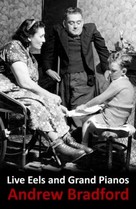
“Live Eels and Grand Pianos” is both a family memoir and a significant contribution to the social history of the twentieth century. It tells the story of the author's parents, Charlie and Kathy Bradford.
Charlie and Kathy were seriously disabled by Polio when they were young children. Charlie contracted the disease in 1909, when he was three, and Kathy in 1913, when she was ten months old. “Live Eels and Grand Pianos” tells the story of their extraordinary courage in the face of adversity.
In the 1940s the idea of seriously disabled people marrying and raising children was so unusual that the author’s birth was reported in the national Sunday newspapers. This book tells how Charlie and Kathy managed to find work and raise a family, and about the prejudice and hostility they suffered, as well as the kindnesses they encountered and the campaigns that they took part in. It includes over twenty black and white photographs of the author’s family taken between 1920 and 1980.
Excerpt
I was ten. I was in the playground of Fleecefield Primary School in Edmonton, North London. It was springtime in 1959. The small boy was in the year below me. I hardly knew him. I can’t remember his name or what he looked like. But I will never forget the conversation.
‘Your parents are cripple dicks, aren’t they?’ he said.
‘They’re not cripple dicks, they’re disabled.’ I replied.
‘And when you grow up you’ll be crippled too.’
‘No I won’t! My mum and dad have Polio – you catch that like a cold, you don’t pass it on to your children!’
‘Yes you do – my mum told me.’
I couldn’t think of anything else to say. I hated his mother for her ignorance and prejudice. More than forty years later I stopped hating her and decided to write the story of my mum and dad, Charlie and Kathy Bradford. It’s the story of their struggle to do the normal things that working class families did in the 1950s and 1960s. Things like earning a living, doing the housework, and all the humdrum things of family life that are usually taken for granted, such as the shopping, the gardening, going on holiday and going to see their son in the school play.
Charlie and Kathy couldn’t take these things for granted, because since their early childhood they had both been severely disabled by Polio. For them, every one of these activities was a struggle. All they ever wanted was an ordinary family life, but for them to become ordinary they first had to become extraordinary. Not only did they have to overcome the physical obstacles, but they also had to overcome ignorance and prejudice.
But this is also the story of my childhood, and how my parents’ disability affected me. Did I really reply to this small boy that my parents weren’t cripple dicks, they were disabled? Had my parents, by the time I was nine, already found it necessary to explain the nature of the Polio virus, and re-assure me that I wouldn’t be affected by it? I can’t remember any such conversation with them; I just seemed to know these facts in the same way that I knew the way to school. Somehow I did know that this boy’s mum was filling his head with nonsense. Poisonous, malicious, nonsense.
Before I introduce you to Charlie and Kathy, here is a very short history of the disease that caused their disabilities. Poliomyelitis, or Polio, is a viral infection spread by contaminated water or food. The only symptoms are headache, a sore throat and a high temperature, similar to flu. When it strikes adults or older children, most of them only suffer these mild flu-like symptoms, but in a minority of cases the virus escapes into the central nervous system and destroys myelin – the ‘grey matter’ that lines the spinal cord. As a result the motor neurones cease to send messages to the muscles in the lower body - usually just the limbs, but sometimes arms or the lungs - which then atrophy due to lack of stimulus.
Polio (which was known as Infantile Paralysis until the 1950s) first became a notifiable disease in England and Wales in 1912 - one year before Kathy caught the disease at the age of ten months, and three years after Charlie was attacked by the virus when he was three.
There were several epidemics in the United Kingdom between the turn of the century and the end of the Second World War, but in 1947 an unprecedented seven thousand cases were reported. Between 1947 and 1958 there were fifty-eight thousand cases, which left thirty-five thousand people disabled, and nearly four thousand dead. The disease was virtually eliminated in the developed world by the invention of a vaccine, followed by mass immunisation programmes in the late 1950s, but it still affects many people in Africa and the Indian sub-continent.
Professional Reviews
British Polio Fellowship Bulletin
Running through Andrew's book is a constant theme of normality. Charlie and Kathy did not see themselves as being 'unique' or deserving of handouts; they did not have 'special needs' - they were simply a couple who had met, fallen in love and wanted to have a family.
Margaret Kohel Evans invites her mother's grandchildren to a delightful visit with their grandmother, sharing charming memories of her across eighteen life themes.
The experience of a young adult trying to figure out what they want to do for employment or education can be overwhelming. My book will give them insight to what it means to be a carpenter. And the progress unions have made in discrimination.
Get