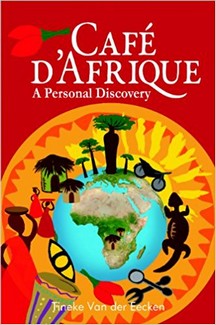
'Café d'Afrique: A Personal Discovery', a travel memoir written by Tineke Van der Eecken about the Zambian culture, music, food and dance. The book comes with the CD or downloadable music from the website.
When Tineke Van der Eecken first arrives in Africa as part of an international aid programm, she brings with her a mix of childhood dreams and Western preconceived ideas. 'I came to Africa in high heels,' she writes. But when she moves to Zambia, Tineke falls in love - in a completely new way - with the country and its culture.
Now she dreams of setting up a 'cultural restaurant' where locals and tourists alike can sample authentic Zambian cuisine, music and dance. Her dream comes true, but can it last? In the attempt to meet the expected challenges, Tineke must come through some unexpected tests and trials that take her not only beyond borders, but also past boundaries. She wonders if what matters may not be the success of her venture so much as the person she is becoming ...
Set against a shifting backdrop of social, political and cultural life in Zambia, this part-memoir, part-travelogue, part-coming-of-age story is a celebration of friendship, not just with people, but with a county.
(c) Imagery by Clare Bates
Excerpt
The beams enter through my bedroom window as if invited. At half past seven in the morning the sun is not so high as it was in the summer, and it radiates less heat. I am thankful for this.
A kookaburra laughs, the sound dominating the other, more gentle, bird talk. A car passes by. Further away there is the unstoppable roaring from the Graham Farmer, Perth’s newest freeway.
I sit up in bed and readjust my pillows and cushions. As I pick up my pen to work on another episode of ‘Café d’Afrique’, it occurs to me that it’s two years now since I lived in Zambia. Well, almost two. My short visit a few months ago can hardly count. It did give me joy, but the memories of an earlier time still haunt me: the motorbike accident, my sudden departure to recover at home in Belgium, and the life I had there, in Lusaka, long before.
My story will soon be finished. It has travelled under its own momentum and will, I am sure, continue to the end, but I wonder — not for the first time — if the end will bring solace, the consolation I crave. I want to throw myself into my new life, this time with a better understanding of myself. Perhaps I am asking too much of this whole process of writing, but it has become part of some private ritual, a ritual I am drawn to without direction. It holds my hand, and memories trickle down like drops of water. The water is murky, tainted by other memories pushing to the fore. I am immersed in the flow of words that follow. In spite of these doubts, I find that the writing somehow helps me grapple — or is it come to terms? — with that sense of being far removed from Africa and of having surrendered something valuable. Each morning when I wake to the sound of the freeway, in my imagination I hear the Mexican wave of dogs howling, so familiar in Lusaka. And I still thirst for news of Café d’Afrique.
I did not go to Africa for Café d’Afrique. Other work of a different kind had drawn me there, to Burundi at first, and to Zambia afterwards. It wasn’t until much later that I ventured into this enterprise. Having never run a business of any kind, I was full of apprehension at the time; there was always the possibility that I might take after my father and prove to be genetically predisposed to do poorly in business.
The dog is begging to come in. He whines and scratches at the door. I throw my blankets off and get up to let him in, then return to continue with my writing. The cat climbs onto my lap, leaving the dog with no other choice but to settle by my feet. She looks down at him, stretches herself, and shows the back of her mouth with a wide yawn. Then she looks away as if to say he is beneath her notice.
Under the heavy languor of my first two summers in Perth, I felt every day as if nothing much would happen. Not here, not in Australia. What surrounded me seemed to be lost in a haze. It was as if Australia was unreal, a country made of plastic — all new and shiny, and seemingly inhabited by people who had wandered in from elsewhere, like me. The mere physical discomfort made writing next to impossible. I hadn’t felt such intense heat for some time. No matter where I tried to work — at my desk, my bed, my couch or a table outside — it was so hot that sweat poured down my neck into the crease between my breasts, and my pen kept scratching the surface of my notebook.
It is mid-winter now, and colder, but not like the cold of Europe. The sun has chosen to become a friend after all, and warms the north-facing rooms of the house. Energy and desire begin to return to me, and longing. I long for news from Zambia, yet whenever I think of contacting someone, the time to make the call has lapsed in an opposite time zone. In Belgium, at least the time zone would be the same. But here I am acutely aware of the ten thousand kilometres that lie between Australia and Zambia. It seems that the distance has made me all the keener to know what is happening with Café d’Afrique. How far I am from that dream and the people I shared it with!
As if in answer to my thoughts, through my bedroom window I see a neighbour at the letterboxes. In Australia, the postman drives a motorbike; I can still hear him in the distance, the revving of his engine going up and down as he slows for each household’s mailbox. I dress and go out to bring in the mail. There is just one letter, but the Zambian stamps and handwriting tell me it’s from Emma. I come in, sit down in the cool living room and tear open the envelope.
‘It was wonderful,’ my friend writes. ‘It was like a dream — Lusaka with all these tourists around. I wish you could have seen it, Tineke.’
There has been an eclipse of the sun. I recall that Zambia’s capital was declared to be one of the best places on the planet from which to observe this total solar eclipse, which drew thousands of people there. Through most of the last week in June, Café d’Afrique was booked out: ‘It was packed for days,’ Emma says. And she adds, ‘The Café must have made good money.’
The last words sound like a joke. In spite of all the expert advice, Café d’Afrique never really made any profit. So why did I do it? And why was it still there?
We believed in it. It was the place to be for those who craved the real Africa while Western influences were jostling to take over. Cars, beers, 500-gram steaks, cable television channels and chains of South African supermarkets, as well as fast food stores, had started to clog lives and minds. They also emptied purses, adding an extra burden to the already meagre average Zambian family income.
At Café d’Afrique, the many tourists who came during the eclipse would have savoured something of African cuisine — at least this is what I find myself hoping and wishing — something like the recipes created by Mrs Zulu, the best chef and manager the Café ever had. That’s the way it was when I lived there, when ‘testing’ (Mrs Zulu’s pronunciation of ‘tasting’) was the order of the day.
I’m sure it can still be just as good now. Why shouldn’t it be? My last visit there, among friends, showed me the level of their commitment. Emma is a perfect example. Even though she is a co-owner, in organising the cultural activities she has thrown herself wholeheartedly into the enterprise. I recognise that the role she has taken on comes closest to the role I had. For me, those activities were what mattered the most — what Café d’Afrique was all about.
I already knew about the eclipse. In fact, I made a trip to Ceduna in South Australia a few weeks ago. In this country, that was where the eclipse could be witnessed at its best. I remember the magic of it, the lacy outlines of trees and plants cast across the land, and the stages the eclipse passed through. Now, with Emma’s letter in my hand, I sit back and close my eyes, casting my thoughts towards another continent. The cat’s fur tickles my skin.
In the bush, somewhere along the Zambezi River, a female leopard makes her way through the grass. Her body bends and curves to left and right as she passes low shrubs, rocks and boulders, her tail swaying softly in line as if it is held up by a piece of string. She stops and looks back. A small brown hare is eating grass, all the while twitching and wriggling its ears like antennae. It stops munching, sniffs up in the air and moves away, slowly. It hasn’t sensed the danger. The cat’s yellow and black fur blends in with the colours of the dry grass and with the black shadows cast by the rocks. The hare’s instinct is to stay near these rocks, but something happens, something bigger than the daily occurrences in the lives of these animals.
The sky, full of dust, suddenly darkens. Baboons, which have spotted the leopard, cry out in alarm. At their barking, the hare stands on its hind legs. It turns its head left and right, pricking its ears. From the high grass, the leopard leaps forward. The hare is off. Fuelled with fear, it travels faster and higher than ever, avoiding the open spaces where its hunter would win. But the darkness of the eclipse is on the side of the pursued animal.
Four hundred kilometres north of the Zambezi, in Lusaka, tourists sit in their reed chairs in anticipation of the eclipse. They are sipping tamarind-and-ginger-based cocktails. The fading sun reflects on Café d’Afrique’s yellow-ochre walls. The mukwa deck shines and the footsteps of the staff make the floor sound like a giant musical box. Voices fade; this is not the normal time of day for darkness.
But am I creating a new story? Maybe I want all this writing about Café d’Afrique to be part of the success I am told it is enjoying now. I feel I must distil the best of its past and its present to make one whole picture. That is why I imagine Brian Zanji starting his performance for the day, although I know that he is no longer there. That is why I hear the rhythmic music on his marimba. It continues till the artist catches everyone’s attention. Then he begins to tell a tale. Brian’s voice is soft, the words joined in melody.
‘Once upon a time there was a little monkey called Mimo who lived with his grandmother in a big tree overlooking the river … ’
The sky is turning darker. The guests slip on the protective glasses provided by the tour operator for the occasion.
But Mrs Zulu … where is she? I look down at Emma’s letter, still held loosely on my lap, and find those words again: ‘What a pity Mrs Zulu wasn’t here. We all miss her.’ And I imagine the motherly way this big woman would have fed everyone the magic of African food and watched over them while they were absorbed in the eclipse. Although she left Café d’Afrique, I am in no doubt that she was the one who had turned it into a success story, however briefly. Even this current revival would not be happening if it were not for her.
My last short visit to Zambia nearly four months ago has made the scene Emma describes more vivid for me. Until I went there again, I could not quite imagine all the changes that had taken place. Café d’Afrique is no longer in the same building as when I was involved with it, or in the same part of town. But many more things have altered, other things … and in my own life as well.
So much change. The year before, just after the motorbike accident, I was at my mother’s house in Belgium where I lay on the couch, my wounded foot suspended to keep it from throbbing. Outside, everything was covered in a layer of white. Frost had created a rounded white frame, making the windows look smaller, the world more intimate. Cobwebs heavy with ice looked like lace.
And there it was again, barging into my thoughts, the question that was always at the back of my mind. What’s happening to Café d’Afrique? Can anyone please fill me in? In the pit of my stomach, anxiety stirred and turned, while in my mind flashes of Zambia pushed to the fore.
When the postman came cycling down the street I became aware that I still hadn’t re-accustomed myself to this sight. During those eight years in Africa, I had to travel into town at least twice a week, or send someone, to check the post office box. Mail went missing for months sometimes. How lucky I was to have it delivered right to my home. The postman manoeuvred carefully along the grey track that separated the snow, and stopped by my mother’s house. I made a gesture to crawl out of my comfy space, but my mother stopped me.
‘Stay where you are,’ she said softly.
The house felt like a giant snow-white sick bay, with my mother and me as the only patients.
‘Are you sure you are well enough to go?’ I asked. She was already at the door when I finished my sentence. She had recovered remarkably, given her narrow escape from death after her last visit to Zambia.
There was a fresh newspaper and letters in the mailbox. I was fortunate. It was the Zambian postage stamp I noticed first, then my name and my address in a handwriting that I recognized. That was my first letter from Emma. My friend had not forgotten me, I thought, and I brushed my fingers over her handwriting and imagined how she would have pushed her glasses up and thrown back her hair with the fine beaded braids while she wrote. I poured myself a black coffee and dragged myself back to my comfortable spot on the couch overlooking the front yard. Then I began to read.
I felt an easing of tension with every line. Café d’Afrique had not died when I left, even though at the time there was every reason to believe that it might.
‘I think it’s working, Tineke,’ she wrote. ‘We have been able to hold out so far, and there are new people who have become involved and are supporting us. Many of the old ones too — they still keep working and believing. There’s Maureen and the dancers. And Gilbert and Chisha. We are surviving, Tineke. And doing more than surviving. You would love it.’
It was the good news I had been craving. I recognized Emma’s sense of initiative, and admired the way she always held back to ensure that she had everything she needed before launching herself into any new project.
So different from Laura.
And so different from me.
At the time of receiving that letter I was sure that I was going to return to Zambia soon, if only because I couldn’t imagine myself being anywhere else. Yet everything around me said it was impossible: my throbbing foot, my mother’s frail health where she had once been so strong. Then there were the events leading up to the accident, and the sudden calamity of it all. Besides, what would I return to?
I remember how I gazed outside at the weeping willows heavy with ice. The fluffy white branches glistened in the morning sun. They bent respectfully for the lowlands’ northerly wind. I made an idle wish — one that even I had trouble believing in: I wanted this to be the turning point; I wanted Café d’Afrique to find its prosperity. I wanted it for the Café, but I wanted it for myself too. Such prosperity would surely free me from all that I tried to accomplish in Africa, including the need to have my venture succeed. That was what I wished for — to set my spirit free from what I had, in the flesh, already long abandoned.
Here in Perth, as I write and remember making that wish, I think how strange it feels now, as if a movement that started there at my mother’s house is pushing me further and further away. What am I doing with these memories from Africa now that I have moved to Australia? My writing seems to transform them. Will it help define this new me too, enable me to carve my way into the future in this new land? Something about Emma’s latest letter seems to lend itself to that process of change, helping it along. Is it the news of the success they have had recently, with the eclipse? Yet I find myself constantly resisting the transformation of my memories. I try to capture them, to hold on before they fade, perhaps so that I can belong, at least, somewhere.
But the memories flow. Images come and go, or roll in sequence like a film — images of a country where I lived my young adulthood, of a world now without me in it.
Professional Reviews
Review by Shane McCauley, 2012-04-12
When much of the news coming out of Africa in recent years is
distressing or even horrific (think Darfur), Tineke Van der Eecken's
revised edition of Cafe D’Afrique is a welcome corrective indeed.
Although by no means completely anodyne - quite the opposite, as the
author does not shy away from the sadder and more unfortunate aspects
of human experience - the overwhelming tone of this memoir is joyful,
celebratory, a gratitude and homage paid to a resilient,
long-suffering and little known people - at least to us here in
comfortable Australia.
The reader travels with unembarrassed intimacy with the author through
African landscapes, principally in Zambia, as well as sharing
psychological landscapes, mindscapes, new ways of seeing and being, as
the young Belgian woman learns to adapt to new foods, mores,
attitudes, music. This last is among the important ingredients of the
eponymous cafe established by the author, and she adds a superb
dimension to her narrative by including a CD of music performed by
some of her African friends on its premises. It is vibrant and
delightful.
The reader travels with unembarrassed intimacy with the author through
African landscapes, principally in Zambia, as well as sharing
psychological landscapes, mindscapes, new ways of seeing and being, as
the young Belgian woman learns to adapt to new foods, mores,
attitudes, music. This last is among the important ingredients of the
eponymous cafe established by the author, and she adds a superb
dimension to her narrative by including a CD of music performed by
some of her African friends on its premises. It is vibrant and
delightful.
Tineke Van der Eecken is above all a subtle and uncluttered observer
of the, or this, African way of life. Her text is sprinkled with
entertaining portraits, anecdotes, dialogue, insights, and even
sub-plots more usually found in novels. As the book's subtitle
indicates, this is about personal discovery, and we are privileged to
share some of it with her.
Human beings, including the author, are presented with candour, warmth
and an unjudgemental presentation of their less noble traits, the
foibles and flaws that contribute to our concept of humanity (to err
is indeed human). Among the book's many achievements is the clarity
with which the author portrays the essential commonality of human
nature, the shared core elements once the cultural and social
accretions are put to one side. We are all, she implies by the end of
her momentous journeying, equally vulnerable. Let us appreciate our
lives and cause as little harm to the lives of others as we can.
Human needs are relatively straightforward - food, shelter, safety,
the attempt to pursue happiness. Tineke Van der Eecken, and her
readers, find this happiness in the seemingly simpler things in life -
a sense of community, friendship, music and communication. And out of
these things is forged a feeling of inestimable value, for it is a
form of love.
Tineke Van der Eecken opens our eyes to another land and another
culture. She writes with great lucidity and compassion, and her
narrative is suffused with a sense of wonder. She shares the Roman
Terence's assertion that nothing human was alien to him. I hope that
many, many readers will share Tineke's discoveries, and experience
that rapture of understanding that always comes tinged with the
poignancy of how it was achieved.
A book about making friends with a country - William Yeoman for The West Australian, 2009-09-15
"Van der Eecken writes with generosity, frankness and insight; consequently her own character and the others she depicts, such as the wonderful culinary genius Mrs Banda, are revealed in all their flawed beauty against a shifting backdrop of social, political and cultural perceptions and realities. Part-memoir, part-travelogue, part-coming-of-age story, Cafe d'Afrique is a book about making friends, not just with people but with a country."
Rejoice in commonality and difference - Michèle Drouart, 1970-01-01
"This memoir, set in Africa and full of colour and diversity, never strays far from its central idea of shared humanity. As Tineke passes through many conflicts and learns to make her way through the world, we grow to recognise with her that a life well-lived is one that rejoices in commonality and difference together. In giving full weight and value to every one of its main characters, whatever their culture, her story celebrates the individual worth of those who make up humanity in all its glory, with all its flaws."
At the heart of the eight compelling nonfiction stories and five-article appendix which make up Dreams of the Immortal City Savannah is this interesting question: What would your life mean if you were living someone else's dream of what it should be?