Category:
Travel
Type: Non-Fiction
Translation of the online bio of Castellamonte, Italy.
Castellamonte- the town
(google translate from the city website)
Castellamonte is a small town in Canavese, famous for the production of artisan and art ceramics. Its altitude is m. 345 and it is from Turin, its provincial capital, approximately Km 38. This municipality has a density of almost 9,000 inhabitants, distributed between the capital and its eight fractions. A good part of the territory lies on the hills and from the summit of the hill, where the ruins of the Conti San Martino castle arise, with a splendid view embracing the mountains of the Orco and Soana valleys, hills and plains.
In accordance with its medieval village appearance, Castellamonte develops into a semicircle around the hill, where the ruins of the Castle of the Counts San Martino arise, likely descendants of the famous King Arduino. In the past, the manor was surrounded by a seven-door walled wall.
Today, however, only some sections of the walls and the gateway to the courtyard remain original, while the two large buildings rising up to the hill and still inhabited date back to more recent times and have been restored on numerous occasions . The construction of the Parish Church dates back to 1842, entrusted to architect Alessandro Antonelli, famous for the Mole of Turin and the dome of S. Gaudenzio in Novara, with the task of designing a structure that was to cover an area of A little lower than that of St. Peter in Rome.
Of the original design remain the external walls realized with stones coming from the Orco stream alternating with red bricks which, because of their circular shape, are known as Rotonda Antonelliana and each year constitute the evocative scenario of the Ceramic Exhibition and other manifestations. The parish church, dedicated to Saints Peter and Paul, was built in 1875 by the architect Formento and in the main square of the Church rises the solitary Romanesque bell tower of the 12th century. Which in 1762 was raised in Baroque style to create a bell tower.
Other two examples of baroque architecture are the churches of San Bernardo and San Rocco, the latter dating back to 1769 and recently restored on the façade where it boasts beautiful terracotta decorations. The Church of St. Bernard, patron of pilgrims, was rebuilt in the mid-18th century. On the other pre-existent, also dedicated to the Madonna of Loreto, in a baroque style, with a frescoed edifice, and overlaid by a window on the façade.
An ancient and curious local legend referred to as Santa Elisabetta, from its Sanctuary on Quinzeina, periodically descended into the Church of St. Bernard to pay tribute to the Virgin of Loreto and that it was reciprocated with equally courtesy.
A second legend of the place told of a priest who, having not celebrated the masses that had been entrusted to him, was officially officially after death, with the resulting rushing escapes of those who ventured near the Chapel of St. Bernard.
In the center of the city, there are two gentle buildings: the Count of Castellamonte, dating back to the 16th century, characterized by arches and loggings, and the palace of Conti Botton, entirely rebuilt in the 18C. And headquarters of the City from 1854 to 1990. It currently houses the beautiful "Red Earth Civic Collection", a real ceramic museum. The Palace of Conti of Castellamonte, which is a rural building overlooking Piazza Marconi, was owned by the Conti Aimone of Castellamonte and sold to the Counts of San Martino Castelnuovo in 1611. It then became the property of the Conti Ricardi of Netro in 1950, Following the extinction of the San Martino Castelnuovo branch, the building was later alienated in 1978. From the historical and architectural point of view, the building must be considered as the best of Castellamonte.
The glorious "Philharmonic" of the capital, founded in 1822, found at the beginning of our century an incomparable patron in the person of Camillo Romana: the same in fact gave to the old association the "Casa della Musica" Palace as a social headquarters. Solemnly inaugurated in 1925 and located in the present Piazza della Repubblica was dedicated to Francesco Romana, philharmonic and father of the benefactor. The first floor of the building shows itself the Concert Hall, once a venue for cultural events of such high artistic value that Castellamonte classified as the Canavese Music Capital. (Castellamonte yesterday - Giuseppe Perotti)
Castellamonte- the Rotunda
The monument is what remains of the great project by Alessandro Antonelli for the construction of the Parish Church of Saints Peter and Paul, a church that would have to be as big as the Basilica of Saint Peter in Rome.
The construction of the huge building was started in 1842.
In 1846, after the construction of the perimeter walls of the church and part of the columns, the works were abandoned due to the lack of funds.
As a solution for reproduction, in the space that according to the original project had to be the presbytery of the huge temple, Neo-Gothic style was built, the present parish dedicated to the saints Peter and Paul.
The outer walls were made of stones coming from the Orco and Piova streams, alternating with red bricks; This is a very used construction technique in the area at the time. The name "Rotonda" comes from the fact that the walls encircle a circular space.
In the summer Rotonda Antonelliana hosts an important ceramic exhibition.
https://it.wikipedia.org/wiki/Rotonda_Antonelliana
http://www.geoplan.it/luoghi-interesse-italia/monumenti-provincia-torino/cartina-monumenti-castellamonte/monumenti-castellamonte-rotonda-antonelliana.htm
Castellamonte- the castle
It can be reached on foot in about 10/15 minutes along the characteristic Via Conti di S. Martino, cobbled and flanked by ancient noble palaces, or by car (but there is parking difficulty) on the road leading to Castelnuovo Nigra . The Castle is preceded by two impressive stone gates, the only remains of the early medieval building, largely destroyed in the popular Tuchini revolt (1380-1393). The whole complex was then restructured by the various owners, in particular by the Counts Carlo and Amedeo Cognengo, in the first half of the '600. They are attributed to the little church near the square. Towards the end of the eighteenth century, on the project of the architect Formento, author of the parish church, was added the eastern part of red brick, with ghibelline barking, following the middle-era fashion of the time. In the oldest part, north, above the front door, recently restored with great care, interesting frescoes from the 15th and 16th centuries have come to light. From the front yard, surrounded by a beautiful terracotta balustrade, you will enjoy one of the most beautiful views of Canavese. The eye ranges from the distant Ligurian-Piedmont Apennines, beyond the hills of Turin, Monviso, the mountains of the Val di Susa and Lanzo, to the slopes of the Gran Paradiso with the peak pyramid of Monte Colombo, while behind are majestic And protects the peaks of the Quinzeina and Verzel mountains. Going down to the cities, after the first palace on the left, you can go to the picturesque Meuta Street, encircled between walls and return to the center, admiring the beautiful terracotta tile panel modeled by the children of the Canavesan schools and shortly afterwards in the little square, On the east side the 19th century building, ceramic terracotta decorations Angelo Barengo and, on the upper cornice, two beautiful statues by Renzo Igne.
Castellamonte- Church of San Rocco
Among the most important sacral buildings in Castellamonte is the Church of San Rocco. The monument dates back to 1769 and is particularly interesting for its precious terracotta decorations on the façade. In the name of the designer, he did not come to us. The façade, made in baroque style by an unknown architect, features elegant balustrades, capitals, and evolved window-frames made of terracotta. The interior of the sacred building is simple, and it is very bright. Very nice is the carved wooden pulpit. Made in 1673, the pulpit comes from the chapel of San Francesco (today used as a Carabinieri barracks). Some of the façade façades have been moved to the sacristy to preserve them over time. Significant is also the pizza overlooking the Church of San Rocco: in continuity with the facade of the church is the cotto palace with ceramic decorations, made with an original and elegant mix of Gothic and Moorish elements; Was made in the nineteenth century by a local diplomat after a long stay in the east.
http://www.geoplan.it/icone-scheda/monumenti/luoghi-interesse-storico-religioso-castellamonte-Chiesa-San-Rocco.JPG
Castellamonte- Church of St. Peter and Paul
This church was built in the years 1871 to 1875 as a result of being abandoned after the abandonment in 1846 of the great project of the architect Alessandro Antonelli of which only the majestic walls of the Rotonda remain, which had to circumscribe the central part of an immense Temple Great almost like the Basilica of Saint Peter in Rome. Of the design of that temple, the present church was to cover only the presbytery, choir and sacristy.
According to the project of the Turin architect Luigi Formento, the present church, as it was fashionable in those years, is the late Gothic style, with frescoes on the inner walls that know Moorish, perhaps inspired by the Basilica of Santa Sofia in Constantinople ( Istanbul).
The Baroque altar (1), built as a great embroidery of fine marble from a different church of the place, is particularly admired. The large windows (2) with Christ and the Saints Peter and Paul, who hold the church, are in the 1930s. Behind the main altar, placed on the side walls of the chorus, two large paintings can be admired by the painter castelamontese Elio Torrieri with a symbolic language of light, hands and flowers.
To the right of the altar facing the people hung up a wooden panel supports a Madonna with Renzo Igne's Ceramic Baby. To the right in the side altar (3) is placed a second museum of ancient sacred objects. At the bottom right is a large natural height crib on red ground of Castellamonte, the work of sculptor Angelo Pusterla.
THE FACADE
The present altar addressed to the people (4), designed with the ambonite by architect Dario Berrino, carries some golden ceramics representing the Last Supper and the Saints who hold the local Chapels (San Grato, San Rocco, San Bernardo and San Pancrazio), a work by Castello di Alfeo Ciolli. The ambone (5) carries the symbols of the four evangelists in vivid colors, by the artist Renzo Igne. Along with Renzo Igne is the statue of San Domenico in ceramic, which is to the left in the altar of the Madonna (6). The golden wooden statue of Our Lady dates back to 1792.
At the bottom of the church, in the space of the old baptistery (7), rebuilt in 1931, the baptismal representation of Jesus and the canceled by the local craftsman Ernesto Bertola, both painted by the painter Leo Ravazzi, In those days taught at the Art School of Castellamonte. The old baptistery room was chosen as an exhibition-museum of precious and ancient objects collected in the various chapels of the wards and thus constitutes the "treasury" of the parish church. Among the works exhibited there is an exquisite pottery of the sculptor Enrico Carmassi representing a cleric. In the center an ancient ceramic flower pot of 1600.
Exiting, after admiring the panorama of the mountains that seem to come out of the arms of the Rotonda, with the Romanesque bell tower inviting to look up, you can still admire the gable (8) of the façade above the portal, the Christ with the Saints Pietro e Paolo on a red castellamontese land, by the artist Renzo Igne.
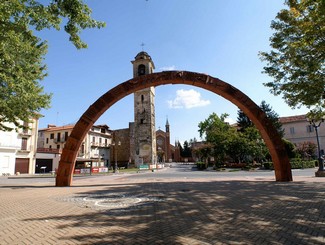
Castellamonte- Arco di pomodoro
This is the testimony of Arnaldo Pomodoro's intervention at the XXXV Ceramic Show (1995). Inserted with great scenographic effect in the Rotonda Antonelliana, the arc has a radius of 6 meters and consists, for each face, of 7 decorated forms that alternate with other smooths, all in cotto
Castellamonte- the Stove
Started in 2002, and then interrupted for lack of funds, the works for the construction of the large Nespolo stove were completed in 2008 thanks to the donation of 50 thousand euros by the Plastic Wood company Carlo Sunino of Castellamonte. This monument represents the happy encounter between the world of culture and work, just like every year is somehow celebrated by the Ceramic Exhibition: the ceramic formwork that make up the reinforced concrete structure of the monument, designed by Nespolo, were in fact Realized by the ceramic artists Sandra Baruzzi and Guglielmo Marthyn with the support of the students of the Felice Faccio Institute of Castellamonte and then cooked in the furnaces of Roberto Perino and Silvana Neri (CNA Members).
Ugo Nespolo Stove The Stufa Monument is the symbol of the great artistic past of Castellamonte and also a concrete and tangible sign of the firm desire to relaunch ceramic production internationally.
Castellamonte- the ceramics museum
The Ceramic Museum, located in the restored palaces of Palazzo Botton in Castellamonte, was born as a "Red Earth Civic Collection", and opened to the public in 1993.
The historic part is represented by fragments of friezes, capitals, pots, Franklin fireplaces, pieces of stoves of the sec. XVII, XVIII and XIX.
The modern part consists of a large number of works from all over Italy, donated to the Museum by the artists who participated in the annual Ceramic Exhibition, the production of artisans castellamontesi, pottery and stoves, and creations of students of the " Art Institute.
Castellamonte- other places of note
Museum- house of the Allaira family
Palazzo Chiantaretto
Castellamonte, artist's threshold
The revival of the Middle Ages, spoken of in the Palazzo Chiantaretto, in the late nineteenth century, was delightfully ingenious, making it a happy blend of art, craftsmanship of Castellamonte's ceramists and fairy tale: a sort of game for adult children who loved to make The fake bastions of a castle that crowned the house as jumpered hats, the statues of a king and queen who are not aulic, harsh, but serene, playful guardians of the house, on the sides of the entrance.
The almost repetitive repetition of the "Gothic" arches of the façade, the balustrades, quadrilobed and moorish motifs, with so much use of terracotta, seem to invoke Alice's journey in a fantastic world, as if the house should hide mysterious, but cheerful secrets , Captivating.
This home can be seen as a representative example of the artisanal production of terracotta relative to external decorations.
Inside there is a modern countertop: the study of the artist, painter and sculptor Marco Ruffino, with large paintings of lively colors, which are reflected in German expression and crockery and ceramics from different "lands" and warm tones.
The subjects of the sculptures are a kind of "revived Gothic bestiary", very personal, since most of them are often united animals, symbolizing love and a thousand human feelings.
Thinking of animals subject to so many works, the house seems to be a Noah's Ark where the "beast" saved is that of different feelings, and so many such as the multitude of Creation animals, stopped, fixed in the colors of the canvases and the forms of pottery .
Palazzo Comunale
Palace of the Counts of St. Martin
Villa Pagliero
Accommodation
FARMHOUSE
Agriturismo La Prateria
Address: Frazione S. Giovanni - Via San Martino, n. 42
Telephone: 0124.512010 - 3932268178
Services: Accommodation - Accommodation capacity: up to 60 people
Agriturismo La Terra di Mezzo
Address: Frazione Filia, no. 99/1
Telephone: 347.5476825
Fax: 0124510191
EMail: cri.vig.virgilio.it
Web: go to web site Agriturismo La Terra di Mezzo
Services: Sourcing - educational farm - selling processed agricultural products - microbirry - Capacity: up to 20 seats
HOTELS
Albergo Tre Re ***
Address: Piazza Martiri della Libertà, no. 27
Phone: 0124.515470
Fax: 0124.510191
EMail: info.trerecastellamonte.it
Web: vai alla scheda Albergo Tre Re ***
Services: Hotel - Restaurant / Capacity: 15 beds - Stars: 3
BED & BREAKFAST
"A Casa di Lilly"
Address: Via M. D'Azeglio, no. 48
Telephone: 347.4297893
Web: Go to the website "A Casa di Lilly"
Services: Capacity: 4 beds - Stars: 2
"The Beautiful Sleeping"
Address: Frazione Filia, no. 123
Telephone: 392.6824011 - 348.2575136
EMail: info.labelladormiente.com
Web: Go to the website "La Bella Dormiente"
Services: Capacity: 6 beds - Stars: 2
"La Branda"
Address: Frazione Filia, no. 43
Phone: 333.2465484
EMail: labrandabeb.gmail.com
Web: Go to the website "La Branda"
Services: Capacity: Sleeps 3 - Stars: 2
"Vole"
Address: Frazione S. Giovanni - Via San Martino, n. 16
EMail: info.ilvole.com
Services: Capacity: 6 beds - Stars: 2.
LOCANDES - PENSIONS - RENTALS
Oriente Restaurant Bar
Address: Strada per Castelnuovo Nigra, n. 26
Telephone: 0124.515472
EMail: francaoriente.gmail.com
Services: Affittacamere - Accommodation capacity: 10 beds
Equinox
Address: Frazione Filia, no. 70
Telephone: 0124.513635
EMail: info.equin-ozio.it
Web: Go to Equin'ozio website
Services: Children's holiday service - Capacity: 13 beds
Foresteria di Filia
Address: Frazione Filia - Piazza della Chiesa, n. 2
Telephone: 0124.513674
Web: Go to the Foresteria di Filia website
Services: Holiday home - Capacity: sleeps 2
PIZZA
Bar Pizzeria "Lo Spineto"
Address: Frazione Spineto, n. 84.
Phone: 0124.582779
Fast Pizza and Lunch
Address: Bairo Road, 3
Telephone: 0124.582346 - 338.3768111
Web: Go to the Fast Pizza and Lunch website
Pizzeria Egypt.
Address: Via G. Romana, n. 3.
Telephone: 3421739820
Pizzeria Jolly
Address: Via C. Nigra, n. 22.
Telephone: 0124.582037
Pizzeria Ristogrill 13-88.
Address: Strada Casino, n. 2
RESTAURANTS
The Valentine
Address: Strada per Castelnuovo Nigra, 21
Telephone: 0124.515476
Web: Go to Website Valentino
The Terrace on Canavese
Address: Frazione Muriaglio - Via Campo, n. 12
Telephone: 0124.513118
Web: Go to the website La Terrazza sul Canavese
Three King Restaurant
Address: Piazza Martiri della Libertà, 27
Phone: 0124.515470
Web: Go to Website Restaurant Tre Re
Closing: Monday
Three Re
Address: Piazza Martiri della Libertà, 27
Telephone: 0124515470
Fax: 0124.510191
Web: Go to Tre Re website
TRATTORIE - OSTERIE
Equinox
Address: Frazione Filia, no. 70
Telephone: 0124.513635
Web: Go to Equin'ozio website
The Brasserie of Castellamonte
Address: Via G. Romana, n. 46
Phone: 348.1598643
The Locanda del Buon Eat - Ca 'Dal Ghe'
Address: Strada Casino, n. 35 / A
Telephone: 349.6277255
EMail: info.cadalghe.it
Web: go to your web site La Locanda del Buon Mangiare - Ca 'Dal Ghe'
Osteria di Filia
Address: Frazione Filia - Church Street, no. 2
Telephone: 0124.513674
Osteria Peccati with Taste
Address: Frazione Spineto, n. 61
Phone: 349.6605873
Fojot Restaurant Flavors of the past
Address: Frazione Preparetto - Canton Berolatti, n. 3
Telephone: 0124.513717 - 3398582312
Worker Company from Virgi
Address: Frazione S. Antonio, n. 214
Phone: 340.3430391
Trattoria Canavesana
Address: Frazione S. Antonio, n. 135
Telephone: 0124.482766
Trattoria La Campagnola
Address: Frazione S. Anna Boschi, n. 54
Telephone: 0124.513262 - 334.9319210
Trattoria Oriente
Address: Strada Castelnuovo Nigra, n. 28
Telephone: 0124.515472
Trattoria Palasot
Address: Frazione Campo, n. 1 - Ca 'Palasot
Telephone: 0124.697028
Trattoria San Giovanni
Address: Frazione San Giovanni C.se - Via Centrale, n. 53
Telephone: 0124.513287
EMail: trattorias.giovanni.libero.it
Web: Go to the Trattoria San Giovanni website
Excerpt
Castellamonte is a small town in Canavese, famous for the production of artisan and art ceramics. Its altitude is m. 345 and it is from Turin, its provincial capital, approximately Km 38. This municipality has a density of almost 9,000 inhabitants, distributed between the capital and its eight fractions. A good part of the territory lies on the hills and from the summit of the hill, where the ruins of the Conti San Martino castle arise,
|