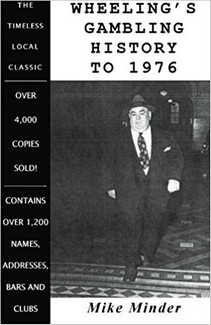
Wheeling's Gambling History to 1976 documents the city's fondness for gambling from the Indians to just after "Big Bill" Lias's death.
This complete and remarkable history of gambling in Wheeling begins with the origins of odds and evens as an old fortune telling "game" and ends shortly after the death of "Big Bill" Lias. Minder, historian-turned-detective, gets credit not only for his care in recounting the evolution of gambling in the Wheeling area, but also for gambling in local Native American cultures. In the same way, he assesses the attitudes of religion regarding the human tendency to gamble. Minder describes the rules of various games and the stories of famous and not-so-famous players. He also investigates the reasons people gamble and methods of cheating. Government-sponsored gambling is also explored.
Excerpt
Shortly before 10:30 a.m. on January 17, 1964, Mrs. George Thomas was walking down the stairs of her home located at 339 Richland Avenue in the Warwood section of Wheeling. Looking out a window, she observed a neighbor from across the street at 336 Richland Avenue leaving his house for work. That neighbor was Paul Hankish, a local underworld figure. Mrs. Thomas later described what she saw to the News-Register:
I saw him reach for the car handle. Them I turned to go into the kitchen where my husband was. It was just a second, then I heard the loud explosion. Smoke came into the house. At first I thought something happened to my husband in the kitchen.
When Mrs. Thomas turned and saw the smoke rising above Hankish's car, she sprang into action:
I cried, 'Oh Paul, Oh Paul.' I ran to him. I was the first one there. He kept saying 'take me down, take me down.' I couldn't move him.
Mrs. Thomas saw Hankish's wife and children run from the house and stand beside the wreckage. Mrs. Thomas' good deeds weren't over yet. She said, "I took the (Hankish) children over to my home while she (Mrs. Hankish) went to the hospital."
Mrs. Thomas may not have been the first one to reach the wounded Hankish. The News-Register identified 23 year-old Earl Bowers as the first one to approach Hankish. Bowers was walking at the corner of Fourth and Richland Avenues, which put him a half block from the Hankish home. Bowers said, "I saw him (Hankish) open the car door." Bowers went on to say that he heard the car door bang shut, the engine starting and then the explosion. Bowers described what it was like to be that close to the explosion and his actions afterward:
It knocked me down sideways. I saw stuff coming past me. Parts of the car were going by my ears. I got up and went over and talked to him (Hankish). He wasn't hysterical.
Bowers wouldn't tell reporters what Hankish said. Bowers did say, "I told him I was going to call an ambulance." Bowers said he couldn't help but notice that both of Hankish's legs looked like they were "torn off and under the seat."
At North Fourth Street and Warwood Avenue, a crew employed by Manufacturers Light & Heat Company was working. They rushed to the scene and joined the crowd of bystanders, which grew to a minimum of 150 people.
Firemen and police arrived at the scene within minutes. The police contingent was led by Police Chief Louis M. Kulpa and his chief detective, Lt. William J. Thomas. Ohio County Prosecuting Attorney Thomas A. Goodwin also made the trip. Fire Chief William McFadden was one of the first on the scene. By this time, Hankish was in agony. As the emergency crews were attempting to get Hankish out of the mangled car, he pleaded, "Get me out of here...get me out of here." Hankish was successfully removed from the car, but only after bolt cutters were used to cut away a portion of the mangled car where one of his legs was trapped. Fire Chief McFadden later described the scene:
He (Hankish) was all cut up. There were quite a number of lacerations on his face. He raised his head up when they got him into the ambulance...there wasn't anything left of the car...I don't think he will make it.
Professional Reviews
Read this a couple times already.
I found this book to be informative and entertaining on what could have been a dry subject. I look forward to reading everything else that Mike Minder decides to put out.
The Borderline Anti-Memory PastBook asks questions a diary does not ask and raises the questions to dialectics and answers them in a way a memory work does not answer questions.