|
Amazon
Growth Central
*Growth Central
Category:
Self-Help
Publisher: Growth Publishing
ISBN-10: 1893505243
Type: Non-Fiction
Pages: 120
Copyright: Jan 1, 2005
ISBN-13: 9781893505247
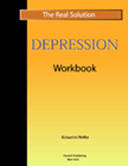
Depression can be costly, both physically and emotionally. The Real Solution Depression Workbook is designed to overcome depression in a way that assumes the participant has already suffered enough, has sufficiently grieved and mourned the losses in their life, has found meaning in it all, and is now ready to begin the work of changing. The reader will discover if they have a tendency to respond to life events in a way that indicates some qualities of Depression Prone Thinking (DPT). The issues of Shame, Perfection, Control, People Pleasing, and Competence are explored and solutions are offered. The Workbook has twelve sessions and is organized to complete one session per week.
When someone speaks of going through depression, they usually mean that they have experienced a bad situation. The bad news is that bad situations happen to everyone, and they have nothing to do with being a good or bad person. The good news is that we have choices of how we think and respond to situations and that good situations happen to everyone too. I must admit that I am no longer very good at telling the difference between a good or a bad situation. Of course there are many situations that have occurred in human history that can only be labeled as bad, but from the standpoint of individual inner experience the difference has become fuzzy to me. Some situations start out seeming good only to end up rather badly. Some seeming bad situations end up causing some quite good results.
In fact the whole concept of good/bad, all/nothing, right/wrong, black/white seem much more hazy to me. My thinking has changed as I overcame my own depression. The Real Solution Depression Workbook is designed to help overcome clinical depression in a way that assumes the reader has already suffered enough, has sufficiently grieved and mourned the losses in their life, has found significant meaning in it all, and is now ready to begin the hard work of changing the “brain muscle” to live out a healthy “depression free” life.
I have written the Real Solution Depression Workbook because of my deep compassion for those who suffer from depression, for those individuals who do not wish to take medication for the rest of their lives, and because I have seen the value and positive outcomes of the cognitive behavioral therapy approach in conjunction with shame analysis.
I am indebted to the many patients as well as the readers of the Real Solution Workbook series around the world who continue to inspire my work. I am grateful to those who have responded and commented not only of the value of the approach but also with edifying suggestions.
Richard Pfeiffer
New York, NY
2005
Excerpt
The DPT (Depression Prone Thinking) Profile
Depression affects almost everyone at some time in his or her life, according to recent studies. However if you suffer from depression over a prolonged period of time, you may have a number of special personality characteristics, many of which are quite positive and that set you apart from the ‘average’ person:
• You may be very sensitive. You may be sensitive to environmental stimuli such as tem¬perature, light, smells, and sounds. Or you may also be quite sensitive to other people and their feelings. Many people with DPT have a heightened sense of in¬tuition (although not everyone).
• You probably have an above average IQ.
• You may be creative. Being both intelligent and creative, you have the best of both worlds. Typically, you may have a very rich and vivid imagination. In this workbook, you’ll learn to use your imagination positively, instead of against yourself, by magnifying your fears, stress, and depression.
• You may have intense emotions and may also have a high degree of emotional reactivity. This is usually a learned trait, and it can make your experience of life more vivid and poignant. In this workbook, again, you can learn to make this trait work for you rather than against you.
• Your parents may have been overly critical and had very high standards. A child growing up with critical, perfectionist parents is never quite sure of his or her acceptability. As an adult, such a person may be overly eager to please, look good, and be nice at the expense of his or her needs and feelings. Having grown up feeling insecure, you may have a tendency as an adult to depend on a safe person or safe place and to restrict yourself from activities involving public, performance, or social situations where there is a possibility of losing face or ‘looking bad.’
• You may have grown up with emotional insecurity and dependency. There are many kinds of dysfunctional family situations that can generate deep-seated insecurity. Loss of a parent due to death or divorce can precipitate strong fears of abandonment in a child. Neglect, rejection, physical or sexual abuse, or family alcoholism also leave a child feeling very insecure. When that child responds to this insecurity with excessive dependency, the stage is set for over-reliance on a safe person or place later in life. While depression isn’t the only type of problem that seems to develop when a child has learned to be overly depend¬ent, it’s a common outcome.
• Another long-term, predisposing factor that can contribute to the onset of the DPT is cumulative stress. Depression can develop over months or years as a result of long-standing problems. It can also develop as the result of too many ‘major life transitions’ or losses (such as marriage or divorce, a change of jobs, geographical moves, health problems, a financial reversal, and so on) within a short period of time.
The long-term effects of depression are varied. Some people develop chronic tension headaches, ulcers, high blood pressure, addictions, and various other diseases. Others become ‘burned out.’ Depression may also cause certain psychosomatic illnesses.
Implications of all this points to the importance of dealing with your depression - including relaxation, exercise, good nutrition, time management, medication, social support, and adopting new thoughts, beliefs and attitudes toward life.
|