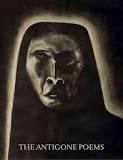
An intensely personal invocation of the ancient Greek tragedy, The Antigone Poems was created in the 1970s while writer Marie Slaight and artist Terrence Tasker were living in Montreal and Toronto. A bold retelling of the ancient tale of defiance and justice, its poetry and images capture the anguish and despair of the original tale in an unembellished modernized rendition.
The Antigone Poems, featuring poetry by
Marie Slaight and drawings by Terrence
Tasker, was created in the 1970's, while the
artists were living between Montreal and
Toronto. A powerful retelling of the ancient
Greek tale of defiance and justice, the
illustrations and poetry capture the anguish and
despair of the original tale in an unembellished
modernized rendition.
Passionate, brutal, and infused with
extraordinary lyricism, The Antigone Poems
provides a special expedition into the depths
of the ancient Sophocles tragedy.
‘I adore these weird little poems. They are
surreal and wild. The charcoal drawings are
terrifyingly brilliant... I deem this a holy
book—written in ecstasy and the madness of
genius… It is the flaming center of the volcano
that makes us create.’
-The Washington Independent Review
of Books
‘Haunting. …a disturbingly poignant and startlingly vivid portrait of one woman’s suffering in the face of pain and heartbreak. It will surely not be forgotten after the turn of the last page.’
-The San Francisco Book Review
Professional Reviews
Grace Cavalieri The Washington Independent Review of Books
The Antigone Poems. Poems by Marie Slaight, Drawings by Terrence Tasker. Altaire Production & Publication (Australia) approx. 40 pgs.
This is the most strangely beautiful book to come across this desk in a long time. First, it’s always interesting to have a publisher print a work 40 years after it’s written without disclosing why. All that we know is that the writer and artist lived in Montreal and Toronto in the 1970’s. I guess Tasker’s death in 1992 has something to do with this premiere.
First we should know something about Antigone in literature. Well it’s an ancient Greek tragedy where Antigone, the female protagonist, is ultimately jailed and sentenced to death, and all you need to know is that everyone—all the principles— die in the end, except for the prison guards. I’m not being flippant, but truthfully, to read these poems, that’s all you need to know.
And I ADORE these weird little poems. They are surreal and wild. The charcoal drawings are terrifyingly brilliant. They scare the bejesus out of you and you can’t stop turning the pages. It’s like bingeing on BREAKING BAD and WAKING THE DEAD both at once. I deem this a holy book—written in ecstasy and the madness of genius and I hope it’s reprinted and lasts forever. The poems are untitled. Check this out:
We live our lives
The instant between life and death
To touch death always,
That is the sun.
This copy I hold in my hand—no one will ever get from me. This is ART you cannot buy or sell. It is the flaming center of the volcano that makes us create.
Kelly Cherry, Blue Fifth Review
A Review by Kelly Cherry
Marie Slaight, The Antigone Poems
Poems by Slaight. Drawings by Terrence Tasker. 96 pgs.
Altaire Production and Publication, 2014
It is in the nature of a play to present to its audience a dilemma: a choice between alternatives, none of them agreeable. A play may therefore be said to be the most philosophical of art forms, as its personae grapple for a solution to the (unresolvable) dilemma. This is seen very clearly in Greek drama and, while it is usual to say that Presocratic philosophy stemmed from considerations of nature, it seems likely that classic Greek philosophy (Socrates, Aristotle, Plato, et al.) was sharply influenced or inflected by Greek drama. In particular, the play Antigone, by the tragedian Sophocles, sets two characters, Antigone herself and the king of Thebes, Creon, in opposition.
Antigone, daughter of Oedipus, follows her heart and “divine law” (here, the previous practices of the community), whereas Creon behaves as if he is above the people. Creon has declared Antigone’s brother, Polyneices, a traitor; it is, he has decreed, thus a crime to bury the body, which has been left out in the open to be ravaged by wild animals. Antigone cannot bear this; she feels she must, as the practice has previously been, as divine law requires, honor her brother by burial, even though she knows Creon will punish her for it with death. Her action is one of civil disobedience, and civil disobedience cannot be borne by the community for long. Indeed, Creon does sentence her to death. This is in spite of the fact that his own son, Haemon, is betrothed to her and in bitter disagreement with his father. Antigone decides to commit suicide before Creon can have her killed. Learning that she has done this, Haemon kills himself in sorrow and anger. Creon’s wife, Eurydice, kills herself when her son kills himself.
A domino row of deaths as will happen later in Shakespeare’s tragedies.
None of this is in The Antigone Poems.
The Antigone Poems is a beautifully made object. Only every other page is printed. The book has a section-sewn binding. Charcoal drawings on French folds are striking and fierce, conveying a strong sense of the otherness of ancient Greece. For the ancient Greeks were not at all like us: their language was a wild cry in the dark, a wailing wind; their battles were savage; their gods hard and desperate; their people superstitious.
It is these attributes of the ancient Greeks that Marie Slaight’s poems capture, not the play. Her interest, I think, is not in the play; it is in the figures of the play, all of whom are larger than life, tragic, restricted by rules and duty: ardent, violent, severe. The drawings reflect these qualities; they are aggressive and haunting, even brutal, and the use of charcoal suggests a darkness that cannot be alleviated. Slaight and Tasker collaborated on this book in the seventies; they were then living in Montreal and Toronto. It’s not often that a forty-year-old manuscript finds its way to publication, but we are fortunate that this one has done so. Here is the opening poem in Chapter One:
In my skull (all)
The hungry cawing.
Fire
In tormented call.
In my heart (only)
The last flutter.
Anguish
In whispered song.
We might take the cawing to be discordant, argumentative voices. Antigone hears them, all of them, in her head. Perhaps the call, the cawing, is destructive and scorching, like fire. Perhaps her heart is like the last rook or crow fluttering. A fluttering thing falls. The call is reduced to a whisper of a song. The end is anguish.
Maybe. Am I reading too much, or the wrong things, into it? But I suspect Slaight wasn’t worried that a reader might misinterpret her poem. She wanted to convey the world of the play more than the play; she wanted to convey Antigone’s state of mind. Hence, poems.
In Chapter Two Antigone speaks of “daemon ancestry,” referring to the line of mythological Theban predecessors including Oedipus, destined to kill his father, and marry his mother, and to blind himself when he learned what he had done. A seemingly abstract little poem —
A fervor
Overtaking
All abysses
Pouring
Ether
In every crevice
— speaks, I believe, of the intensities in this troubled family and the poisoning of each generation by the previous.
Chapter Three takes us through Antigone’s death. Having been walled up by Creon, she hangs herself. Haemon, desperate and heartbroken, loyal to his father and loving Antigone, conflicted between both, dies on his sword. From Chapter Four: “A sword on slate / Impaled / By sunlight.” Is there no turning away from such stark events?
Not here. Chapter Five permits Antigone/the author to reflect on her ambitions:
. . . .
To live all lives, all deaths, encompass all women.
To smash every confine.
. . . .
I have written a few words
Created a few images
Influenced a few lives.
And here we are, recognizing a writer’s anguish, which may be as turbulent, as disordered, as that of a mythic heroine. Like civil disobedience, artistic endeavor, especially artistic innovation, runs the risk of offending the community in which it occurs. We hope that the artist’s (writer’s, visual artist’s, composer’s) life is not at stake but in a sense it always is: for the work is the artist’s life. Antigone protests, with her life, the injustice of Creon’s rule; in that respect, she is a revolutionary despite her affection for older ways, for religion, for divine law: a revolutionary and a feminist. At the same time, she, like all the play’s personae, are subject to fate. She is fated to be a revolutionary, and she is fated to die.
Again, that is the artist’s fate, too—unless her work survives. And how rare that is! But how much hoped for!
I imagine the artist might, as Antigone, Creon, Haemon, Eurydice do, live with such focus that he or she is blind to everything else, but would that result in a ruined life? I am merely asking questions here; I have no answers. Nor do I know anyone who has answers for these questions. There is a perpetual tug-of-war between the world and art, and the artist may make one choice at one point and another at another. Some choices, of course, preclude others, but most choices are not as dire as Antigone’s, who thinks of marrying death. Marrying death introduces a certain luridness or sensationalism into her characterization when we view it from a distance, but if we live her lines as she says them, marrying death becomes something smaller, something like an ache in her heart. Death, however, puts an end to further decisions. Antigone, Haemon, and Eurydice might or might not have influenced their future, but they are unlikely ever to know either way. The artist, I like to think, will find a way to recognize her or his individual death in the created work while yet passing beyond it to a late style (Edward Said’s formulation) that will approach the Beethoven late quartets.
Meanwhile, this book—the poems and the drawings, the paper, the cover, the printing— is serious, intelligent, one of a kind, and gorgeous. It is a major find, a supplement to or interpretation of the Sophoclean play as much as is Anne Carson’s Antigonick and more unified. (Sophocles, born nearly five hundred years B.C., was himself a writer who furthered the modernization of Greece, moving toward characterization and a natural idiom of speech.)
The Antigone Poems can be read quickly but absorbing them, and the drawings, takes more time, contemplative time. Philosophical time. I cannot recommend this book highly enough.
Kirkus Reviews
Rich in allegory and metaphor, this illustrated collection of poetry explores the tragedy of Antigone, the defiant woman of Greek myth.
With a strong first-person narrative, the collection is divided into five chapters featuring fragmented poems that explore love, loss, passion and pain through Antigone’s eyes. The book opens with a riveting prelude: “And sing / my bitter praises / to nails / and flint / and flesh.” As the collection moves forward, Slaight continues with poems that are spare yet precise in their language and construction. The first chapter introduces Antigone as a woman awakening, through pain, to her senses as well as to her vulnerability and power: “The passion comes angrily…then the awakening of all senses, nerves—open, alive, tingling.” However, there’s no consistent narrative thread to follow through the collection; rather, fragments and images capture Antigone’s journey. Some of the stronger lines focus on her insight into her role as a rebel: “All love pains / Are an aged protest / Wanting fresh surge; / Decrying the ancient throb / Of memories.” Slaight’s poems also use this close first-person perspective to unpack Antigone’s struggle for independence and identity as a woman—“Fought order, limits, time.” It is not exactly clear why Slaight focuses more on Antigone’s suffering and less on her rebellion from Creon, ruler of Thebes, though a later chapter provides a transition into her exile: “I walk on blood / I carve a vein / I bear sons / In exile / I carry screams / I seek revenge / I await return / In exile.” Throughout, Tasker’s haunting charcoal drawings reflect the tone of anguish and despair in Slaight’s poetry.
A beautifully bound, impressive collection with language as evocative as its illustrations.
David Hightower’s lyrically expansive meditation on the whims of fate and the unpredictability of the human condition fill the pages of THE HANGING MAN DREAMS with thrilling music and mesmerizing imagery. Hightower’s richly infused voice echoes the e