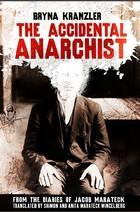
The true story of an Orthodox Jew who was sentenced to death 3 times in the early 1900s in Russia -- and lived to tell about it. He also happened to have been my grandfather.
By the time he was 25 years old, Jacob Marateck had been a labor organizer, an officer in the notoriously anti-Semitic Russian army (in which the soldiers under his command wanted to kill him at least as much as the enemy did), and sentenced to 10 years of hard labor followed by permanent exile iin Siberia, from which he escaped, (in addition to the 3 death sentences). Throughout it all, he never lost his sense of humor or optimism, and those were what helped him to survive.
The Accidental Anarchist is the remarkable true story of an ordinary man who became extraordinary by participating in the history-making events of the early 1900s in Russia Poland. His story, based on the diaries that he began keeping in 1905, during the Russo-Japanese War, is told in his own voice, and filled with his ironic perspectice and intimate thoughts. Marateck is an unforgettable character, not larger than life, but rather a unique reflection of it.
Excerpt
Chapter 1: In the Beginning
I have no excuse, save for the ignorance of youth and a desire for grand adventure, which may have been one and the same thing. Consequently, the seemingly minor decision I made to end my education before the age of thirteen led me down a path from which each future choice was misdirected by the previous foolish one.
Not that I didn’t have a loving family to guide me, particularly my older brother, Mordechai, who had seen me risk my life repeatedly but was unable to convince me to make at least one sensible decision. There was simply too much fun to be had.
The result was that, in a little over ten years, I went from being a yeshiva student, a baker’s assistant, and labor organizer, to a corporal in the Russian army during the war in Manchuria (in which the men under my command wanted to kill me, simply for being a Jew, as much as the enemy did, simply for being in the way), to a revolutionary. For my efforts, I earned my first two death sentences, which was a little more excitement than I needed.
This limited my curiosity as to whether my end would come from freezing or starvation, from Japanese artillery or Chinese bandits, and whether it would be today or tomorrow. From my experiences with the comically inept Russian army (at least, it would have been comical had our lives not been at stake), I learned that, no matter how terrible it was for anyone to be in the midst of a war, it was a hundred times worse being on the losing side.
Still, I was slow to put into practice the lessons from my youth and, following the war, became a revolutionary who wanted to overthrow the Czar. This got me involved in amateur spy missions that would have gotten a Hollywood screenwriter fired, but got me sentenced to death for the third time.
As a result, I traveled the width of Russia, from Petersburg to Siberia, where my adventures were to have come to an end. But even if my record wasn’t clean, my conscience was; everything I did was done with the most honorable intentions.
And ultimately provided enough excitement to last a lifetime.
Professional Reviews
The New York Journal of Books
The Accidental Anarchist tells the intriguing true story of the colorful Jacob Marateck, a Jew conscripted into the Russian Army during events leading up to World War I.
He becomes a leader of soldiers in the brutal Russo-Japanese War, many of whom wanted to murder him for being Jewish, yet he gains their admiration after leading them in ferocious battles.
Marateck is an extraordinary character facing certain death many times with consistent humor and steadfast faith in God. The reader certainly does not need to be an Orthodox Jew to appreciate the intense commitment Marateck has to his faith and his religious duty. His notes reveal a breathtaking ability to absorb the absurd that life dishes out to a lowly Jew in the Czar’s anti-Semitic army with aplomb and grace.
Despite being subjected to court martial several times, Marateck escapes under the most amazing and bizarre circumstances. At times he and his comrades face an enemy within the Czar’s army more fearsome than the nation’s military enemy at their borders.
Barely surviving terrifying battles, the brutality of his own soldiers, and being sentenced to death by his own officers, Marateck faces it all with humor, faith and courage. He later joins the Polish resistance whose membership desperately wants to end the reign of Czar Nicholas II.
After being captured, he is sent to a terrifying prison camp in Siberia, where very few prisoners survive the brutality of the vile Gulag and the notorious Siberian winters. He eventually escapes with a very colorful character known as “The Warsaw King of Thieves.” Together, with no official papers or money, they travel more than 3,000 miles home.
Jacob Marateck is an ordinary man forced into extraordinary courage by experiences that include a lifetime of dreadful events wrapped into the eventful years of his youth. The incredible tales of war and courage, faith and death reveal unforgettable individuals and astonishing experiences. For the reader, this knowledge is a swift, unrelenting trip down a shocking rabbit hole of incredible and frightening reality.
This story is told by Bryna Kranzler, the granddaughter of Jacob Marateck. Ms. Kranzler’s captivating writing technique envelops the reader with Marateck’s magnetic personality.
These conversations, events that should have been muddied by the ravages of time and history, are rewritten with incredible detail and exquisite narrative that pushes the reader ever-onward, hanging upon baited breath with each sentence. Yet between Marateck’s notes and Ms. Kranzler’s consistent ability to wrap it into moving prose, this memoir reads much more like a thrilling novel. In some cases, truth is indeed stranger than fiction.
Marateck bares his heart through his carefully detailed notes. They become a symphony representing a brilliant, singularly valiant human life enveloped within the loving care of the author’s loving dedication. The Accidental Anarchist begins with a powerful allegro of youth, in which Marateck throws his life about in a careless affront to its sacred value.
This is followed by an adagio of pain, suffering, and grief—a period in which death stalks Marateck around every corner. Here, at the bottom of life’s deepest pit, he discovers the lament of a life unfulfilled and the precious nature of his predicament. A rondo completes the package, filled with hope and desire, tempered by experience and chastened by pure faith.
If a reader could ask for anything more from this moving, powerful experience it might include additional maps, pictures, diagrams, images, illustrations, or other cues for visual learners. On the positive side, the book includes an excellent epilogue, superb author’s notes, a fine glossary, and a detailed index at the conclusion.
Having read The Samurai of Vishnigrod would have made this experience slightly more transparent; however, familiarity with that title is by no means is a prerequisite. Through Ms. Kranzler we enter her grandfather’s heart and his life—and what a magnificent experience.
Seattle Post-Intelligencer
“There was simply too much fun to be had.”
Reality and three narrowly dodged death sentences kind of puts a damper on that illusion as 13-year old Jacob Marateck, citing “the ignorance of youth and a desire for grand adventure,” leaves his small Polish hometown to seek some rudderless escapades in the Warsaw of the absorbing and often black-humored true story The Accidental Anarchist.
Indeed, the adventures in this novel are many, and unforeseen. Variety-spiced life mixed with historical events of the 1900s in Russia and Poland sees Marateck moving on from student to baker’s assistant, labor organizer to an officer in the Russian army during the Russo-Japanese War of 1904 against the Japanese in China. Marateck has his own struggles close at hand, too, in situations “in which the men under my command wanted to kill me, simply for being a Jew, as much as the enemy did, simply for being in the way.”
At the same time, a fervent Marateck tries to contribute to the rumblings of revolution then underway, intent on doing his bit in overthrowing Czar Nicholas II — including joining in "amateur spy missions that would have gotten a Hollywood screenwriter fired.” But in the course of these uncertain times, he is sentenced to death three times, the first two times for, respectively, hitting a superior, and then for falling asleep on guard duty. Having narrowly averted execution in most entertaining and unexpected fashion, Marateck is then left to face the harsh Russian and Asian winters, surviving sub-zero nights, starvation-tested marches, and ongoing gun battles.
Returning to Warsaw to catch up with the revolutionaries, Marateck is arrested and sentenced to death again. But three times’s a charmed life, if you want to call it that, as he ultimately receives a reprieve and is sent instead to a Siberian labor camp. After escaping his fate of hard labor and permanent exile in Siberia with Warsaw's eccentric "King of Thieves," the two strive to survive while roaming the expanse of Russia from Petersburg to Siberia. The objective: obtain false papers to travel home while avoiding the Secret Police. With more adventures in different circumstances, the rollicking and rewarding second half of The Accidental Anarchist, ensues.
It’s all part and parcel of the the book's captivating plot that gets a big boost from the writing and the characterization. “It is not the circumstances of our lives that determine who we are,” notes Kranzler in her Dedication, “but rather the way we choose to interpret them that defines our personalities and, to some extent, our destinies.”
In the author's first-person narrator Marateck, then, we have a likeable interpreter whose wit, self-deprecation, and hopefulness shape and shift the defining moments of the novel, and see us through the grim circumstances of war and volatile political times. Through all that Marateck has experienced and endured, the narrative outlook carries us through the bleakness and death with unflinching directness and dark humor. We’re placed in the midst of war or 24/7 evasions from the government officials, replete with confusion, snafus, and Catch-22 frustrations.
And so, one page surrounds us in the chaos of battle and trench warfare, where Marateck helps transport a would-be wounded lieutenant, who turns out “was without a head and probably had been for some time.” Then the turn of a page will put us smack dab in the absurd midst of a scene where a dithering general has gotten his brigade lost: “We plodded on past devastated villages and frozen, long-unburied corpses until, at sunrise, our general, perplexed, halted the column and politely asked some blank-faced Manchurian peasants if they could tell him where to find the battlefield.”
Somewhere in that gray area between dire and droll lies one (among other) Marx Brothers-moment in which Marateck and his men had been seemingly “ditched”: “Our battalion, it seemed, had been ordered to retreat while we slept … and no one had bothered to wake us.” The situation might have been considered darkly amusing had the aftermath not been one of hardship and deadliness in wintry conditions over enemy lines. Even Marateck, long inured to the harsh contingencies of wartime experience, had kicked up his anticipatory dread and defenses a notch or two by now, saying “I’d never had any romantic notions of combat being anything other than terrible, but I had not expected it to be this terrible.”
But no matter what side of the emotional gamut is being explored, Kranzler’s vivid and visceral writing, anchored to the rock solid and consistent depiction of the protagonist and the force of history, makes for a seamless and cohesive page-chaser. The fact that this is a labor of familial love no doubt helps, too: Award-winning playwright Kranzler, Marateck’s granddaughter, is the daughter of Shimon and Anita Marateck Wincelberg, who had previously translated the 28 notebooks that made up Marateck’s diaries, publishing the first 12 as The Samurai of Vishigrod. After her father passed away, Kranzler inherited the job of editing and publishing the rest of her grandfather’s diaries. Presumably because there was still a lot of work to do.
And maybe because “There was simply too much fun to be had.”
Reader Views
Bryna Kranzler has masterfully pulled together the notes and journal entries of her forbearer, Yakov (Jacob) Marateck, and turned them into a warm, enchanting, readable Jewish saga, with all the richness of pre-Bolshevik color and Polish-ethnic splendor. To dive into “The Accidental Anarchist,” at 334 pages, is to lunge into a whole different world and time that draws one into the spirit of the times and the mind of Yakov. Yet, the reader, whether a Goy (Gentile) like myself, an adult or a teen, is not left behind by incomprehensible words and phrases. The unobtrusive footnotes and italicized Yiddish/Polish/Russian words are lightly peppered throughout in such a way as to keep the stream of the story flowing, while bringing the reader along.
“The Accidental Anarchist” unfolds in two major episodes. The first follows Yakov from Polish Vishogrod into the ill-fated Russo-Japanese war in Manchuria as a Russian soldier. The valiant exploits of the younger Yakov are often riveting and so alive one can, at times, almost feel the chill of the bitter cold and the concussions as the artillery shells explode with deadly effect. The lust for life and the depth of friendship fills each page, driving the story from one frosty, muddy, bloody scene to the next. The desire to cheer swells up as Yakov finds his brother Avrohom at the front, and later finds his lost friend, Glasnik.
The second, and larger, portion of “The Accidental Anarchist” follows Yakov back home, to Vishogrod, then to Warsaw. There Yakov pursued some clandestine exploits in his youthful idealism that brought him into the Czar’s judicial and penal system. The reader watches as Yakov find himself face-to-face with another death sentence, and the unlikely turn of events that get him sent, rather, to a Siberian prison camp. On the way to what he thought was his execution, he is able to hand a hastily scrawled note to an unknown girl. This action will resurface much later and bring the book to its delightful conclusion, for the girl is the author’s grandmother. But from this point of the story to its conclusion, Yakov travels, under guard, toward Siberia, becoming friends with “The King of Thieves,” Pyavka. Together they struggle to survive the deprivations, the escape, and the trek back toward Warsaw. Their sometimes strained friendship carries them through more adventures until they make it back to Warsaw.
“The Accidental Anarchist” is a book that is full of odd valor, peculiarly rich ethnic scenes and a most improbable nobility. Not only is survival through the most dubious situations a large theme in the book, but the vibrancy of genuine friendship radiates beautifully. There is also the thick and deep texture of family, and the humorous tradition of the matchmaker.
As one takes up “The Accidental Anarchist,” they will be launching out into an adventure that will stick for years to come. Kranzler has been faithful to her forbearers in retelling Yakov Maratek‘s story, but she has also handed the reading public a wonderful account of life, faith, and friendship. I highly recommend “The Accidental Anarchist.”
Margaret Kohel Evans invites her mother's grandchildren to a delightful visit with their grandmother, sharing charming memories of her across eighteen life themes.
AVAILABLE TODAY 2012!
PRESS RELEASE, June 1, 2009
A True Story of My Life and My Experience with United States Immigration
I was an Abducted Alien by Department of Homeland Security...
Startling memoir is about a woman
The story of Ron Hull, paralyzed in a surgical accident back in the dreaded polio epidemic days, was able to overcome most of the stigma and stereotypes and "pass for normal" for 30 years. As Ron's paralysis increased gradually through the next 20