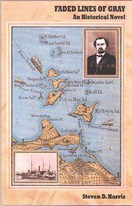
In 1864, two men are selected to lead a commando expedition to free Confederate officers imprisoned on an Ohio island, and to simultaneously capture the USS Michigan, the only US warship on the Great Lakes. They are both devoted to the rebel cause. Or are they?
By the spring of 1864, Confederate battlefield hopes had withered.The South’s last and best hope rested on its ability to put into motion operations behind the Union lines that would drive Northern voters to replace the then-current administration with one that would be willing to negotiate a settlement with the South. High-ranking Confederate officials, armed with $1 million in funding (worth $25 million today), were sent to neutral Canada where the missions would be designed and where a large Confederate expatriate community to carry out the plans was located.
The most daring and dangerous plan was for a commando expedition to simultaneously take over the U.S.S. Michigan, the only Union warship on the Great Lakes, and liberate nearly 3000 Confederate officers, including half a dozen generals, from the Johnson’s Island prison camp just offshore from Sandusky, Ohio. A rebel crew would take over the Michigan and cruise between Buffalo and Detroit, shelling these key Northern cities and others along the way. The freed prisoners, aided by local Confederate sympathizers, would make their way South where they would rejoin the rebel fighting forces.
Two men - John Yates Beall and Charles H. Cole - were selected to lead this Confederate expedition. They both had worn the rebel gray. Or had they? The lines between black and white fade together into shades of gray in this thrilling historical novel based on actual events and real people. Faded Lines of Gray is a story not only of one of the most thrilling escapades of the Civil War but also of the characters themselves and the factors that influenced them, for better or worse.
Based on the memoirs of a Pearl Harbor survivor. Letters from two pen pals take the reader on a journey into the past, a past where nightmares came true, and when hatred reigned.