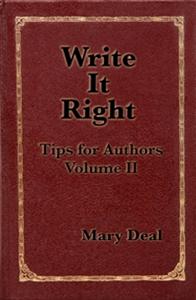
The result of many suggestions, this eBook is the 2nd Volume of Write It Right – Tips for Authors by an award winning novelist. Extra articles by popular authors are included, as are many links and referrals to sites for further research. Also, numerous examples are given to further explain the many topics discussed. A reference manual to which many will refer to perfect their prose.
Write It Right – Tips for Authors, Volume II, is nearly double the size of Volume I. It’s packed full of writing tips to help you polish your prose. Articles in this volume not only further discuss writing, editing, and perfecting your work, much attention is given to publishing, promotion and building your brand. Information about publishing houses, literary agents and editors is included. Ways to publish, such as through standard publishing companies or the various methods of self-publishing is discussed. Writing is more than merely getting a story written. Articles in this volume pick up from there and help you make those sales. Explanatory articles from several prominent writers dot the works, as do quips and torts from famous authors of old whose messages can still incite sparks of genius within us all. This really big volume will truly help you become more of what you work toward; that of being a successful author.
Excerpt
An excerpt from the section, Beginnings and Endings:
Denouements and Epilogues
Once the mystery of a story or the main plot dilemma is resolved through the climax, you wouldn’t simply end the story. You need to show how the resolution affected the characters. That wrap-up is known as the Denouement. It can be incorporated into the end of the last chapter after the climax, or can be as long as another one or two short chapters. Only then does the story end.
An Epilogue is a small additional section added after the denouement. It is reserved to show how the characters were affected by the resolution after a period of time has passed. The period of time will depend on how the story ends.
For example, if a couple decides to call off a wedding, an immediate epilogue might show one of them traveling afar to forget. However, if the marriage was doomed from the beginning, the epilogue might show the couple having their first children, a set of twins, and promising one another to make the marriage work.
A good Epilogue should be no more than several paragraphs to one to two pages. It serves as yet an extra clincher to the Denouement. You can also use the Epilogue to plant clues to an upcoming sequel; clues that remind the reader of something unresolved or on-going already mentioned in the story that didn’t require wrap-up in the Climax.
In my thriller, River Bones, you’ll find a strong subplot built around Huxley Keane, the love interest of Sara Mason, the protagonist. Huxley is involved in an on-going search for his MIA brother. After Sara solves the primary mystery, I use two short chapters for the Denouement, mainly because when people realized who the perpetrator was, so many additional clues turned up to cinch his guilt. Plus, several occurrences couldn’t have happened until the perpetrator was identified. Incredibly, these confirming clues could only be found after the perp is caught. Talk about a story writing itself! Then I use an Epilogue to show the protagonist and her love interest cementing their relationship. By moving the story forward in the Epilogue, I am able to show that the two characters will have a new life together where the main plot and subplot become entwined into one story. That left the lives of the characters open for sequels.
But what’s your opinion of putting the story ending at the beginning? Roland Merullo did this in A Little Love Story. It was intriguing because by the end of the book, you’re left wondering what happened – and then you remember that you have known since the first page. Finishes like this are unique and take some practiced experience to pull off.
Doing this, the transition from the present to telling the back story must be as smooth as possible. This method negates some of the feelings of jumping into back story. Merullo pulled it off, but I do not like telling my entire story through back story, which is what it would be since we already know the ending. Just me. I like moving toward an unexpected outcome, not reading the outcome first. It’s akin to a habit some people have of reading the ending of a book first before buying it.
Professional Reviews
Wholeheartedly Recommend
When it comes an expert who writes about writing, Mary Deal is the real deal. As an editor, as well as a multi-award-winning author of several suspense novels, she has extensive knowledge about the craft of writing. Fortunately, for the rest of us, she's also willing to share her expertise which includes demystifying the mysteries of how to get your writing published. She does all of this in a direct, no-beating-around-the-bush manner and yet manages to maintain a non-intimidating voice. It's a bit like having a true friend telling you what you really need to know even if, in some cases, you may not want to hear it. I wholeheartedly recommend her resourceful guides, Write it Right – Tips for Authors, Volumes I and II, for authors who are serious about their work and the craft of writing in general. ~ Gary Val Tenuta, author, artist, book cover designer
This is your journal, for your writing. An interactive journal with historical tidbits designed to nurture creativity and self-motivation, features one side for drawings, sketches, or pasting personal pictures, and the other side lined for notes or j
It takes you to a dark place in the company of two of New York's finest detectives as they go the extra mile to bring a sadistic serial killer to justice.