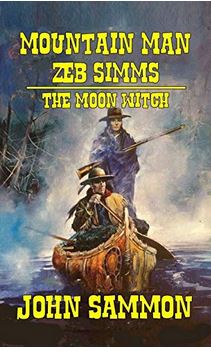
Kindle Edition
Amazon
Amazon
Category:
Western
Publisher: Outlaws Publishing
ISBN-10: B07S1XGQ8V
Type: Fiction
Pages: 298
Copyright: May 20, 2019
Price: $0.99 (eBook)
A story of love and courage, greed and cruelty, magical powers and mythology, hardship and a desperate battle for survival all set against the backdrop of the Old Oregon Trail.
Zeb and the Moon Witch is loosely based on the Odyssey of Homer.
Renowned guide, tracker and mountain man Zeb Simms is hired in 1847 by a merchant to guide two wagons of goods over the Oregon Trail to the missionaries Marcus and Narcissa Whitman at the Waiilatpu Mission Station in the Oregon Territory (Washington State). The men in the wagon party spend much of their time fighting amongst themselves, made worse by the addition into their midst of a Comanche Indian woman Red Bird who seems to have mysterious magical powers.
Zeb finds a love for this woman he can’t control.
The wagon party is targeted by a cutthroat renegade Pawnee Killer and his band of misfits exiled from the Sioux Tribe. Pawnee Killer vows to kill Zeb and his party and take possession of the Indian girl he suspects of being a sorceress, and whose powers he wants to harness.
Red Bird promises Zeb entry into a spirit world, leadership of Indian peoples and eternal happiness. But first he must slay the demon on the mountain, the evil spirit Unk Cekuna.
This is a story of love and courage, greed and cruelty, magical powers and mythology, hardship and a desperate battle for survival all set against the backdrop of the Old Oregon Trail.
Zeb and the Moon Witch is loosely based on the Odyssey of Homer.
Excerpt
It was a warm spring day in May of 1847 and the town of Independence, Missouri bustled with activity. People scurried along the newly-laid wooden planking this part of town’s first sidewalk, a sign of respectability from what had been a raw frontier town.
Wagons clattered in the dirt street.
Men in suits and felt top hats joked and gestured in dramatic fashion their hands pointing and moving up and down to make their views known with one another, while women wearing hoop skirts with sun bonnets on their heads laughed and shared local gossip.
Nearby at a corner near the Messner Dry Goods, Clothing and Groceries store, men were rolling barrels of beer along the ground while other men pulled the heads off chickens taken from a coop, letting the frantic animals run about headless before stripping them of their feathers to be served up as squabs.
A little boy with a rickety little two-wheeled cart hawked gathered hickory nuts. “A farthing for a piece a farthing for a piece!” he yelled. No one had told the boy newly arrived from England that his potential customers used a different kind of money.
Canvas awnings shielded clapboard business fronts from the glare of the mid-day sun in the treeless street.
Farther on along the way stood a red-brick two-story building, the Owens-McCoy House with its covered front porch and ancient Greek temple-style wooden columns. Completed just seven years before, it was the pride of the people of Independence, one of the town’s first permanent buildings and the opulent home of Jackson County’s first county clerk. He was a speculator who had grown rich off trading and shipping goods to Mexican officials before the Mexican War along the Santa Fe Trail (Owens would later help to found the city of Kansas City).
For the people who liked to point it out to visitors the home seemed to symbolize that almost anyone could get rich like the county clerk, and that Independence was not merely an experiment, a hope, a transitory, flimsy temporary haven, but a permanent town that had come to stay.
|