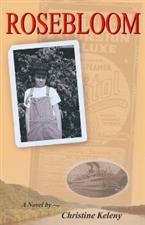
In 1936 Rose runs away from home and gets a job on a Mississippi. What she's looking for is adventure. What is finds is much more.
Rose is thrown into the lives of the varied people and towns of the Mississippi while working on river boats, going to a prep school in St. Louis where she lives with a black family in the Ville, and working in a bordells in New Orleans (not as a call girl, of course. She is a Catholic girl from the Midwest after all). What she doesn't anticipate are the close relationships that develop with many of the women she encounters. She also discovers the harshness of the world far way from the security of home. Ultimately, Rose realizes what is most important in her life: her family and her friends.
Rosebloom takes place at a time in history that buffets Rose between the great depression and the coming wave of WWII. She gets herself into situations through her naivete and also just by chance that test her resolve and teach her not only about herself but about the world of others which she would never have know if she hadn't left her small farm in Southwest Wisconsin.
Available as a paperback book or ebook.
Excerpt
Rose Marie Krantz was a beautiful baby; a beauty she would come to find was as fragrant and as prickly as the climbing rose-bush just outside the window by her crib. But just now, it was growing without restrictions on a small southwest Wisconsin farm amidst the valleys and buttes of the driftless, unglaciated upper Midwest.
~ ~ ~
Rose was given her name by her father, because it was his wife’s middle name and because of the rose-shaped, pink birthmark on the back of her right shoulder. It was a favorite spot he would kiss when he caught her running in the farmyard on those hot Wisconsin summer days. It would turn her into a squealing, writhing, little cherub; curly, auburn locks softly caressing his skin as she tried to break free. It’s hard to tell if that was why she was her father’s favorite, but being a favorite child in a large family didn’t mean much, especially after the depression hit. Rose was turning eight that year, and her sixth and seventh siblings had just joined the family. By then the specialness of children had worn a bit thin, not to mention the money, clothes, and free time.
Michael was the oldest in the family. He was the quiet, studious type who did his chores without question but yearned for the hours he could spend behind a book. He could only go to school part-time, since his help was needed at home. Both of his parents knew, however, the only way for a young man to make it in this tough new world was to get an education, so they let him go as much as they could.
Second in line was Gertruda, though everyone called her Gerty. She didn’t have Rose’s beauty, but she was stubborn and clever―two helpful qualities in a large farm family. Gerty was the second mother in the house, and she ran it with precision, something her mother lacked. She resented being the oldest girl. Frequently she had to be in charge of her younger siblings since her mother always needed help, and Rose seemed to get away from most of the house chores somehow, or at least that’s how it seemed to Gerty. Gerty had gone to school through the ninth grade, but once the twins came along, she was needed at home; the luxury of school would have to wait.
Rose was number three. She was a rosy-cheeked child with a twinkle in her eyes and a skip in her step which gave away a spirit that couldn’t be suppressed; she wanted to do and learn about everything she came in contact with. After she started walking, she would follow her father around the farm asking him “why?” so many times, he would call out for his wife to take the small urchin before he started to yell. When she was old enough to know about school but too young to go, she would follow Michael as he did his chores, asking for stories about the things he had learned that day at school. She was mesmerized by it all: English, math, science and especially geography; she loved to hear about the places and people from far away. No one knew at the time, but Rose’s future was engrained in her very soul.
Next in line were Margaret and Katherine, both of whom were girls with a capitol “G.” The twins, Sean and David, were both all boy and kept the girls in the family busy trying to keep them out of trouble. John―number eight in line―was a blessing to the family with his quiet, reserved manner. Child number nine was due in December.
The farm they all grew up on wasn’t large―about one hundred acres―consisting of the typical two-story, white farm house, a small barn to house the plow horses, their feed, the dog in the winter and a passel of wild farm cats every farm is blessed or cursed with, depending on who you talk to. There was a corncrib for animal feed, an out building for equipment, a small chicken coop, and a pen for those years it was profitable to raise pigs. In early 20th century Wisconsin, when Grandpa Krantz started the farm, it was not the fashion to raise milk cows, so when Rose’s father took over the farm, he didn’t keep cows either, despite most of his neighbors doing so.
Rose’s father had worked the farm with his parents, who had spent all they had to purchase it. Grandpa Krantz had come over to “the land of opportunity” on a ship from Germany. He worked in the coal mines of Pennsylvania to earn enough for a down payment on a small farm. He then moved to the harsh, but beautiful southwest Wisconsin rock hills which were told to have reasonably priced land and a good German community to support you. There he met his wife, Christine, and as in all good Catholic homes, they started a family. As it turned out, Rose’s father, Karl, ended up being their only living child, so it was assumed he would take over the farm. Karl had wanted to go on to high school and take up a trade, but when he met his beautiful Irish wife, Lilly Rose O’Leary, soon after his father passed, he didn’t see a way off the land. It was the fastest way to support a family, and his mother would have been heart broken if he had tried. So he stayed, married his red-haired beauty and kept his mother happy with grandchildren in her waning years. Rose’s mother, Lilly, grew up in a large family of mostly girls, so when she met this strong, handsome German, she decided she would follow him wherever he went.
Watching Lilly, a person could tell immediately where Rose inherited her spirit. It wasn’t from her quiet, no-nonsense father; she received her love of learning from him. Lilly was the well that poured out the spirit into each of her children - some more, some less, but all were left with her watermark. She was also the cog in the family wheel that kept it all going and going with flair. She had a song on her lips and a lightness of heart which made even the most everyday, mundane chores easier to tolerate, for everyone. Along with this spirit came a stubbornness which even surpassed her husband’s. The Irish were as devout Catholics as the Germans, and they accepted children as blessings from God. But, “Saints preserve us,” by child number nine, Lilly had decided the blessing needed to stop, no matter what Father Kelly at St. Mary of the Hills had said.
As Rose grew, so did her love of adventure and the great “out there.” Once all her chores were done―the beds made, wood piled in the kitchen, breakfast dishes washed, animals fed―Rose was free to go.
There wasn’t much supervision of the older children during their free time―there wasn’t the time or the need. If they were old enough to wander off the farm, they were old enough to take care of themselves and each other. So Rose, her best friend Silus, and at times various younger siblings, built forts, found caves, and played cowboys and Indians, like Jack Armstrong on the All American Boy radio show. As they matured, so did their games; they became detectives like Inspector Dawson Haig in the series Yu,an Hee See Laughs from the Prairie du Chien weekly, The Courier, which they would snatch up as soon as Rose’s father was done with it.
To continue to feed her hunger for knowledge of life beyond the farm, on quiet evenings just before bed, Rose would pull out books on different countries and of different cultures and read well into the night. She would get these books from the small library at her one-room schoolhouse or from the larger library in Prairie du Chien. The Prairie librarians, knowing Rose’s propensity for these types of books, kept track of new acquisitions and always pointed them out to the extremely appreciative Rose.
Rose’s desire to travel was cemented when her school took a trip during their last week of school to the Villa Louis―the stately Dousman family home on Saint Feriole Island in Prairie du Chien. Rose was in eighth grade, and the plan was for her to go onto high school at St. Mary’s Academy―an all girl’s school in Prairie. She was to go for at least one year, boarding at an elderly Aunt’s in town in exchange for some work around her home. Rose wasn’t so keen on the whole idea, and after she visited the ostentatious Dousman home, she lit upon a plan of her own.
It was 1936, and the home had just been opened to the public as a historic landmark. Rose’s teacher, Miss Turner, thought it would be a great opportunity for some hands-on learning so close to home, plus a fun trip to celebrate the end of the school year.
The class slowly stepped up to the cream brick, two-story home built in the Italianate style. Miss Turner attempted to gather the young, male stragglers who were still trying to skip stones across the artesian spring-fed pond which flanked the south side of the house, despite her entreats to the contrary.
Professional Reviews
From Diane Castle
Christine Keleny has a delightful writing voice which transports you back in time with the main character Rose, a sort of female version of Huckleberry Finn. Rose is an optimistic young woman who altruistically leaves her overburdened family to find work for the summer in the kitchen of a riverboat. Despite her circumstances, Rose is almost always cheerful, and reading her narration is a mood-lift. We follow her through her adventures down the Mississippi, to St. Louis and even New Orleans and back as she receives one heck of a life education along the way.
The adventure is full of interesting juxtapositions and lovable characters. POSSIBLE SPOILER ALERT: For example,at one point in the story Rose attends a high falutin' private school while secretly living with a black family. At another point, she lives and works in a bordello (in an administrator's capacity, not as a call girl) while attending a private Catholic school. END SPOILER ALERT
The historical details in this book are rich, well-researched, and engaging. At the end of the book the reader discovers that many of the details were actually relayed to the author by a person who lived through the era and worked on a riverboat, which makes this book a wonderful historical recording of the details of an era.
From Karla Nordorft Heller
I fell in love with the guileless young Rose ... and you will too. Highly recommend this book, this series and this author!
From Sandra
Rosebloom tells the story of Rose Krantz, a 16 yo girl growing up in southwest Wisconsin during the Depression. Knowing that her family is overburdened, she decides to run away from home to seek adventure. Upon signing up to work on a river boat, she begins to realize that the world she knows and the 'real' world are two different things.
The author skillfully weaves historical facts into her book, and it's easy to tell that a lot of research was done prior to writing this novel. I also found that Ms. Keleny took on some rather difficult subjects, such as racial tensions and prostitution, and handled them very realistically and very responsibly, yet managed to capture the voice of a young, naive girl whose optimism and genuine friendliness sets her apart from the people of her time.
Rose doesn't see color - she just separates people into nice and bad. This allows her to form a strong friendship with Lilli Mae, a colored girl whose room she shares on the river boat and who works with her. It allows her to view Grandma B. as family, and be invited into the matriarch's home. It could be argued that her lack of understanding in regards to segregation is a tad unbelievable, but I chose to overlook that aspect, and decided that her sheltered upbringing on her family's farm was the cause of that.
Upon her arrival in New Orleans, Rose is separated from Lilli Mae at the docks, and makes the acquaintance of a Madam running a brothel. Madam E. takes the young girl under her wings and offers her a job keeping the books as well as sending her to school, plus room and board, in exchange for those services.
It is there that Rose meets Malcolm, a young, Cajun man who is a jack of all trades. They fall in like and begin a courtship, one that I'm told is continued in the sequel.
Rose's voice was mostly believable. The story is told primarily from her POV though we also get glimpses at the other characters' inner thoughts. She's usually optimistic and cheerful, even in dire circumstances, choosing to see the glass as half full and exhibiting a canny ability to find good even in bad situations. The narration is almost always so cheerful that I found myself smiling along with the character.
The writing is rich and very detailed, and I found myself completely immersed in the vivid descriptions of the country side, the boat and the towns, so much so that it felt as if I was right there with the characters.
The primary focus of the story is not romance, but the adventures of a young girl in the mid-30s, coming into her own. Very nicely done.
I received a free copy of the book from the author in exchange for an honest review.
Love, romance, innocence, intrigue, danger, and lust. Life is complicated, and love even more so. Life, and love, can be hazardous to a lady's health. Especially if she's fallen in love with a married pop star.
Full free audiobook. Listen now. (https://www.youtube.com/watch?v=vAQROzxB6ow&list=PL8eJT6MpCTmJoUx0_Bf5-InKdP5Kogy4b) This book is about life and death and overcoming personal struggles to discover the real you that is hidden inside. The story empha