Told with a surprising amount of humor and insight, Hiding in Water uses its unique platform to share a universal story of reconciling belief with reality: belief in ourselves, in others, in our chosen religions, and even in those who lead our countries.
In the years before she was born, author Katherine Lippa’s father co-founded a group in which the participants believed they could levitate and move buildings with their minds. His parenting style was based on the premise that all people have a psychic nature and that with special training, a child can harness and build on those abilities. Young Miss Lippa was a willing participant in the experiment until the day she came to believe that her “powers” caused an unforgivable tragedy. Told with a surprising amount of humor and insight, Hiding in Water uses its unique platform to share a universal story of reconciling belief with reality: belief in ourselves, in others, in our chosen religions, and even in those who lead our countries.
Excerpt
Prologue:
According to my father, my parents met in “some religious organization.” According to my mother, they met in a cult. The Holy Order of MANS (plural) was founded in San Francisco in the late 1960s. MANS was an acronym, which at the time was known only to the inner circle of the group. The members of the outer circle must have been left to guess its meaning. Maybe it’s “mastering the art of nothingness.” No that can’t be it. How about “mandatory abdication of normal society?” Probably not. In fact, it stood for ‘Mysterion, Agape, Nous, Sophia,’ Greek for mystery, love, mind, and wisdom.
My father, Max, was one of the group’s founding members. He was raised in a Jewish household, and though religious law decreed that he was Jewish no matter what, he displayed an early defiance of tradition. His Bar Mitzvah, the ceremony in which boys participate when they reach age thirteen and become accountable for their actions, lasted only a few minutes. Max refused to read aloud from the Torah and walked out. Instead, he entered the fold of adulthood by exploring multiple religions. Inasmuch as Max was a spiritual student, he also served a practical purpose for the Holy Order of MANS, building structures like the altar by which lessons were taught and prayers were prayed.
The leader was a man named Earl Blighton, a cult entrepreneur and former social worker and engineer who served as an apprentice in other successful groups and then began his own movement. Blighton ordained himself a Science of Man minister and called himself alternately ‘Father’ Blighton and ‘Master Paul,’ a name chosen because of the group’s adoption of certain apostolic Catholic, or Pauline Catholic, rituals and hierarchy. The Father/Master taught his brand of mysticism to those who had grown weary of the hippie lifestyle and who were searching for a new path to enlightenment. Telepathic training was considered the norm. Spiritual illumination had as much to do with understanding the Universe as it did the belief that with practice one could levitate, become temporarily invisible, and develop the power to move objects with one’s mind.
My mother was avoiding her cloistered East Coast family and seeking out individuals she considered to be more open-minded. San Francisco was a whole new world to her. The counterculture explosion there was exciting and liberating. Young people bucked authority and re-imagined the American Dream. Artists created huge papier-mâché animals and attached them to buildings. My mother, an artist herself, dropped acid and watched a crocodile crawl down the exterior of an apartment. When she ran out of money, she found the Holy Order of MANS, or HOOM as it was called by insiders. For my father, HOOM was a true avocation. For my mother, it seemed to be a good place to stay, among intellectuals and the spiritual elite.
The group did some good as well. It purchased houses and filled them with homeless kids from the area. Each young person had to get a job, and the proceeds from that job would go to the organization, which would, in turn, provide food, shelter and spiritual teachings. In July of 1968, Max became the first student to be ordained to mastery. He was appointed to house leader and, encouraged by Blighton and his wife, ‘Mother’ Blighton, my parents married shortly thereafter. He proposed to my mother with a beautiful ring inscribed, I love you Sherri, for always. My mother’s name is Marilyn.
In 1969, Blighton announced his intention to revise the order’s vow ceremony so that a member’s commitment would be for life. Prior to that, commitment was until a person reached “spiritual maturity.” As Max intended to start a movement of his own, this would not do. He argued against the revision, and when Blighton refused to reconsider, Max led his household in a revolt against the measure.
Blighton did not tolerate any challenges to his authority and removed Max from his position as house leader and sent him on a mission to Hawaii to purchase a new property. Marilyn, who had grown to dislike other aspects of the order (such as how the homeless kids could never get a leg up because all of their money went to HOOM) left with her new husband. In Hawaii, once they called to check in, they were told that they were expelled from the order and added to the ‘banned’ list. For HOOM members, this was akin to a sentence of spiritual death.
My parents didn’t have enough money to leave Hawaii, so they stayed. My brother, Mason, was born later that year. Most of the locals thought Mason was a Hawaiian baby girl. His lashes were long and thick, and his skin was dark and smooth. In fact, he was simply a combination of Marilyn’s Italian side and Max’s Russian and Polish lineage.
My parents lived in Hawaii for three years and then moved to Marilyn’s home state of Maine where I was born on June 10th, 1973. It is often said by visitors that Maine feels like its own country. On the one hand, the state has a shockingly limited amount of diversity (in fact, for years it has led the nation in least amount of people of color). On the other hand, only in Maine can you be within one hundred miles of Denmark, Peru and China. That is, Denmark, Peru and China, Maine. Many of the towns are named after countries, including Norway, Sweden, Poland and Mexico. The state also boasts the most stolen and replaced sign in the country, which points to all of these various worldwide namesakes.
Maine is much like other states that rely on the tourist industry, in that we generally dislike tourists. Come to Maine. Shop at LL Bean. Eat our lobster. But don’t talk to us. ...In fact, could you just leave your wallet on the counter and go home? We’ll send it back to you after tourist season. In some ways, Maine was a perfect fit for Max, who generally liked to keep his distance from other people unless he was selling them something or teaching them something. Marilyn designed the house they built in the small country town of Limington. As they were the first residents on the newly bulldozed dirt road, they were given the privilege of naming it. Max decided on Lippaline Lane.
Together, my parents built a successful business called Dabble Art. Theirs was the start of a popular trend of color-in posters. Marilyn would draw elaborate black-and-white illustrations of sea adventures, gods and goddesses, forest scenes, and various other-worldly designs. Max would package copies of the prints with a set of markers and a clever Marketing ploy that reflected the spirit of the times: “Designed for people of all ages, sizes, shapes and colors.” Once their products started becoming successful, a larger West Coast company called Doodle Art was formed with the intention of purchasing Dabble Art and expanding. When my parents declined, their new competitor sought to employ a team of artists who could draw in a style similar to my mother.
Max was a natural salesman. He could ask the right questions and be convincing enough so that a prospect would believe they would make a great deal of money by selling Dabble Art posters. If he was unable to persuade a business owner to carry the posters, he would be annoying enough so that they would accept a few just to make him go away. He was dogged in his approach. He went to every store, every craft show, every fair and festival. He even went so far as to travel to New York, where he worked tradeshows.
During one weekend, a gentleman with a Metropolitan Museum of Art badge strolled by the Dabble Art booth more than once. After the third or fourth walk-by, Max stopped the man and asked what brought him there. He told Max that the museum was looking for an artist to paint a mural in their lobby. Marilyn’s drawings were exactly the style for which they were looking. Excited, Max called Marilyn to tell her. Her response was absolute. “Max, I can’t go to New York to paint a mural. I’ve got two little kids to look after.” The matter was dropped.
A year later, Marilyn did ask Max to look after her two kids, but it wasn’t to paint a mural. She had a difficult relationship with her own father, but when he was experiencing a painful and lingering death, she made the three-hour round trip drive every day to spend time with him. She asked Max to feed her children and her pet hamster. He agreed. She returned home one night to find that the hamster was dead in its cage and nearly skeletal. Marilyn asked Max if he fed it at all. He looked up from his newspaper, and spoke with a deliberate tone: “Marilyn, you never loved your father anyway, so why should I take care of your hamster while you’re in a hospital room waiting for him to die?” He resumed reading.
The marriage continued until 1978, when Max had divorce papers served on Marilyn. She was in her own hospital room having a nervous breakdown when the document arrived. Before the divorce, my brother Mason and I were a real team. At seven and four years old respectively, we jumped off of banisters together pretending to be superheroes; we hid dinner peas under the sofa that Marilyn built (which had a rise eight inches off the floor); we feigned ignorance together even though those peas were clearly visible to Max; when we were upset about minor disappointments, we packed a trunk together and told Marilyn we were running away; we decided together to stay when she tempted us with molasses cookies, made with our great-grandmother’s special recipe. A shift between us began on the night our parents told us they were getting a divorce.
Anyone who has experienced a divorce has a divorce story. Mine goes like this: Mason and I were watching a Dr. Seuss special, though I kept looking over my shoulder, aware of our parents’ hushed conversation in the dining area. They approached us, sat down and broke the news, assuring us that it wasn’t our fault. Mason turned back to the television and stared silently into the screen. I asked lots of questions and, over the course of the discussion, repeated one question four times to Max: “Are you going to stay in Maine?” He answered each time that he would remain until both Mason and I graduated high school, but his eyes became more averted each time he said it. I suspected he was lying. Between questions I looked at Mason, wondering why he wasn’t saying anything.
A couple of days later Mason announced to me, “We have to be better so that Mom and Dad will stay together.” I couldn’t figure out why he would suggest that the problems of these adults were because of something we did. I thought maybe he had missed some of the conversation because he turned to the television while I had asked questions. I felt sad for my older brother that he thought this mess was our fault, but I couldn’t bring myself to contradict him. “Okay,” I said.
Despite our best efforts, the divorce was finalized and Marilyn moved my brother and me to the suburb of South Portland, Maine. She chose the town because of the superior schools, even though it was a dream of hers to live in the countryside. Max moved to a nearby town.
By the time I started elementary school I was aware that there were many religions and beliefs in my family. Max seemed most interested in his own supernatural version of Sufism (which he called “the friendly branch of Islam”). Marilyn alternated between Agnostic and “spiritual but not religious” (although she hung a portrait of the Madonna and Child near her bed and occasionally prayed to rosary beads). Her mother, whom we called Tu-Tu, was a Fundamentalist Christian, which meant she took the Bible literally but did not ascribe to any particular denomination. My Uncle Edward and his wife were Baptists. My Uncle Leonardo and his wife were Catholic, although his wife was interested in Transcendental Meditation (or TM), much to Tu-Tu’s dismay. My father’s family was made up of Reform and Conservative Jews. There was also a Quaker and an Atheist or two in the mix. I didn’t understand much of what these beliefs meant. All I knew was that each representative wanted their piece of me. The battle for my spiritual well-being had begun.
Professional Reviews
Clarion Starred Review
Had Katherine Lippa’s life been normal by traditional standards, readers of her Hiding in Water: A Memoir Based Mostly in Reality might have been deprived of her wicked wit, her skewed way of interpreting cause and effect, and her refreshing candor about reconciling religious beliefs with reality.
It’s a fact of life that people don’t get to choose their families. Were that possible, one would have to wonder whether Lippa would opt for a father who wasn’t allegedly a prophet from another planet, a mother who wasn’t perpetually morose, and an older brother who didn’t engage in violent and perverse acts.
This bittersweet retrospective of a dysfunctional upbringing will resonate with those who have wished they could trade their family members in for a new set that wouldn’t embarrass, terrify, confuse, or sadden them. Themes of empowerment, redemption, and sibling dynamics figure prominently within Lippa’s exceptionally crisp wordsmithery as she exposes the volatile consequences of favoritism, denial, and indifference.
Lippa candidly acknowledges that “there is something inherently fallible in the craft of memoir,” and she draws on an engaging combination of the four years of journal entries she began at age ten and the remembrances of those who either shared her experiences or were sideline observers. Lippa’s skill as a raconteur reflects that much of her quirky childhood was spent believing her actions could influence global events if she could just harness her mind’s psychic powers, a suggestion planted by her free-spirited, cult-leader father during the ’60s and ’70s.
The writing here captures the myopic, guilt-riddled angst of childhood, especially when Lippa compares the Iranian hostage crisis to her parents’ bitter separation: “I viewed the hostages’ plight as far more dramatic than my own, but I had made the somewhat anachronous decision that if they were released, my father would come back.” Raw authenticity underscores Lippa’s disclosure that she believed it was her fixated jealousy toward media darling and young peace activist Samantha Smith that contributed to the latter’s tragic death. “I tried to will a reversal of time,” Lippa writes. “I would go back and have a do-over. This time I wouldn’t wish her dead, and she would live.”
Lippa whimsically articulates her fourth-grade aspirations to become “a writer of books, a famous actress, a good witch with real magical powers, and a savior of the world.” Her breezy, conversational writing style shows her to be as unapologetic about her conflicted spiritual beliefs—and her disappointment over unanswered prayers for invisibility and the power to fly—as she is compassionate toward victims of HIV/AIDS and open-minded about same-sex relationships.
The chapters are well organized and cleverly titled, and the whimsical cover art embraces Lippa’s fascination with magic tricks, her tank-shark pet named Norman, and the human mystery that there is always much more lurking beneath the surface than we realize from first impressions.
Blueink Starred Review
Author Katherine Lippa presents a quirky child’s-eye view of her parents, the world and the source of all calamities in this smart memoir of her youth.
With the aid of entries from a journal she kept from ages 10 to 14 while growing up in Maine in the 1980s, Lippa readily captivates the reader with her life story under the questionable guidance of parents who met in a religious cult in the ’60s and divorced when the author was four.
Lippa’s deadbeat father, Matthew, portrays himself as a prophet with psychic abilities who can move buildings with his mind. He convinces his daughter that she also can make anything happen by concentrating long and hard. Meanwhile, her mother, Martha, becomes too wrapped up in her own troubles from an impoverished life to pay much attention to Katherine, who is being harassed and abused by her older brother, Michael.
The complexities of her family dynamics leave the author to her own devices to reconcile her beliefs with reality. At age nine, Lippa’s life goals include being a writer of books, a famous actress, a good witch with real magical powers and a world savior. On the plus side, she makes early progress in acting roles. But when she uses her “powers” to wish someone dead and they then die tragically in a plane crash, Lippa starts taking the blame for subsequent world disasters, from the Challenger explosion to Chernobyl.
Hiding in Water is intelligently written, breezing along with wry humor despite the discussion of some serious issues. At times, its sassiness, wit and candor channel the talent of writer Anne Lamott. Lippa skillfully incorporates dialogue into the story and draws succinct portraits of family members, giving her book a novelistic feel.
In short, this memoir is a sterling piece of writing and a refreshing take on what shapes a childhood. It delivers a read that will delight book club members everywhere.
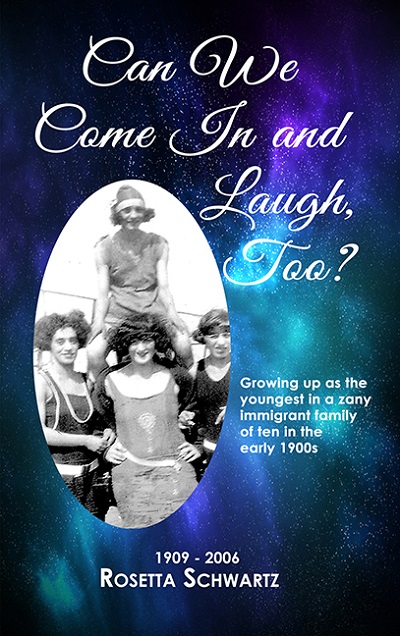
Rosetta was born in 1909 as the youngest of ten children. The family had more laughter than money and neighbors would knock on their door to ask, "Can we come in and laugh, too?"
Sherlyn Powell opens up about her love and devotion to her family and the overwhelming repercussion when communication breaks down. Heartbroken and distraught she learns to release her prayer and realize with faith God would reunite her family.
This book is an autobiographical account of the lessons I learned about life and how I was able to apply them to inspire, motivate and empower others in my own work as a firefighter, as well in my daily life as a husband, a father and a man. When I w