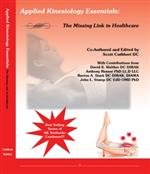
Category: Health/Wellness Publisher: The Gangasas Press
ISBN-10: 0988745208
Type: Non-Fiction
Pages: 213
Copyright: Jan 2013
ISBN-13: 9780988745209
Two New AK Textbooks offering the most validated, highly referenced, and current AK information.
This clinical resource presents the most complete Applied Kinesiology evidence base, along with updated rationales for AK management of acute and chronic health complaints, functional assessment, Applied Kinesiology outcomes-research like never before, and nutritional, meridian and biopsychosocial updates.
These texts fill an important gap in applied kinesiology and manual muscle testing literature. Clearly written and fully illustrated throughout, this text offers practical, comprehensive coverage of the AK approach to holistic health care. The basics of applied kinesiology are presented in a concise, comprehensive, and updated style – all in one volume. Over 300 pages of highly illustrated material from leaders in the field of applied kinesiology ensure the diagnostic and treatment approaches presented are up-to-the-minute and easier to follow than before.
Professional Reviews
Applied Kinesiology Essentials
Dr. Phil Maffetone’s Review of AK Essentials
A new generation of applied kinesiology (AK) textbooks is here. The first of several planned publications, Applied Kinesiology Essentials is co-authored and edited by Scott Cuthbert, DC.
Beginning in 1964 with Dr. George Goodheart’s initial work (Goodheart, 1964), the clinical history of AK emphasized the need for a thorough assessment before any treatment is rendered. This includes areas that are asymptomatic as one part of the body can so profoundly affect another. Such is the case with this textbook, which highlights manual muscle testing as a key assessment tool.
Applied kinesiology is not another technique. Instead, it offers clinicians a system of evaluation to help choose a wide variety of existing techniques that best match the patient’s needs. This assessment process strongly emphasizes manual muscle testing. AK is a paradigm—an overreaching way of viewing the needs of patients, their individuality, and how we all strive for a healthier living. This notion, of course, and how we live it out, originates in our brains, and Applied Kinesiology Essentials conveys this model very well.
Cuthbert carefully discusses the extensive reaches of AK’s assessment and treatment capabilities. These include how body and brain dysfunction, whether pathologic or, most commonly, the reversible physiopathologic state, is reflected in muscle imbalance. Through a better understanding of afferent and efferent systems, sensorimotor receptors, mental receptors, proprioception and cognitive development with it’s important motor relationships, we can better integrate this holistic approach into a unique and effective model of healthcare.
Just as important, this textbook provides an up-to-date scientific scrutiny of a vast and often misunderstood—and misused—segment of healthcare. Those employing any aspect of manual muscle testing will find it refreshingly useful, from physical therapists, chiropractors, and osteopaths, to medical doctors, massage therapists and other practitioners who incorporate any form of bodywork. This aspect of the book by itself has incredible value to help communicate the scientific strength of AK for the inter- and intra-professional exchange of ideas, and, when necessary, for local licensing boards and legal needs.
A key clinical component of Applied Kinesiology Essentials is the emphasis on muscle imbalance—the combination of abnormal muscle inhibition (“weakness”) and hypertonic muscles (tightness)—and the assessment and treatment of weakness as a primary factor. A whole chapter is devoted to the important concept that muscle inhibition is a primary characteristic of muscle pain. Included is the discussion of six types of muscle weakness: those associated with fatigue, tightness, stretch, osteoarthritis, other joint disorders, and myofascial trigger points.
A primary focus of the textbook is the proper employment of manual muscle testing and its common use for the evaluation of neuromuscular dysfunction. The first of many texts to present this basic notion appeared in 1949 (Kendall, 1993) to evaluate weakness in polio patients, and today manual muscle testing is recommended by the American Medical Association’s guidelines for physical impairment (American Medical Association, 2007).
Applied Kinesiology Essentials is comprised of eleven easily manageable chapters, each well referenced. After introducing the AK integration of complementary and alternative medicine, and a thorough discussion of muscle inhibition, a variety of manual muscle testing assessment tools are outlined, including their reliability and validity, and how they relate to neurophysiologic methods. And, as many texts are overly academic, this one includes some very important case histories that help bring the detailed information into proper clinical perspective.
There’s an important chapter on the long-standing relationship between traditional Chinese medicine and AK—two approaches that share many non-muscle testing assessment and therapeutic components, and how practitioners can incorporate muscle testing into these models.
There’s also a valuable chapter on the organ-muscle relationship that discusses the accumulation of viscerosomatic evidence. I was disappointed, however, that the extensive work on myokines and the view of skeletal muscles as part of the endocrine system was not mentioned (Pedersen, 2012). Scientists are beginning to understand the molecular effects of muscle contraction and the release of myokines, which communicate with organs, glands, the brain and other tissues. Myokines are released into the circulation during muscle contraction, even the low level of activity performed during an AK evaluation.
Cuthbert has written a textbook that can greatly assist practitioners in finding the key pieces of the often complex, and sometimes confusing assessment and therapeutic components—parts of the whole that, when better understood, can lead to more successful and faster patient outcomes.
A word of caution: This book is not an oversimplified how-to text you can follow along to make treating patients easy. It requires knowledge of the human body, but more importantly, insisting that you the reader and therapist carefully, painstakingly, assess each patient and his or her uniqueness before rendering any therapy. It’s what patients—and all of healthcare—should demand.
In addition, Applied Kinesiology Essentials does not instruct how to test each of the body’s major muscles. This is something the reader must already know or rely on other texts (although future books by Cuthbert will address this topic).
While a significant amount of peer-reviewed, indexed papers on AK have appeared in recent years, this text brings much of this information, and references, into one book combined with the essential information to more easily utilize a complex holistic approach to patient care.
- Dr. Philip Maffetone
References
Goodheart Jr. G., 1964. Applied Kinesiology. Privately Published, Detroit, MI.
Walther, D., 2000. Applied Kinesiology Synopsis, 2nd edition. Systems DC, Pueblo, CO.
American medical association: guidelines to the evaluation of permanent impairment, 6th edition. 2007.
Kendall FP, McCreary EK, Provance PG. Muscles, testing and function, 4th edition. Baltimore, MD: Williams & Wilkins 1993.
Pedersen, B., A Muscular Twist on the Fate of Fat. N Engl J Med 2012; 366:1544-1545.