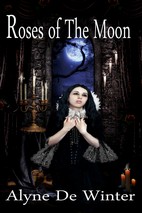
For all of her young life, Lady Mara has been plagued with nightmares brought on by strange, frightening noises echoing up through the stairways and vaults of the labyrinthine Castle Szeppasszony in the depths of night. When, at age 16, she finally discovers their origin, the bloodcurdling secrets of the castle's beautiful lady, Countess Orzsebet, are dragged out into the light of day. Revealing these horrors brings down curses, chaos and war, opening the way for the long-exiled Dragon People, the evil Royal Zsarkany, to return. How does Lady Mara survive when all she loves is torn from her, and a dark and terrible future is all she sees?
Set in early 17th century Hungary under the dark cloud of looming invasion by the Turks,Roses of the Moonis a literary tour-de-force, a fairytale set in a dark time and place
where epic forces of evil seem set on annihilating all that is good in Mara's world. As a lonely young girl, Mara comes of age in a secluded castle tower, her devoted nurse her only friend. Timid and neglected, little Mara spends her early years enduring heartbreak and disturbing dreams, terrorized by mysterious night sounds rising through the castle walls. An inner strength and goodness fortify Mara as she emerges from these difficult years to take control of her life as a feisty teen, defying the conventions of her restrictive upbringing.
Determined to learn the dark secrets of the castle and confront the evil forces gathering around her, Mara sets out on a mission of discovery. Why do the women from the village keep disappearing? Why is she drawn to the roses in the castle garden that grow under the glow of the moon? Why does her mother, the beautiful Countess Orzsebet , treat her with such contempt? Will she be forced into a loveless marriage in order to secure an alliance for her noble family? What is she to do with her wayward heart whenever she is in the presence
of Szander, the handsome young hussar? And what mysteries lie within the
innermost curtain wall where the golden Lucifer tree sheds its luminous flowers?
With Roses of the Moon, Alyne De Winter has crafted a beautiful and compelling coming-of-age tale in a lavishly-created world where hints of supernatural horrors slowly reveal themselves within the walls of a gingerbread castle. The writing, which is crisp and gorgeous, lovingly describes Mara's world with both broad and nuanced strokes of lush prose. With its cast of unforgettable characters and apocalyptic themes of good versus evil, this book pulls you in
and doesn't let you go. You will be turning the pages far into the night, and you will fall in love with Mara.
Created as the first installment of what is to be an epic series, Roses of the Moon holds its own as a stand-alone novel, and is sure to become a classic.
By:
Cheryl Nance
Excerpt
An army of white towers rose up against the dark forest. Circled by ravens, crags and three lofty, white curtain walls, Castle Szeppasszony was a baroque pearl nestled in a vast, green cradle on the Mountain of the Moon. At the very center of the castle, deep in the inner yard, was an oak grove, and in the midst of the oak grove was the wall-without-a-door that compassed about a single tree called the Lucifer tree, and its garden. The castle itself was built in a great O; all its towers and houses were connected by parapets above and corridors below, by secret passages between and enclosures beneath where things took place that one must never mention for fear of being called over-imaginative or mad.
If you stood on my balcony at the top of the Trefoil Tower, built into the castle wall, you would see, just below and to your left, the main gate and the road snaking down through the plum orchard to another gate in the first curtain wall. Beyond that gate was a large park called the killing field, though I had yet to see anyone killed there. From the road, a lane branched off eastward, up through the woods, to our small but productive vineyard, and another forked west toward an ancient herb garden with crumbling walls and plants rooted so deep into Faerie that the air was thick with spirits.
Beyond the gate in the second curtain wall, the land tumbled down in terraces to the edge of the chasm where the River Kigyo roared around us like a dragon chasing its tail. On the other side of the river was the third curtain wall with its drawbridge and narrow-turreted barbican. Out in the valley, the village of Eiliria knotted itself for safety around the Cathedral of Our Lady of the Angels. Its fields and orchards were all bound round with sagging rock walls that had to be constantly reinforced to keep the forest creatures and hungry night spirits out. Deep in the valley forest, beyond the village walls, the Stream of Tears meandered south like a thread of light, toward the dark foothills of the Carpathian Mountains.
We were indeed well fortified on the Mountain of the Moon, safe from our enemies, the Turks, who ravaged the lands around us but had not as yet dared to enter our realm full, as it was, of enchantments.
At nine years old, I was a religious child. A walking icon of the Holy Virgin, dressed in dark blue, red, silver or black, my dark hair in a long plait down my back under a crown-like jeweled and velvet parta. A large, ornate crucifix, chains of saints’ medals, scapulars, and rosaries shielded me as if my young, innocent soul were on the very brink of Hell. We were Roman Catholics holding out against entrenched Orthodoxy, Protestant incursions, assaults by the Ottoman armies of Mohammed, learned heretics, and witches that charmed the trees and birds and other wild things of the forest. Castle Szeppasszony was the last bastion of God’s Glorious Word teetering on the edge of doom.
One winter evening, I was in a small cobbled courtyard with a doll that was no plaything, but a protective shield, meant to take any harm that might come to me upon itself. I was admiring how the ice-cold waters in our unicorn fountain froze in the air like silver ribbons when I heard a mysterious, golden voice ringing down an eerie minor scale. The voice captured me, and like a net, drew me into the forbidden wing of the castle, to a door that was always closed to me. Red firelight streamed under its lower edge, a snort of dragon’s blood incense seeped out. The beautiful voice took me under its spell, then slowly faded away. The emptiness was filled with a chorus of deeper voices, chanting.
Crushing my doll to my heart, I reached for the knob and pushed the door open just wide enough to see clouds of gray smoke scintillating with brilliant fires of candle flame, and through the smoke, disembodied faces, white and stark with shock, staring at me. A shrill, imperious voice erupted from within, cold in its fury:
“Mara! Get away from the door!”
I fell back, and as if lifted by a whirlwind, spun down the corridor until the points of my shoes caught in the swirling hems of my skirts and tripped me to the floor. Lying winded for a moment, I glanced around for my doll. She was gone! I looked back and saw her small dark shape lying in a wand of firelight that flashed along the upright edge of the door, wedging it open upon the private chambers of the Countess Orzsebet.
I crept forward thinking that I might have time to quietly retrieve her, when someone in the room snatched her up.
There was a flicker of silence. Then, the door slammed open, and in that shaft of light, the profile of a beautiful mask appeared, surrounded by an elaborate circular neck ruff. A glimmer of bright fabric rained down from the mask to the floor, and a single hand curled there around the handle of a long whip. The mask slowly turned to face me, its eyeholes stared in my direction, and the ruff fanned out around its head like the neck feathers of a great bird of prey. The figure drew swiftly back into the room and out of sight, only to reappear and gaze at me again.
Captured in the beams of what I knew were the Countess’s eyes, I froze like a mouse in the witch grass waiting for the descending hawk. She walked toward me with a smooth, gliding step that reminded me of the serpent that slithered into my chamber in the night and hid beneath my bed to escape the winter cold. The eyes behind the holes of the mask bore down upon me, baleful and fiery blue.
She towered over me holding the bloodcurdling cattail aloft. As if she carried the fire within her, the mask glowed hot, motes of light sparkled in her red-gold hair, her jewels twinkled like dragon’s eyes, and her ruff stood out around her head like the rays of the rising sun. The voice of this glowing creature was hollow, distant, and cutting as the north wind.
“Mara, you are forbidden to enter here. If you tell anyone what you have seen in my private chambers, your fate will be thus.”
She snapped the whip. I shrieked. She threw my doll at my feet, wheeled around, and floated back to her chambers. The long train of her gown was stained crimson and left a faint odor of blood in the air....
Professional Reviews
Dreams of Blood
"This is an intricate Gothic-horror fantasy that tells the story of Lady Mara as she grows up, a neglected princess in a labyrinthine castle haunted by evil. Basing her story on the legend of Countess Bathory, Alyne weaves a complex web of ritual, mysticism and dark magic that gradually builds up an intense mythology around the mysterious Lucifer Tree and the dragon-queens of old who worshipped gods that existed long before the birth of Christ.
Whose are the screams that echo through the castle walls at night and why does the Countess insist that all the roses within the castle be destroyed?
Beautifully written, The Roses of the Moon is a magnificently visualised, claustrophobic world of great beauty and great horror that builds to a disturbing climax. If you like Gothic Horror, this book is a dark jewel that you will greatly enjoy"
Simso
A Highly Imaginative and Memorable Fantasy
"This is a remarkable book, the creation of a whole world, set in seventeenth century Hungary, and envisioned in brilliant detail, lovingly evoking all its flora and fauna and rich pagan lore. And it's the intensity of the author's vision and linguistic flair that makes this synthesis of the historical and the occult totally credible within the genre, especially as related via the viewpoint of the young Countess Mara, who always engages the reader with her wit and pathos. The story combines a folk-tale element - the fairy tale of Snow White- with the grim legend of bloodthirsty Countess Bathory. There are parallels with other writers in the fantasy genre like Angela Carter or Mervyn Peake's Gormenghast novels, for Mara's Castle Szeppasszony has an overwhelming presence and operates as an active force in the story. But Alyne de Winter has fused these elements together in a totally original way."
Paul A. Green - author of The Qliphoth (Libros Libertad) and The Gestaltbunker (Shearsman Books)
Imaginative Gothic Fantasy
This is intelligent, well-conceived fantasy. I appreciated the setting in Hungary against a backdrop of invading Turks, and the elaborate Castle Szeppasszony (a sprawling structure similar to Ghormanghast). It is interesting to follow the girl Mara as gradually she comes to comprehend what her mother, the Countess Orzsebett has been doing all these years, although this reader did wish at times that Mara would have come to this realization sooner. There are interesting, original depictions of magic; my favorite centered around the otherworldly (and mad) Zsarkany. Magic itself is an interesting component of the story, subdued and hinted at mostly throughout, and blending with the growing Mara's imagination so that it is hard to distinguish between what is her imagination and what is magic. Compelling characters exist in her father particularly, but also her love interest, Aleszandor. The novel is patient with itself, developing the story carefully...leading to a memorable finale.
Pray for the light. Pray that you last that long. The Long Hour Before Light is a classic collection of Horror tales, re-mastered by Champagne Book Group