Kindle Edition
Amazon
Geza Tatrallyay
Category:
Poetry
Publisher: P.R.A. Publishing
ISBN-10: 194141608X
Type: Non-Fiction
Pages: 122
ISBN-13: 9781941416082
Price: FREE! (eBook)
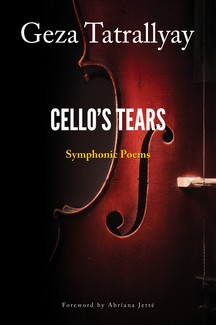
While poetry often uses precise phrases and carefully constructed stanzas to create a kind of written music, author Geza Tatrallyay ups the emotional and structural ante through literary translation. The result is Cello’s Tears, a testament to universal truths that is unhindered by the constraints of a single language.
I wrote the poems in this collection over quite a few years and in the many countries where I have lived. The influences therefore are varied, insofar as they derive from the different cultural, linguistic and natural contexts.
Thus, when I lived in Japan, I experimented with the sparse rigor of expressing a feeling in the seventeen on of the haiku, and the five units and thirty-one on of the tanka. Japan also spawned the several poems entitled Japanese Feeling I & II. Montreal is clearly the birthplace of Jogging on Golgotha, while bucolic Vermont gave rise to The Cemetery, Frogs in a Pond, Evening: Heron and Pond and Squirrel among others.
The one common thread in the collection is the exploration of poetry as translation. In the first instance, poems can be seen as the translation, or the encoding of raw emotion into words. I then go beyond this, and in some of my work explore translation from one language to another, which involves the de-encoding of what is written in one language to get at the feeling behind the words in the poem and then re-encoding that into words in the second language. Examples of this are: A Wanderer’s Evensong, the lovely little poem written in German by Johann Wolfgang von Goethe, my own Autumnal Question, first written in Hungarian and then in English, and the enigmatic French Canadian poet, Émile Nelligan’s Vieux Piano or Old Piano.
It is but a short step from translating works between languages to trying to translate the feeling encapsulated in another art form into poetry. Many of the poems in this collection are such attempts to re-encode in words the emotional meaning or existential angst or unique world view— always very personal—behind works of music (Death strikes up…, On Hearing Mahler Once Again, Valse triste et sentimentale), painting (Tableau: Last Judgment Revisited, Fragment: reaching, Distant searchlights…, Query) and sculpture (Creation).
In some works, I experiment with language—thus, Fragment from a Dying Civilization, Imbroglio, On Propaganda and Warning deconstruct words to enhance the message, while in others, unconventional word use attempts to do the same.
And lastly, since poetry is verbal music, I have organized the collection into four parts, much as the symphonic form has four movements. Parts II and III respectively comprehend the works influenced by music and the visual arts. The collection ends with Dollops of Drivel, which tries to convey the Wittgensteinian frustration with the inherent impossibility of communicating the fullness of one’s feelings.
Excerpt
Echoes
The distilled soul’s silent song
yearns to break out, to penetrate
the evening’s thickening mist
toward the distant lightning
where shadows play momentous games:
my song remains an intention—
it cannot escape this deep well.
Oh, these echoes reverberate
sonorously, like cello’s tears
streaming among silhouettes
in this useless melancholy.
|