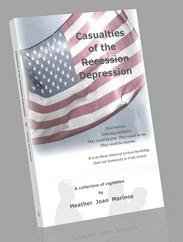
Category: Mainstream Publisher: LEXI Communications, Inc.
ISBN-10: 0988755904
Type: Non-Fiction
Pages: 158
Copyright: March 7, 2013
ISBN-13: 9780988755901
Word snapshots of real (and sometimes raw) moments experienced by people who have been adversely affected by this long economic downturn - namely, the middle class. By capturing these brief episodes and providing a written backdrop for each year (in the form of an economic and political commentary), the reader can see the transformation and progression of this (Recession) Depression - from its conception to its continued existence in the present day.
"Has economic activity returned to close to normal levels?"
Did the "Great Recession" really end in June 2009?
Is the American economy in a recession, a depression, or on the road to recovery?
Do our political leaders and economists truly believe what they are saying, or are they deluging us with "feel-good" marketing rhetoric?
In her own evocative and mince-no-words style, Heather Joan Marinos argues that American economic activity has not returned to close to normal levels.
Through a writer's lens, we catch a glimpse of some of the poignant moments in the lives of the people most affected by this economic downturn ― the middle class. Heather takes the reader on an American odyssey from 2006 to the present day, through a collection of vignettes and scenes, and some passionate commentary along the way.
It is, after all, the people who tell the real story of our economy.Their challenges and triumphs are not rhetoric. Their resilience and humanity is what gives us hope for a prosperous and triumphant future.
Excerpt
Partial excerpt from the Introduction:
"We have been told that the so-called 'Great Recession' began in December 2007 and ended in June 2009. Political pundits would have us believe that our economy is on the slow but certain road to recovery. Tell that to the one in seven Americans who, today – in 2013 – survives on food stamps... or the professional who has been unable to find work for well over three years... or the family that lives in a makeshift tent. Yes, indeed, we witnessed the exuberant rise of an American economy and some of us profited handsomely from it, embarking on a spending orgy that knew no limits. But, as with every over-inflated bubble, we knew the day would come when the economy would go bust. And when this happened, it left millions of casualties shattered across the nation. Not to be confused with the chronically poor and homeless demographic, these men and women instead represented a cross-section of the middle class. They were (and still are) the new faces – not of the "Great Recession" – but of a twenty-first century depression, one that continues to this day. And, like any progressive malignant tumor, if we continue to deny its existence, the end result will be catastrophic."
AMAZON: **** Poignant narrative
"Casualties of the (Recession) Depression by Heather Joan Marinos is a remarkable juxtaposition of historical and economic analysis and poignant narrative. Marinos echoes what many renowned economists have been saying regarding the recent financial crisis, that it is not over and that the so-called recovery has not benefited the majority, but she does so by recounting heart-wrenching stories of the people most affected by persistent joblessness and lack of opportunity. Interestingly, it is not the very poor who feature most prominently, but the middle class, who began "a juggling act" at the outset of the crisis and have been juggling ever since. Despite the discomfiting nature of many of the vignettes, Marinos still manages to communicate hope in the future. More Ehrenreich than Krugman, Casualties of the (Recession) Depression is a welcome addition to a growing body of work that highlights the troubling economic predicament of average Americans."
AMAZON: ***** Emotional, Raw - Could Not Put This Book Down!
"The title of this book captivated me. Very few people are willing to admit that the economic situation in the USA and elsewhere is not just a recession, but in fact, a depression. The vignettes in Casualties of the (Recession) Depression were short but very powerful and emotional. I cried, and because of the author's ability to show what is really happening during these dark economic times, I continue to feel the utmost compassion for what many of us believe is the rapidly dying middle class of America.
This book is not for everyone - no, I believe some people won't get it - the subtlety of the lessons one could glean from the book won't be apparent to those who believe there is nothing wrong with the status quo. Many people place their faith in banks, corporations, etc., and think nothing of extending their credit and carrying huge amounts of debts. After all, if our governments are in debt and get away with it, why can't we?
Casualties of the (Recession) Depression is a book that did for me exactly what I think the author wanted to accomplish, and that is to get the reader to think. With me, she succeeded, and for that reason alone, I give her 5 stars!"
AMAZON: **** a really unique way to look at a tough subject
"This is a small book but it's got big impact. I found the mix of vignette and informative background to be quite unique. The combination really puts the economic issue into context. Can't wait to see the next work from this new writer."
Hearts of Gold
Synopsis
by
Frank P. Whyte
Portland, Oregon is known as the City of Roses. Of course that’s an odd name for a city whose mere mention conjures images of driving winds and torrential ra
The Wholly Book of Exodus is humorous adult literature that features adult language, situations and content. It is the companion book of Jay Dubya's The Wholly Book of Genesis that satires the entire first book of the Bible.
The Wholly Book