Category: Historical Fiction Publisher: Fresh Ink Group
ISBN-10: 1936442108
Type: Fiction
Pages: 205
Copyright: April 26, 2012
ISBN-13: 9781936442102
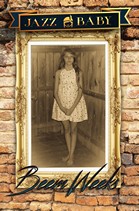
A young teenage girl comes of age among the seedy streets of 1920s New Orleans.
While all of Mississippi bakes in the scorching summer of 1925, sudden orphanhood wraps its icy embrace around Emily Ann “Baby” Teegarten, a young pretty teen.
Taken in by an aunt bent on ridding herself of this unexpected burden, Baby Teegarten plots her escape using the only means at her disposal: a voice that brings church ladies to righteous tears, and makes both angels and devils take notice. “I’m going to New York City to sing jazz,” she brags to anybody who’ll listen. But the Big Apple—well, it’s an awful long way from that dry patch of earth she’d always called home.
So when the smoky stages of New Orleans speakeasies give a whistle, offering all sorts of shortcuts, Emily Ann soon learns it’s the whorehouses and opium dens that can sidetrack a girl and dim a spotlight…and knowing the wrong people can snuff it out.
Jazz Baby just wants to sing—not fight to stay alive.
Professional Reviews
LL Book Review
Imagine a coming-of-age protagonist who is a mix of Scout Finch (a few years older) and Holden Caulfield (a few years younger), navigating an adult world of Blue Velvet type characters. Reading Jazz Baby, a distinctly Southern novel by Beem Weeks, one can’t help associate other literary works and films; yet this remarkable novel manages to etch out its own identity.
Pubescent and pretty, precocious and impetuous, Emily Ann (Baby) Teegarten is growing up fast in Rayford, Mississippi in the Jazz Age. There she harbours grand aspirations to sing jazz in New York. Her parents are encouraging but too poor to help on their own. A rich couple offers to take Emily Ann to a church in Jackson to audition for a scholarship. She sings beautifully but sounds, “a bit too Negro for a white child,” according to the pastor. When the pastor adds that they can, “train that heathen tone from your voice,” Emily Ann`s reaction, while saving her integrity, ruins any chance at a scholarship.
A family friend, Tanyon Thibbedeaux, plucks her away. At least he appreciates her talent for what it is and envisions her singing at speakeasies across the river, in New Orleans. He also breaks the news to Emily Ann that, during her absence, her father died. Furthermore, the death was at the hands of Emily Ann’s mother.
The orphaned girl is taken in by her righteous, but loving and stable, Aunt Frannie. This complicates Tanyon’s and Emily Ann’s plans. But she’s a clever girl despite her age. She discovers how to use her sexuality—which carries more value than real money in Rayford—to get friends to help distract her aunt so she can get away on her excursions with Tanyon to the Big Easy.
New Orleans speeds up Emily Ann’s growth as she encounters people for whom money is more important than sex, particularly big time gangster, Frank Rydekker. She’s there to sing but many people eye her for another profitable vocation. With the help of Tanyon, her de facto guardian now, Emily Ann manages to steer clear of real trouble for a while. But when Tanyon betrays her to save his own hide, she’s forced to fend for herself in a volatile world of prostitution, booze, drug use, and some hardcore men and women ready to use and abuse her.
It’s a hard story. But what comes through so wonderfully in all this is the first-person voice of Emily Ann. Nothing’s held back; no self-consciousness. While her unbridled and indiscriminate sexual thoughts might give pause to some readers, they shouldn’t, because there is no hint of gratuitousness. Emily Ann’s immaturity keeps her perspective so natural, ironic, and even humorous. Sad too, such as how she struggles with her feelings for her mother when Emily Ann visits her in jail:
Raising a child had never occupied a foremost spot on whatever agenda guided Mama’s life. I reckon in her eyes motherhood appeared as one of those strange abstract paintings that mostly confuse folks as to the artist’s intentions. All those whispers of “She’ll grow into it” faded like worthless cobwebs by my tenth year, when the woman still showed no interest in helping me along. And I ain’t even mad at her, neither. Some women just ain’t meant for mothering.
I only wish she hadn’t taken Papa away.
The mix of characters is another terrific aspect of this novel. Many would be unlikeable in real life but their self-serving actions are understandable in the context of their situations. We pull for Emily Ann but we kind of get those who intend her harm, or at least we can’t hate them. They are what they are, very much in the Flannery O’Connor sense.
But not everyone is out to do harm to our heroine. She develops good connections with various people—some of whom meet with tragic results—who provide some redemption of humanity for her.
But it’s Emily Ann who truly comes into her own. Only a tough and honestly portrayed character such as this could survive all she encounters. In The Virgin Suicides (book and film), Cecilia declares to the physician who stitches up her wrists after her attempted suicide: “Obviously, Doctor, you’ve never been a thirteen-year-old girl.” The author of this novel, Beem Weeks, obviously is not a 13-year-old girl either, but he sure narrates convincingly as one.
Jazz Baby is intense, raw, erotic, violent, and often uncomfortably sensuous, which makes it so different from To Kill a Mockingbird and Catcher in the Rye . But like those classics, the protagonist is fresh and compelling, her story brilliantly conveyed. One of the most accomplished self-published works I’ve read.
Christoph Fischer
“Jazz Baby” by Beem Weeks is a very authentic feeling and atmospheric novel set in 1925 New Orleans. The dreams of a young white, talented Jazz singer, are slightly shattered by family tragedies and other obstacles in her way to fame. Story telling from a young voice often has the quality of honesty and rawness that befits the at times bleek or sad character of the book.
Weeks captures the colourful and varied aspects of the place and time wonderfully, just as we would imagine it: A young girl’s naive dreams of fame in New York and the famous Jazz clubs, the ongoing prohibition, latent or obvious racism, the Southern accent and the harsh, rough and seedy sides of the city and of those circles aspiring to become famous artists.
There is quite a lot of sex in the book – Jazz baby also has ties with a brothel and mixes with some drug users while growing up and pursuing her dream.
I enjoyed reading the book and got through it very quickly. There were times when the authentic use of the accent felt maybe a bit too much for my European ears and I wanted the story to go on for a little longer.
Technically and stylistically however the book is of high quality, well paced, plotted and told and with carefully and lovingly constructed characters that stayed with me long after I had finished the book. This is great novel from an author to watch.
Sienna Rose
Jazz Baby reminds me of the time when I, as a small child, peeled open my very first pomegranate. Hidden beneath the unassuming skin I discovered a treasure of sparkling, edible ruby-red jewels that felt smooth to the tongue and when bitten, burst into a luscious sweetness with a tart, sassy edge. So too with Jazz Baby!
In the interest of disclosure I offered to review the novel for author, Beem Weeks, and was forthwith gifted a paperback copy (since I’m an old fogy who hasn’t broken down and bought a Kindle or other reading devise). I hefted the small book-only 205 pages-in my hand, admired the cover and commenced to reading. From the first pages, the voice of protagonist/narrator, Emily Ann A.K.A. Baby Teegarten demands your attention with the raw power one would expect of a character who is a natural born vocal artist. It is easy to imagine her belting out soulful tunes to the accompaniment of various rag-tag “colored” jazz musicians, who more than make up in spirit for what they lack in musical training.
The novel is set in the deep South during prohibition, in a backwater place called Rayford, Mississippi, with forays over the river to New Orleans where drinkin’, druggin’, whorin’ and the occasional murder are inextricably entwined with the jazz scene of the speak-easies. The language is so southern that as I read, I could almost feel the heat and humidity rise, and swear I smelled a hint of swamp water wafting in. Perhaps it’s due to the languid climate, or maybe it was something in the water, but for Emily Ann, just about everyone she encounters (‘cept maybe Aunt Frannie) – from the Choctaw Indian boy who works in the garden to the colored help, a girl about her own age— whips up a lust in her loins. I declare, belts come a-loose and panties flutter to the floor like magnolia blossoms in a stiff breeze.
There are moments when Mr. Week’s writing danced with its back to an erotica cliff, one foot over the edge and the other on an oil slick; truth be told, I think he fell off more than once, but that’s for you to decide. (If you have curious children about the house, you might want to stash the paperback in your sock drawer and read it after they go to bed.) In any case, I can just about guarantee that you will not be bored. The tempo is steady and throbbing as a hot jazz tune; the characters and their adventures are as wild and dangerous as a swamp full of alligators (oh yes, there is a scene with a gator!) I couldn’t stop turning the pages and finished it the second day.
In the final analysis, Apples are good for leaving on the schoolmarm’s desk, but pomegranates, well…they’re for something else altogether, so go ahead and drink in the sumptuous juice of Jazz Baby.
Based on the memoirs of a Pearl Harbor survivor. Letters from two pen pals take the reader on a journey into the past, a past where nightmares came true, and when hatred reigned.
Fourth Book in the Southern Swallow Series finds the Academician Li K'ai-men in exile on Hai-nan Island. China has a new invasion threat. A showdown between ingenuity and technology explodes as the Sung Dynasty tries to preserve itself.