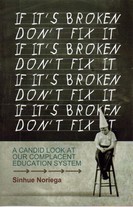
Kindle Edition
Amazon
get a copy IF It's Broken Dont Fix It
amazon
barnes and noble
Category:
Education/Training
Publisher: Penguie Press
Type: Non-Fiction
Pages: 240
Copyright: 2013
ISBN-13: 9780615901756
Price: $3.00 (eBook)
as a man of many journeys. When he is not writing, he is teaching inside the classroom.
Over the past few decades, we have seen a rapid decline in our education. The Department of Education spends tens of millions of dollars towards improvements, yet test averages continue to decline at an alarming rate. The question they will not answer is: Why our students are still failing despite all the efforts? Learn the incredible secrets they don’t want you to know.
From inside a women’s correctional facility, to the small town public junior high, a teacher on the “inside” takes you on a tour of our pubic education system and exposes they hypocrisy of the philosophy: “they preach what they don’t want you to teach.” Districts are businesses only interested in a mediocre raise in score, while fronting a façade of ideals. The system stands accountable to no one, and earns a profit for each student, while obvious solutions are steamrolled by bandage fixes. Learning has become a systematic breakdown of dull mechanics rather than a meaningful and rewarding experience.
A call for accountability is being voiced by our nation’s parents. Disillusioned educators are given disappointing rhetoric, and nothing serious is being done.
We cannot stand idly by to see our children grow up in the shadow of what was once this nation’s glory. You are called to stand, to hold your ground, and not give way. We must take back our youth’s education for the sake of our nation. The idea is simple: To believe in the education of the mind, not in a distorted definition that leaves a bitter taste in our youth.
Excerpt
Before the Madness
Years ago, before NCLB, our system was not perfect, but it still produced a mediocre citizen and a pretty good society, along with a few extraordinary individuals as a byproduct. And meritocracy was great, when you understand the alterna-tive. Sure, we were at the cliff’s edge, looking down, and start-ing to slip, but we were nowhere near where we are today. Children went to school, did their homework, for the most part behaved, and became capable of self-sufficiency. Gradu-ates went on to work, and our education system was stable.
Now, after the gears have rusted, and the pistons have all sprung a leak, the system only produces dysfunctional citi-zens, along with a few average citizens as a residue amongst the grime. Everything has come to a grinding halt. Schools are proving grounds for delinquents with a pink slip. Our graduates leave without skills for jobs that no longer exist. Not only did we end up losing those that fell through the cracks, but the crack turned into a gorge and everyone else fell in.
In March 2011, Secretary of Education Arne Duncan told
Sinhue Noriega
73
Congress that more than eighty thousand out of the nation’s one hundred thousand public schools could be labeled as fail-ing under No Child Left Behind.
So what happened to the rest of us? We were told that we no longer fit on the bus. It was jam packed with 504s and every kid from the local precinct. What happened next was everyone’s guess.
The new millennium was the era of discovery. We discov-ered that special was treated—well special, and everyone could be special if they wanted to be. No one wants to be left behind, so everyone hoped on board the “special needs” bus. Referrals filled every school and every district across the na-tion.
The lucky thing was that there was a new sickness that everyone could have, as long as you could say you had a diffi-cult time paying attention in class. (In the 1980s we called it boredom.) Mothers everywhere saw rays of hope at the end of the bleak tunnel.
The acronym ADD soon became a common phrase in the academic world. Despite the bad manners, there were no more Johnny-be-bads, just kids with ADHD. And there would soon be entire districts focused entirely on alternative education.
It is no secret that ever since NCLB came into existence teachers everywhere have been complaining, and for good reason. Stress and worry have replaced those former years of glory when a teacher could really teach. The animosity be-tween the test, teachers, and administrators has grown tre-mendously. What used to be a neutral relationship of mutual respect has withered into an antagonistic coexistence where educators complain behind closed doors, and administrators continuously harass educators with their countless lower level
If It’s Broken, Don’t Fix It
74
techniques that they erroneously believe will raise test scores.
Where Has This All Led Us?
NCLB did not bridge the education gap by bringing lower-end kids towards the top, but rather it narrowed the gap by pulling the top down. The result of targeting at-risk kids is that the number of at-risk students has now exponentially multiplied. Teaching for the test, along with targeting failure, has generated a massive landslide in scores.
Since NCLB began, our numbers have dropped and kept on dropping. 2011 statistics show that over ninety percent of all schools in the entire state of California are in program im-provement today. More than half of those are second or third year into their program improvement. Most states share simi-lar troubles. The New York Post and The New York Times have both written extensive articles about its state’s test troubles over the years. In October of 2009 the Post reported that “Federal test scores cast serious doubt on state results that suggest big gains in New York. The feds say just forty percent of fourth graders cut it in math—not eighty percent, as Alba-ny claims. Worse, New York’s fourth graders are actually be-low their level of two years ago on the federal exam, despite huge “gains” on the state test.”
Pushing teachers to teach the test has hurt us more than it was envisioned to help. As NCLB winds down, something else looms on the horizon. But change is slow, and districts continue to push what they have become accustomed to push. Barack Obama in his 2012 State of the Union address had this to say about the system: “Teachers matter. So instead of bashing them, or defending the status quo, let’s offer schools a deal. Give them the resources to keep good teach-ers on the job, and reward the best ones. And in return, grant
|