
Kindle Edition
Amazon
Amazon
Category:
Action/Thriller
Publisher: Create Space
ISBN-10: 1530264936
Type: Fiction
Pages: 304
ISBN-13: 9781530264933
Price: $6.00 (eBook)
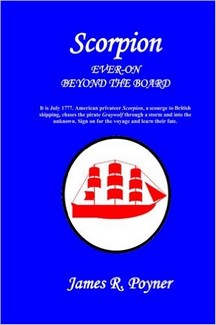
"Scorpion" is an American privateer from 1777 that chases a pirate into a storm, and then never returns. Will you sign on?
If you think about it, a ship and her crew can easily be seen as a micrososm of how a nation should go about its business, The three parts of a person--strength, mind, and heart--are each called on by a sailor, and if that mariner is encouraged to readily use all three parts, then that sailor will be most able. Imagine then, what a ship crewed by such sailors would be like, especially if that ship is endeavoring to preserve the nation represented by its flag. Reading "Scorpion" will introduce you to just such a crew. So go to Amazon, and either order the paperback or get it for your Kindle.
Excerpt
Chapter I
A Summer Day
IT WAS A wonderfully blue Summer day in seventeen seventy-seven, with the sea air and the light spray, both regularly tossed over the bow, refreshing to face and soul, much like our occupation. That blessing of good weather, of course, made it the sort of day that brings out the best in all of us, particularly those whose profession is traversing the seas, great rivers, and broad lakes of the world. Yet, regardless of our life's course, sailor or not, officer or man, lad or lass, we all shine with happiness, and find our daily tasks infinitely easier, when the weather is just right. At least, those of us endowed with good hearts and minds do.
Unfortunately, not all good-hearts are brave enough to shine and carry out their arduous tasks amid the darkest of times, nor are all good minds clever enough to challenge the wily servants of evil. Both may—and will—try. Bless them for that! The men of Scorpion, however, were brave enough to meet such tasks and foes because our loyalty to each other—and to our infant nation—was absolute! We had the heart and the steel to stand up to villains, or at least, to challenge those who would deny us our freedoms. That was part of our calling, as well. After all, a good storm of Nature—Who is by no means evil—can challenge a sailor, just as surely as any leaded-storm brought on by other humans. We were ever ready to stand up to either, and so, we plied the water as resolutely as the tide climbs the shore. To my mind, there was nothing that could deter us from travelling our well-established course.
We would follow it. We would live or die by what we found along the way. We would accept, without apprehension, the tests of man and Nature. Fill our sails, then, and away! Roll on—roll on! Roll ever-on!
The ocean off Boston, in July 1777, seemed far-removed from the main war, far-removed from the chatter of infantry muskets and the boom of field pieces, but then, that war, the one for American independence, was characterized by many side-shows, thanks, in part, to the young nation stretching about a thousand miles along the Atlantic Coast. Scorpion's part was the same as that of the several other barks that were armed with two-dozen twelve-pounders and a brace of three-pounder swivel guns on the bow. We were to dutifully harass enemy shipping, while endeavoring to avoid traps, since we could ill-afford to lose even one ship.
As a privateer, we patrolled the shipping lanes, took prizes, and usually escorted those ships to Boston, where they and their cargo were sold through auction to help finance the war. Our operations demanded that we be both brave and clever. Further, the British, who were by no means servants of evil, were, first of all, our enemy, and more, they did not lack for good minds to lead them in military affairs. What is more, they were intent on denying us both the independence we had declared, and the liberty sought by that declaration. Defending all of that and our young nation was enough for most of us.
Another thing my crew and I had to routinely exhibit, in order to succeed with our mission, was strength in all three human aspects. We had to be able to endure all the physical hardships associated with running a ship: furling and unfurling sails, turning the windlass to lower or weigh the anchor or lade things like gunpowder, working the pumps to counteract a leak, pulling at the oars of a long boat linked by cable to the bow of the ship when Scorpion was becalmed, and a myriad of other strenuous activities, each a task for our physical aspect.
Oh, now and then someone would complain that a task was hard, but never would he refuse to complete it, not even if he was condemned to get down on his hands and knees and scrub all of the main deck. He would try to complete the task, and that might have been enough for me, never mind if for the last several years none of the crew had ever behaved so poorly for such punishment to be even considered. As Captain Whyte had counseled, the willingness to try meant that that man was still a dedicated part of the ship and crew, while of course, willingness was bound up in strength of character, in his heart, a second aspect. What more can a Captain want?
To the man, we each recognized the importance of performing our tasks without fail, no matter how insignificant or menial they seemed. To not carry out a job meant letting down the entire crew, and that was not the sort of failure that a responsible, caring man wanted to have attached to his name. No, we each had our duties, and we each fulfilled them, no matter how much they taxed either our strengths or our willingness! Yet, by working together, our strengths became combined, and so, the tasks were made easier.
Then, in addition to our physical duties, there were the many parts that had to be played out each time we went into action. Again, physical strength was called upon, along with a goodly amount of energy. Once we went into general quarters, cannon balls, kegs of powder, and the like had to be brought on deck using the windlass-powered winch, and then they had to be distributed to the gun crews. For each of the latter, handling their piece meant employing a good amount of strength and energy while using both with efficiency that translated into speed, and with accuracy that translated into a well-landed blow.
A harness of rope and pulleys, called a block and tackle, was bound to each cannon. Used to hold its gun in place during bad weather, the device was primarily used to move the gun in and out of its port, in much the way a stable hoist was used to raise sacks of feed or bales of hay up to the loft. For each cannon on Scorpion, two or more men tugged at the ropes threaded through the pulleys. First, the gun was pulled back, a swab laden with water was shoved down the muzzle to clean the inside of the barrel, wiping out any lingering sparks in the process, then powder and a twelve-pound iron ball were run down to the breech and tamped in place, and finally the cannon was wheeled back into its port and aimed, raising or lowering the barrel at need with the elevation screw mounted at the end of the gun's carriage.
Then at the command, Fire, a long match was set to the breech hole, and seconds later, the cannon boomed out its ball and recoiled. Again, the piece was pulled back, swabbed, reloaded, and returned to its firing position. A good gun crew could be set to fire again in five minutes, the time it takes to twice swing a ship a hundred and eighty degrees, or to turn two broadsides. Scorpion had the agility to make such a pair of pivots in four minutes, and her gun crews never failed to be ready. Then, on those occasions when it was impossible to turn the ship, usually because of a countercurrent or a contrary wind, the number of men on the harness was doubled, while other members of the idle gun crews stood ready to assist in anyway that they could.
Aye, there was a lot of physical exertion that went into working each piece, and with two-dozen cannon, that meant that a lot of men, almost a hundred—four per gun—had to be employed to fight a battle. Still more would be aloft, and at least one would be at the helm. Not surprisingly, the gun deck could become very chaotic during a fight, and as a result, all sense of order and duty could easily be lost…unless the crew was well trained and disciplined!
For the British Navy of that time, too-often discipline meant breaking a man's spirit so that he became no more than a dumb animal capable of being taught to perform certain duties, without failure…and without question! For the young American Navy, discipline was much milder. We did not want to break our men. Instead, we wanted them to be alert and quick thinking, because we were convinced that that would ultimately give us the edge. So, we trained them as best we could, and when a man needed to be punished for a minor offense, punishment would be in the form of a constructive task, such as white washing the top of the mainmast.
It was particularly then that the man's willingness to try became a factor. More serious matters usually meant court martial, demotion, or even time in the brig. That my crew worked as well as it did was really a testament to the effectiveness of our form of discipline. That none had ever been found guilty of serious infractions was a further testament. Yet, I believe it was still more important that we gave our men and ourselves a sense of pride both in what we were doing, and in what our ships meant to America. My men and I were quite proud of our young nation, and of its hope for freedom and equality, but we were especially proud of our charge.
Scorpion was a stout, but fast, three-master with a white stripe through the gun ports, the rest of the hull being black, which had been softened to a dark gray by weather and water. Typically, for a bark, her first two masts were square-rigged, with the third, the mizzen, also square-rigged although with the lower sail running fore-and-aft back from the mast, the latter to help with turns. Otherwise, the main deck was one smooth expanse that was unmarred by a raised forecastle or quarterdeck. Aye, she was a fast, modern ship for her day! Spirited and agile, she responded with a wonderful quickness to her helm, and while she groaned and creaked like any ship in bad weather, there was a marvelous buoyancy in her roll and other actions that made it a joy to take her wheel in any sea and under any circumstance.
We were as confident in our ship as we were in ourselves. What better union could there have been! How important that was...and still is!
"Sail, ho!" Tibbs cried from the forward nest.
As I clung to a line near the mainmast, I looked up at my longtime shipmate with long-earned fondness and asked, "How many and where away?"
"Three ships, sir! Four points to starboard! Wait—smoke—gunfire!"
The dull booms reached my ears moments later, and I commanded, "General quarters, Mr. Jenkins!"
"Aye, sir!" the First Mate returned.
With that, he stepped over to the foremast and rang the brass bell that hung a few feet above the deck on that spar. It sounded clear and loud, a fair herald to the human thunder we might soon produce. In response to that clanging, men surged out of the various hatches. A few rigged the hoist that would bring munitions up to the main desk, others sprang to their assigned guns and started preparing them for a possible confrontation, while still others carried muskets and munitions-laden pouches aloft. After an appreciative shoulder clap of Seaman Dickens, Tibbs took his weapon, a pouch of shot, and a horn of powder from the other lad. Moments later, his musket primed and set in the hook that graced the side of the foremast, he resumed his watch duties in the nest, although not before glancing at the other muskets and then finally nodding to me that they were ready.
"Stand by with our colors, Mr. Newton!"
"Aye, sir!" the Second Mate replied and directed two men to be ready to hoist our national banner off the mizzen, before he stepped forward and took the wheel, Seaman Draper properly remaining at his shoulder.
"Keep us advised, Tibbs!" I called to my old mate.
"Aye, sir," the venerable lad crisply replied.
Now, since we were the only American warship in the area, the fighting on our horizon was for us to investigate. It could be a French raider attacking British merchantmen bound for New York, or a British man-of-war firing on Dutch ships trying to smuggle goods into Boston to supply the Continental Army through that port. Whatever the case, we were under orders to discover the truth, and to lend assistance where it was needed. Yet, our orders had never anticipated what we were to find on that momentous day in the ship's history.
Still ignorant of the nature of that day, the lads went on unfurling every available sheet of canvas. With that, Scorpion seemed to bloom open like a flower of Spring as she plied toward the scene in question. As always, I wanted us to respond by reaching the site of trouble as quickly as possible. That was implied in our orders from Boston.
Then too, what we found that day gave that hope for speed a new reason, while that discovery was also the first step in the great change.
|