
Amazon
Amazon
Category:
Mainstream
Publisher: Create Space
ISBN-10: 1482056283
Type: Fiction
Pages: 246
ISBN-13: 9781482056280
Price: $6.00 (eBook)
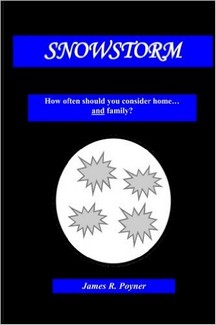
A monster snowstorm, a much different time, a much different era, people facing adversity, people learning what's important, a wide-ranging cast of characters including a young woman overcoming an inner turmoil, all of that and still more.
Having read Arthur Hailey's "Airport" and "Hotel", I wanted to try a novel that also drew together a wide-ranging cast of characters. "Snowstorm" is the result, while it also draws on my own experiences during Chicago's great snowstorm of 1967, as well as on my familiarity with the city and its North Shore environs. Add to all of that the themes on home and family, and this tale should offer something for everyone. Finally, thanks to the nine plus years that I worked the bookstores at O'Hare, and to my ready observations, I was able to work in Joe's solution for dealing with the great mounds of snow. You'll see.
Excerpt
A GREAT, WHITE beast was silently closing on Chicago and its environs. It would bring disruption and chaos; it would paralyze and challenge all that was normal. Soon the great city and its numerous suburbs would know its snarling menace, and through their ready-appreciation for the monster, they would learn to appreciate other things; some that had been forgotten in just a month's time.
That is the way of adversity: It is a moment of concern that is a cradle for life's lessons. If we have the courage to face such a challenge, then we have the makings for surviving, for adapting, and for evolving into something better. If we lack such courage, then there may only be eternal darkness in what remains to us.
Winter clouds, heavy and moist, laden and threatening, were drifting in from the southwest. They were reason enough for a modest dose of anxiety, especially for those few who were awake at the time. Without question, the scattered assortment of airport workers, most on the clock until 8 a.m., harbored a trace of concern. They sensed something but most did not have the means for naming their dread. Only two of them did, while only one of those had just realized the need to alert the other, his senior partner.
The night, its growing gloom deepened by the dark-tinted windows, was thick and black—ready to challenge the faint of heart, ready to trouble sleepers with foreboding dreams, ready to blanket in a smothering embrace. Those windows showed the arriving clouds, and for most of the workers at O'Hare, they were expected. Those same people figured it was just their sense of anticipation, giving them that tinge of concern.
They knew that the forecast had called for four inches, beginning around five in the morning. The clouds were just evidence of that prediction coming true. Those steadily growing, laden ships of ice crystals were reason enough to invoke that sense, while the amount in the forecast was just enough to concern them.
Certainly, those clouds did not look any different than the ones that had brought modest falls of snow earlier that season. So, why should the maintenance personnel, the desk clerks, the baggage handlers, and the like, be more than moderately concerned? Why should they care about the enhanced gloom, much less their sense of foreboding? Most such people were not the kind to be fretful of harbingers.
Otherwise, like the rest of the airport, O'Hare's Terminal 2, the middle of the three sprawling, tentacled boxes that served thousands of travellers a day, was nearly deserted. Ticket counters on the upper level fed a very modest trickle of travellers to the wide concourses that served the gates, while the baggage claim areas on the ground level were also nearly devoid of people.
At the counters, a skeleton crew of clerks sold tickets to the sparse, haggard passengers, mostly for 3 a.m. red-eyes to LA or New York. Not much else was open, beyond America's big three. Still, with tickets in hand and with suitcases tumbling down to the waiting chains of tractor-pulled carts, the jet travellers began the long walk to their assigned gates, some stopping for coffee from ten-cent vending machines, or from one of the all-night snack shops, presided over by a sleepy-eyed waitress and a cigarette smoking cook, both done up in barely-soiled white, neither likely to develop a fondness for the graveyard shift, much less their infrequent customers.
Back then, 1967, there were no security barriers to pass through, and the proliferation of vendors selling a menagerie of over-priced goods had yet to occur. Carry-on luggage was usually no more elaborate than a briefcase and a raincoat, while the overhead bins were generally reserved for blankets and pillows, maybe hats, which were still somewhat in vogue, while no one had even heard of a wheelie, unless it was in reference to what a dragster might do. Of course, it was also a very different time, separated from now by a numbing jungle war, by the technology explosion, and by a mountain chain of plastic debt.
In the meantime, down below, in the belly of the terminal, the modest squad of security officers, augmented by one or two Redcaps, made sure that the few dozen overnighters got to their rightful owners before either disappeared into one of the half-dozen taxis bound for the O'Hare Hyatt or for one of the Loop hotels. Those arrivals were lucky to be where they were going, but that was to be the extent of good fortune for most of them that day. The really lucky ones were those settling in on the departing jets!
Otherwise, it seemed like a typical early morning at Chicago's airport that never closed. The airfield that, at the time, rightfully boasted of being the world's busiest. It was then that O'Hare was the nation's aviation hub, just like Chicago was still the rail hub, geography and entrepreneurs having a hand in all of that. The airport was several miles of runways that were ever ready to receive and to launch the great silver birds that carried people to business meetings, to friends and loved ones, and even, to war. It was always in motion, even at 2:30 a.m., but then, that quality applied to the city, as well. That was requisite to being one of the big three—never a moment when everything was closed.
Then too, just as O'Hare was not typical for an airport, so was that morning destined to be atypical, even if it had started out as ordinary, tinged with a trace of concern, shaded with clouds of gloom. In time, the entire population of Chicagoland—some eight million people, back then—would get to confront the great beast, would realize a need for being very concerned, would want that pair of old kitchen chairs right next to the snow shovel. Only then would the majority of airport workers also better understand that there was more to the prevailing sense of gloom that had deepened with the night.
In the more rural areas of Illinois, what was to happen to them was not as apt to make the headlines. It really was Chicago's greater concentration of people that made the event so significant. The storm was notable—worthy of a narrative—for just that reason, if only because of the greater bounty of stories from those who had experienced it.
At that moment, about two-thirty that morning, only one person, Harry Bellfield, the noted singular airport worker, had begun to realize the enormity of what was drifting in with those clouds, had begun to detect the white monster that was poised to strike at Chicagoland. Harry was an apprentice forecaster for the airport's weather service, and the twenty-three-year-old rookie weatherman had just returned to his small table in the employees' cafeteria with a second mug of hot coffee. As he sat down, he ran his hand through his short, sandy hair and blinked as his mind finally joined his eyes in refocusing on the neat clusters of paper before him on the table. They were the latest data and maps from the Weather Bureau. Most were printed on the yellow paper of the weather office's Teletype machines, adding a potentially disarming color to the scene; never mind if the substantial nature of the pile was yet another omen.
Of course, there were no fax machines, back then. The Internet and E-mail had yet to appear, because only companies, schools, or government agencies had computers. Not only were the latter very expensive, but they also were the size of a lowboy dresser, while their keyboards produced punch cards that were then fed into the machine as lines of instruction. Of course, the trade-off was the cost of goods—a loaf of bread, a gallon of gasoline, and a pack of cigarettes each cost about thirty cents, tax included. Postage was five cents. Guys in grimy overalls pumped the gasoline for you, while taking the time to wash your windshield and check under your hood, even give you reliable directions. There also was the great explosion of popular music brought on by, and in emulation of, the four mop-headed lads from Liverpool.
But then, driving the various elements into a frenzy of sharp interaction, there was the war over in Vietnam. People were dying or being maimed in horrible ways in Southeast Asia, and too many of them were Americans from the younger generation, while it was their older counterpart that insisted on the war being fought to stop the spread of Communism. All of that opened the way for the dark aspects that defined the era: the proliferation of grass, hashish, and drugs like LSD and heroin; male hair that was often too long and shaggy; sex that was too freely had to foster long-term respect, much less lasting relationships; and demonstrations calling for peace that too often turned violent. The older generation's blind devotion to the Establishment, particularly the policies and efforts of President Johnson, was just as dark and just as troubling. Understandably, it was a trying time.
Only the space program, just starting the Apollo phase, kept it from being truly archaic. Both generations were utterly fascinated with that—the stuff of Jules Verne and H.G. Wells coming into being right before their eyes. How could you not enjoy something like that? President Kennedy's challenge was being answered.
As for Harry, he had finally figured out what he had first begun to sense when Saul and he had come on duty at midnight. The puzzle had offered its solution as he returned to the table with his refreshed cup. Now he knew for a fact that there was a reason to be very concerned—he had, at last, gotten a good glimpse of the stalking beast. Yet, there was more than that concern at work.
The immediate problem was how best to present his findings to Saul, his senior partner, the one who would decide whether, or not, to get the word out. Things were about to get serious—much more than anyone realized—and Harry had to convey that sense to Saul. Joe Hanson and his maintenance crew, the people who kept the runways clean, did not need any weather-related surprises, while it was for Harry and Saul to see that they never experienced one. Joe's third shift, the one that would be on duty when things started, could have handled what was already forecast. But Harry could already see where his take on things meant that Mack and his dozen men, hunkered down in the cabs of as many plows and salt spreaders, would be wholly inadequate, swamped in short order, by what was coming.
As for Saul Androwitz, he had already taught Harry much that was practical and useful in their trade. That is not to discount Harry's well earned, almost a year-old, BS in meteorology from Northern Illinois University. That schooling had given Harry a very good start. Now he was learning what a seasoned forecaster, meaning Saul, had acquired through long experience. Harry welcomed the new phase of his education, which was one reason he felt good about his job, despite its midnight to 8 a.m. hours.
Among other things, he wanted to learn how best to factor Lake Michigan into the equation of each forecast. The Lake seemed to influence quite a bit of Chicago's weather, and Harry's sense was that too many forecasters—to their detriment—simply ignored the Lake when they worked up their predictions. Saul had already taught him that that was their mistake. Yet, that day, the great plain of fresh water had shed its mantle of adversity. That time, the great block of air hovering over it would not obstruct, or divert, the incoming weather.
Otherwise, Harry was also happy because he was working at a place where he would certainly gain the sort of prestige that might impress the right person at one of the local television stations. Further, his work schedule still permitted him time to go out on weekends with his fiancée Mary Whitehouse. She rounded out his life and gave him purpose, something he needed to succeed.
As for the military draft that was beginning to darken the landscape with the start of the third year of direct American involvement in Vietnam, he was little concerned by it. The man at Selective Service had assured Harry that his job pretty well made him exempt. If for some reason it really did not, the man had continued, Harry could almost certainly land a very safe job in the Army, Navy, or Air Force, each of which had a high regard for experienced weather forecasters and considered them unexpendable, exempt from combat.
Properly, those things were furthest from his mind, just then. The Near Future was before him—steadily sharpening, steadily closing on him—particularly as he looked again at the sheath of maps and Teletype printouts that were arranged on the table, carefully grouped by type, each group compiled chronologically, most recent on top. In the center was a black and white map of the Midwest, a series of circled S's, which Harry had made, showing the progress of the title character's center. Asterisks, representing reports of snow, were accompanied by hourly rate totals for each reporting station. Those six-point stars were steadily spreading northeast from St. Louis. There was no question that the snowstorm was approaching Chicago.
Everyone knew that. Yet, only Harry had realized how errant the broadcast forecast was. At the same time, he also recalled Saul's long-time friendship with a well-placed man at Chicago's Streets & Sanitation, while that shard was just enough of a glimmer to keep Harry from giving into despair.
Of course, Saul, like Harry, also knew the current prediction. Most of the other airport workers also knew that there were four inches of accumulation in the forecast, enough to make at least the coming morning a tough commute—maybe both ways if the city was uncharacteristically lax, which was unthinkable, thanks to Mayor Richard J. Daley's stern expectations. Given the obvious need, Saul and Harry had kept an eye on the storm since they had come on duty at twelve. They had to be ready to tell the right people, particularly Mack, when the need arose, and Harry was convinced that that need was before them.
So sensing the error in the forecast, Harry had brought the data with him on his break because he had sensed from the start of their shift that there was something wrong about the Weather Bureau's forecast, and because he felt he needed a few minutes of uninterrupted concentration to figure out what was wrong. It called for the snow to begin around five that morning, just before the start of the morning rush hour. He and the data, the papers spread before him on the break table, agreed with that much.
He also recalled hearing the same forecast on Channel 7's ten o'clock newscast, which meant that most people would know it. A few might get up early and allow themselves plenty of time to get to work. But none of them would know that the real challenge, as Harry saw it, would be getting home.
Typically, Harry and Saul's primary job had kept both of them busy as they showed pilots the best weather routes to their destinations, which included an advisory that St. Louis and areas south and southwest of Chicago were, or would be, experiencing heavy snow—over half an inch per hour, which meant poor or deteriorating visibility. They also updated the tower on a regular basis and took readings every hour on the hour. Midway Airport and Meigs Field, the latter on the lakefront, did the same so the radio and TV stations could report all three temperatures and other conditions. There were three reporting stations, because the far-flung field of houses and low rises, which made a semi-circle around the stone and steel spires of the Loop, meant an equally wide variation in temperature.
Harry enjoyed doing all of it. It was good to help people. He also felt it was just as important to not be caught off-guard by a bad Weather Bureau forecast—too many people depended on Saul and him being right. Unfortunately, every time he had tried taking a look at the charts, a pilot or Saul had wanted something. So, just after the two o'clock readings, when his partner had told him to take a break, Harry grabbed up the armload of data and headed off to the cafeteria.
When the medium-build weatherman had first sat hunched over the table and papers, and after adding data to his black and white map, he brooded to himself, Now what's wrong with their forecast—four inches? No, there's plenty of moisture, and it's already making snow south and southwest of here. Conditions are also right for that much snow here, the Lake won't interfere, we're within the necessary temperature range, and the barometer's falling.
Again, his fingers raced over the maps and then the lines of words. Was there something he had missed? No, everything was before him. He had the clues to figure out the mystery. He knew that intuitively. He looked at them again and again for close to half an hour, not even aware that he had taken nearly twice the time allotted. Then Harry refilled his cup, sat down before the data, and suddenly, he knew what was wrong.
"Hey, Harry, you staying up here all night," Saul asked from the cafeteria's doorway.
With the next hour's worth of departing flights taken care of and the hourly report to the tower still several minutes away, the middle-aged, balding forecaster had felt it safe to abandon their aerie long enough to swoop down and chase Harry back to the nest. Saul was not really mad at his apprentice. The kid showed very good promise: bright, easy to work with, knowledgeable, and quite willing to learn. Harry also had a gift for saying things in a way that was easily understood and generally direct.
So Saul meant to go easy on Harry that night. It was the first time the younger man had ever taken more than the allowed fifteen minutes. But then, Harry had been acting peculiar—distracted—all the while that they had been on duty that night, with the oddest thing being to take all of the maps and Teletypes with him on break. Harry's strange behavior had been a first, too.
"Oh, good," Harry cried, delighted with the arrival of his mentor. "Uh, Saul, grab some coffee and come look at this. I think I'm onto something."
The younger man was also glad Saul was there since it meant not having to waste time by making a trip back to the office with all of the papers, or having to wait until Saul had come back from his break. It seemed important to discuss the storm from Harry's new perspective, ASAP—as soon as possible. People always needed to know when things were going to get bad, and it always took time to get the word out because social media was limited to landline phones and letters. Sure, they were prepared for a fair amount of snow—four inches, a good fall for Chicago—and it was enough to make everyone take notice. But what if that notice failed to address the true concern—if it failed to truly prepare those people, particularly pilots and commuters? Harry again recalled that Saul had a friend at Chicago's Streets & Sanitation who would be just as interested as the airport—the noted glimmer.
With a bemused grin, Saul obeyed his partner's request and, sitting down across from him, coffee in hand, asked, "So, what have you learned, Harry? I admire your initiative, and I hope you won't be afraid to employ it in the future. That can be one of the most important things we do as forecasters. Just say something next time, okay?"
"Yeah, sorry about that, Saul, I can see where I should've. Thanks, for being patient."
"It's all right." Then, with an instructor's proper attention, Saul asked, "So, tell me, what do you make of all of that—why the great interest?"
"Well, ever since we came on tonight and looked at this stuff for the first time, I had a feeling there was something wrong about it—about the forecast, that is. Now, I know what's wrong—I just figured it out."
"Yeah," Saul mused. "Well, I must admit I'm curious to find out. I can't imagine what's wrong with the Bureau's forecast, except that maybe they called for too much snow. Typically, as you know, we get three inches or less. So, what do you think?" Saul wondered, as he found himself naturally intrigued, and of course, he wondered what the kid had noticed that the Weather Bureau and he had not.
"Well, I hate to disappoint you, but my opinion is that they've called for too little."
"Too little—really," Saul wondered, eyes widening before he passed his hand over his balding head and looked anew at the data and maps, particularly the map of the Midwest that readily held the veteran forecaster's attention, even if it was a somewhat ordinary centerpiece. He was properly concerned.
"Well," Harry began, "from what I can see by all this, we're in for a major storm that could easily last ten hours, and mean at least as many inches of snow." Even as Saul mouthed, As many, Harry added, "More, if it lasts longer."
It was, of course, a bold prediction. Saul had thought four inches was too much, especially after the noted tendency for Chicago. With someone else, Saul might really have laid into that person—harshly scolded them. Saul did not like pranks involving the weather. He had a deep respect for Nature's awesome, fickle power—the sort of respect that took offense at tricks played at Her expense.
At the same time, Saul knew that Harry was really a younger reflection of himself, which meant Harry was not the type to play that kind of joke. Saul also could see that the kid was dead serious about his prediction. Further, Harry's senior partner could respect him for having the courage to make it, and for realizing that the situation was serious enough to risk a rebuff of his feelings.
"That's quite a prediction. You know, as well as I do, that the odds of our getting that much—ten inches—are about a million to one, maybe more."
"Sure, I do, Saul. Everything has to work—the storm center has to follow its projected course, and we have to consider location of the freeze line, the storm's rate of travel, wind speed and direction, barometric pressure, moisture content, Lake Michigan's influence, and the rate of snowfall, among other factors," Harry said, ticking those points off on his fingers. "Each of those has to contribute in just the right way, which is what makes the odds as steep as you say. Well, I see enough right here to bring those odds almost down to zero."
Then as Saul grimaced, Harry added, "Sure, like you, I know that weather can be fickle. But I don't believe Nature will be fickle this time. No, I'd say we're looking at a major storm that should reach Chicago just after five, like the Weather Bureau said, or in two and a half hours, just ahead of the start of rush hour—right at the start of the main operations here—right at the worst possible time! But it's not the fact that it's going to snow then that bothers me."
"What do you mean?" Saul wondered, especially since Harry had stated the major concern for both the city and the airport.
"Well, both drivers and pilots are used to snow by now, this winter. No, what concerns me is that this is going to be a very intense rate—remember, I said an inch and hour, which agrees with the rates these stations to the southwest are reporting. Anyway, that's severe enough to reduce visibility to nothing, making driving very difficult, and it also means that it's going to be even worst for the jets landing…here!"
Saul raised his brows at the urgency in Harry's conclusion. They both knew that the bit about visibility was always a concern to an airport. Landing was dangerous enough—not being able to see a well-lit runway within a hundred feet of the ground, substantially added to that danger and was reason enough to abort a landing; something the pilot could always do. While Saul was open-minded enough to hear his partner out, he felt a dread in his gut that warned him that Harry had yet to play his trumps. So Saul asked the younger man what he had concluded about the storm itself.
"Well, first, the storm center is beginning to stall over Cairo," the young man began, pronouncing the name, Kay-ro, the statewide preference for the city at the southern tip of the state.
"Stall?" Saul cried and frowned, as if a major support of his doubt had been abruptly knocked away, as if his ace had been trumped.
Stall meant a lot in reference to a storm's action. For one thing, there was no readily apparent formula for saying when a stalled storm would start to move again. The one in question had a reputation for being slow moving, which had likely been the basis for the Bureau's accumulation figure, but stalling put a different, darker spin on the forecast. Saul was highly concerned by Harry's first fact, especially when linked to the other factors concerning the present storm. Foremost of those was that it was a given that it would produce snow. With the prospect of the storm stalling, the odds had dropped significantly in Saul's estimation.
"Second," Harry continued, knowing it was better to reiterate what Saul or another knew than to let that person wrestle with both their ignorance and Harry's point, "that fact is compounded by the fact that we got a Bermuda high out east that's moving slow enough to jam things up pretty good for as much as ten hours, maybe more. The high could also stall."
As Saul raised his brows at that, young Bellfield continued, "Third, the storm coming our way is packed with moisture—lots of moisture—from sitting over the Gulf for a couple days. That means it's got a lot to dump, which is why these other stations are seeing an inch an hour, and which is why I think there's enough there to make it snow in Chicago at that rate for ten hours. However—and this is my main point..."
Saul more sharply grimaced, as if to say, You mean, your others weren't bad enough?
"My main point is that if it stalls, like it appears to be doing right now, we're going to get buried—enough that ten would be conservative!"
"Really," Saul moaned. Quickly recovering while sensing that Harry had just used his ace to pull the last of the trumps, to clear the way for running the cards, piling up the tricks like so much snow, Saul then managed, "Well, I begin to see where you're onto something. I can also see where ten might be closer to the truth, given what these reports are saying, and I can see where that's the main flaw in the Bureau's forecast—they didn't count on the storm stalling. It has a history of being slow moving. That's its tendency, and that's the basis for their forecast. Like us, they predict based on a system's tendency. As for the rate, well..."
Once more, Saul glanced over the Teletypes. He could see where Harry was onto something, and where the odds for a big storm had been sharply reduced, almost to nothing. It was going to snow. There had been no question of that. It was also clear that enough of the conditions had been fulfilled for them to consider forecasting a major snowstorm. At the same time, calling for ten inches seemed a bit much, never mind what Harry had said about being conservative, although that nagged at Saul like a pebble in his shoe. No, they had to come up with a number that promptly conveyed the seriousness of the situation, but one that was not so far-fetched that it is was doomed to be dismissed by the honchos.
Otherwise, Saul then reminded himself, the storm had shown an attraction for water: first, the Gulf; then, up the Mississippi; then, east at the Ohio; and now, it was hungrily eyeing Lake Michigan—another tendency. Saul, like Harry, knew the Weather Bureau's prediction called for four inches in an eight-hour period. Double the rate, like Harry had, thanks to the data from the reporting stations to the southwest, the moisture content, and the stalling factor, and they were looking at eight inches. He explained that to Harry, and asked him how he had arrived at ten inches.
"Because, Saul, even if things become unjammed, it will still take a long time for this storm to simply pass over us. Long enough for another two or three inches to fall. But I think you're missing the important point," Harry said with the same urgency, making Saul wonder if the kid was about to lay down his hand and claim the rest of the tricks. "Right now, it's not really a question of how much, but how fast. If that storm hits us at five, that means Joe and his first shift could find three inches on the field when they come in at eight!" While Saul grimaced yet again, Harry added, "There's no way his night shift can clear that much alone. That's a lot, and when you factor in poor visibility..."
"It becomes very serious, especially for us—for the airport!" Saul answered, almost gasping like he had just waded a block through knee-deep snow.
"Exactly," Harry agreed. "On top of that, just think what that kind of snowfall will do to rush hour, which is why your friend in Streets & Sanitation should also know."
"You know, Harry," Saul said and beamed, knowing it was time to concede the hand, "you just made a couple very valid points. I'm convinced by what you said about the storm. Still, rates don't mean as much as inches do to most people when it comes to snow, even rain. Visibility can mean even less to them. That only matters to pilots. So I want to wait until the next Teletypes at three, before we think about committing ourselves. For now, let's take this stuff and ourselves back upstairs, and let's see what the new reports say."
"Fair enough," Harry agreed, once more appreciating Saul's characteristic note of caution.
|