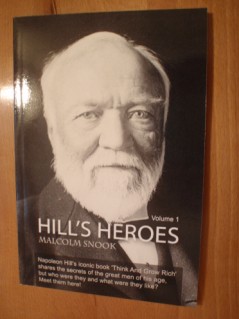
About the great men and women of the 1920s and 30s who inspired Napoleon Hill.
Puts Napoleon Hill's work into context for modern readers.
The great men and women of the 1920s and 1930s influence our lives hugely today. We take international flights for granted, but it was the Wright brothers who were primarily responsible for making aircraft controllable and responsive.
We take electrical appliances for granted, but if Thomas Edison had not invented the electric light bulb and made it practical there would have been no electricity generating industry nor supply to our homes and therefore no incentive to invent any electrical household appliance from washing machine to vacuum cleaner, microwave oven etc etc. As an aside the great whales would probably be extinct as lighting was primarily by whale oil prior to electric light.
Today we have smartphones, but without the pioneering work of Alexander Graham Bell we wouldn't have been able to even send voices down a wire and so it goes on, the invention of photographic film and moving images, cars for the masses.
The nineteen twenties and thirties are the foundation of our lives today and sparked the change and development we now revel in.
The pioneers of that era can also inspire us in our own endeavours. They were studied by Napoleon Hill to try and disitil the secrets of their success. His book Think And Grow Rich is still widely read today, it's not without its flaws but it is valuable. Contemporary readers knew the men Hill studied as intimately as we know Steve Jobs, Bill Gates or Bill Clinton because their lives overlapped with the likes of Henry Ford, George Eastman and all the other characters in Hill's Heroes.
Today's readers of Think And Grow Rich may well know something of the lives of the likes of those mentioned above, many will not, my book Hill's Heroes redresses the issue, but it's interesting history in its own right. Researching the book certainly taught me a lot!
Excerpt
Born November 25th 1835 – Died August 11th 1919 Andrew Carnegie was a self made industrialist
who emigrated from Scotland (Dunfermline in Fife) to the USA at the age of thirteen with his
parents William and Margaret. William was a linen weaver but also a campaigner for improvements
in the conditions of the working classes – an interesting early influence. Andrew's first job was as a
bobbin boy in a cotton factory, later he became a telegraph operator (note the coincidence as
Thomas A. Edison had the same job for a period). In common with Edison, Carnegie was an avid
reader, after a local citizen opened his private library for use by working class boys. Carnegie
himself would later demonstrate his gratitude and understanding by endowing numerous schools
and libraries.
He founded the Carnegie Steel Company in Pittsburgh after progressing from telegraph operator to
a more senior role with a railroad and then investing in a company that made railway sleeper cars.
This led on to bridges and other industrial enterprises and finally steel making. Probably as a result
of his father's influence his policy was always one of treating his workers as partners of capital.
Think And Grow Rich tells the story of the creation of US Steel, and the sale to JP Morgan of
Carnegie's assets. What it doesn't tell us is how Andrew Carnegie used his millions as a great
philanthropist and peace campaigner, founding among many things The Carnegie Endowment For
International Peace based in Washington. Note also that Henry Ford was accused of being a
pacifist! Truly there is a message that comes from these great men.
Carnegie's story is indeed one of rags to riches and it's little wonder that his story inspired Napoleon
Hill, given that Carnegie is credited with doing it himself, and has been described as the second
richest man in history. However Hill tells us that Carnegie used a Master Mind Group and made its
members rich too. This supports Hill's assertion that any plan or transaction you make should
benefit ALL who are involved.
Carnegie was a prolific writer (see his Gospel of Wealth). He believed the wealthy are merely
custodians of wealth under a moral obligation to improve the lot of others, he believed that to die
excessively rich was to die disgraced and his good works are too many to list.
Andrew Carnegie's wealth probably peaked at $475 million which by the standards of the 2000's
could be as high as $297/8 billion of that $475 million he had given away all but $30 million when
he died unexpectedly. He is widely considered to have been, at the peak of his financial success, the
second richest man in modern history. For the richest and a comparison of relative philanthropy,
particularly the proportion given away at death see John D. Rockefeller.