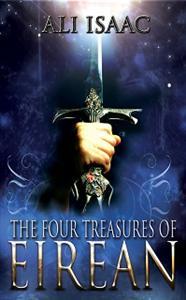
Four lost treasures, an enigmatic sorceress, and a boy in a wheelchair. Book One of The Tir na Nog Trilogy begins an epic fantasy adventure into the shadowy past of Ireland's long lost legend.
In the magical realm of Tir na Nog, a four thousand year old conflict is about to resume. Disgraced fairy-King, Bres, intends revenge on his brethren. This time, the effects could be catastrophic for all mankind.
Who can stop him? All the heroes of old are long gone.
Conor Kelly is just a boy in a wheelchair. Enigmatic Sidhe-Princess, Annalee, is his moody and mysterious guide.
The Four Treasures of Eirean are their only hope, but these powerful talismans were stolen and lost long ago.
Is Annalee all that she seems? Can Conor overcome his demons, and face up to Bres?
Book One of The Tir na Nog Trilogy begins an epic fantasy adventure which takes us back in time to the shadowy past of Ireland's long lost legend, where fairy kings and gods walked amongst mortals, and where feats of magic, swordsmanship, and courage were customary.
Here among the ancient stones of Newgrange and Tara, Conor discovers that anyone, even the most unlikely of us, can still be a hero.
"A sophisticated fairy tale of epic proportions that will appeal to children and adults alike." -
Jay Howard
"It's Narnia meets Percy Jackson." - Jason Parent
"I found myself wanting to learn more about Irish folklore, and someday visit Ireland." - Laura Libricz
Excerpt
Prologue – The Dream
4000 years ago...
Eochaidh mac Eirc, Ard Ri, High King of Ireland and leader of the Fir Bolg, stood on the cliff edge and looked out to sea. The night was clear, the water was calm, and the moon and stars observed the scene like many bright eyes. There was no sound save the hum of distant waves washing against the shore far below. A faint breeze, drenched with the salty scent of the sea, tugged at the hem of his cloak. Behind him stretched a small array of tents and cooking fires, where the men of his hunting party slept, or ate, or gathered in small groups to drink and talk.
The world seemed at peace. Nothing seemed amiss, yet as Cesard approached, he observed that Eochaidh seemed troubled. The King frowned, shrugging his cloak closer about his shoulders.
Cesard spoke in soft tones. “You sent for me, Lord?”
The king turned, his silhouette casting a large shadow against the deepening night sky, for the Fir Bolg were made of tall, big shouldered, broad chested men.
“Ah, Cesard.”
Alarm prickled along the sorcerer’s spine. The king feared nothing and no-one, was mighty in battle, and swift in his decisions. He was not given to lonely midnight vigils. It was clear that something was worrying him.
“How may I help you?” he asked.
Eochaidh turned his troubled gaze back to the horizon.
“Tonight I had a dream,” he said. “A dream so powerful, it kept me from sleep. I believe it to be a message, a warning from the gods, and I tremble at its meaning. You are my most trusted and learned advisor. You are accustomed to communing with the gods. Give me your interpretation, for I would have what I suspect confirmed or denied by your expertise.”
Cesard swallowed, a deep feeling of foreboding flooding through him.
“Tell me your dream.” He wrapped himself firmly in his cloak against the sudden chill he felt.
“It seemed,” Eochaidh began, “that I walked in daylight through this camp to this very spot where we now stand, and I looked out to sea, just as I do now.
“On the horizon, a dark cloud formed, and began to blow towards me. It moved very fast, faster than the winter wind across the plain. As it approached it became larger, its shape ever changing and undulating, until I could see that it in fact contained a multitude of smaller shapes. A great din arose from it, a rough harsh sound that struck terror into the hearts of all who heard it.
“As it came upon me, I saw that this dark shadow comprised a swarm of black crows, all crying their loathing. The host descended from the sky upon us, even as we reached for our weapons. They were a force of magic we could not fight against with our mortal weapons, and many of our tribe fell that day. But Sreng, my Battle Champion, cut a wing from the body of the largest, noblest bird, and then… I awoke.”
Eochaidh turned to his sorcerer and their eyes locked.
“Tell me, Cesard. What does this mean?”
Cesard disengaged his gaze from the King’s and returned it to the horizon.
“I fear it to be a bad omen.”
The king gave a hoarse laugh.
“I don’t need magical arts to see that,” he barked.
“Well, it would seem to me that the dark host represents an enemy that will come from the air and the sea, and wrest this land from us in battle, using a powerful magic we cannot withstand. Perhaps we will clip their wings, but not cut out their hearts.”
The King’s voice was harsh.
“Are you foretelling our doom?”
“I am merely interpreting your dream,” returned Cesard mildly. “Perhaps that’s all it is, just a dream.”
“No. It was more than that, and you know it. Besides, your skills have never failed me before. We must ready ourselves for war.” Eochaidh brushed past his advisor, resting his hand briefly on his shoulder, before striding off back through the camp.
Cesard shivered, eyes scanning the horizon for enemy ships, but finding none, followed hurriedly after his King.
Some way further north along the coast, at Killary Harbour in Connemara, the Tuatha de Denann were landing their first ships.
Chapter 1 – The White Room
the present day...
In a small town in the centre of Ireland, a boy in a wheelchair was waiting in a hospital corridor for his physiotherapy session to begin.
He looked up and down the corridor; no-one in sight. Just a row of dull grey plastic chairs with black iron legs and no-one sitting in them to his right, a door on his left, and a door opposite. Past the chairs, the corridor ended abruptly in large, heavy double doors, with a security keypad on the wall beside them. To his left, the corridor took a right turn out of sight. That was the way he had come in. No signs on the doors, no windows, no noticeboards, no community artwork on the walls, no vending machines.
And no people.
Conor was, for the first time in his life, entirely alone.
His special needs assistant, having brought him over from school, seemed to have silently and unobtrusively slipped away instead of remaining to make the handover. Conor’s mother would be furious.
Conor’s mother was never late, having a tendency, even after all these years, to be somewhat overprotective, much to his annoyance. So where was she?
He felt the vague prickling of unease at the nape of his neck.
Why had he been brought here, instead of to the usual place? And where had his assistant gone? Perhaps no-one knew he was here. Here he was, sitting alone, in an eerily deserted corridor of an unfamiliar wing of a normally very busy hospital. His mother would be running around in a blind panic, looking for him. But would anyone think to look here?
The silence and solitude were unnerving.
This is my life. I am a thinking, feeling human being like anyone else, but because I can’t let anyone know it, I have to endure being dumped in an empty corridor until someone remembers I exist.
Where was everyone?
He could feel his disquiet morphing into anger. He was normally afraid of his anger, but right at this moment, it felt like company.
It’s not my fault that I’m trapped inside a body as unresponsive as a lump of wood. I can’t help it if no-one understands me when I try to talk. I can’t help it if my legs don’t go where I want them to when I try to walk.
He glanced down at his legs with distaste. Although they looked the same as everyone else’s, they just didn't function like anyone else’s. It wasn’t that he couldn’t move them at all, he just couldn’t make them do what he wanted, when he wanted. He could walk fine with his walking frame. Ok, he was a bit stiff and jerky, like a wooden puppet, but what could anyone expect from a boy who spent most of his time sitting in a wheelchair? He loathed the walking frame. It looked just like one of those things they gave to old people. Kind of like a backwards Zimmer frame. His sisters had tried to funk it up a bit, and make it look trendy, but it was so not cool.
Bad as it was, the walking frame wasn’t the worst thing. Oh no. Worse than that, and quite the hardest thing about standing and walking, was balance.
How on earth does everyone else manage to stand without instantly keeling over? Man, they make it look so easy.
But he just couldn’t get the hang of it.
Sometimes, he imagined what it would be like to be Brian O’Driscoll. Now there was someone who really knew how to use his legs. Conor often watched the rugby on telly with his dad, and could only imagine the sheer thrill and exhilaration of being able to run like that, how it would feel to be able to have so much control over one’s body.
Sometimes, too, he wished he could use the Force, like Luke Skywalker, and will his legs into action. And yes, there had been moments of sheer frustration and desperation in the past where he had tried, really screwed up every ounce of concentration that he possessed, and still nothing had happened. Well, he supposed, magic only existed in the movies.
Anyway, that was how, once a month, Conor came to the hospital for his speech therapy and physio. He didn’t see the point any more. All the exercises and manipulations he had endured during his fourteen years seemed to have made not one bit of difference.
I am like Stephen Hawking, only without his technology. I bet I would amaze everyone if they only knew what was going on inside my head.
Suddenly, the door opposite opened just a crack. A face wearing glasses peered through the gap, caught sight of him, and paused.
“Conor?” a woman’s voice enquired, sounding very loud in the deep silence of the corridor.
Conor stared at the narrow stripe of person he could see through the door. He supposed the voice must have come from her, although it was difficult to tell when the door hid more than it revealed.
The woman on the other side of the door blinked behind her glasses, and pushing open the door, stepped into the corridor. “Are you ready?”
Her words were slightly accented, as if she couldn’t quite get her tongue around the language. She removed her specs and stowed them safely in the pocket of her tunic. Her eyes, Conor noted, were too large for her face, like a character from a Manga cartoon. In colour they were grey-blue, but so pale he would have described them rather as silver.
Looking uncomfortable under his scrutiny, the woman retrieved her glasses, wiped them on the edge of her tunic and replaced them. Her nose was so small that they kept sliding forward, and she had to keep pushing them back.
He noticed her hair next. Nothing unusual about the colour, lots of people in Ireland had jet black hair, but hers was so long, he imagined she must trap it beneath her every time she sat down.
As if he had spoken aloud, the woman reached back with her hands, looking a little self-conscious, and deftly tied her hair into a loose knot.
“Right then,” she said hurriedly. “Will we go through?”
She quickly moved to the back of Conor’s wheelchair. Without waiting for a reply she grasped the handles and propelled him through the doorway.
The room was unlike anything Conor had been expecting. It was a large window-less square, and all the walls, the ceiling and floor were painted a dizzyingly bright white which made his eyes ache just to look at it. There were no floor mats or cushions, no benches, hand rails, walking frames or tread mills, no therapy balls, hoops or bean bags, just a large, white, empty, featureless room. Most alarmingly, the harder he stared, the more the perimeter of the room seemed to swim out of sight and blur into a distant shimmering haze. Conor felt quite disorientated, like he was floating in a cloud. In fact, he could have sworn that the walls weren’t walls at all, but great towering banks of undulating fog. He blinked.
I must be imagining things. What is this place?
He looked around with interest, and a measure of concern.
“I am taking you through the Faeth Fiadha,” said the woman in matter of fact tones, almost as if she had heard him. It was uncanny, creepy even, and Conor shuddered involuntarily.
Faith Fee-what? What the hell are you talking about? You’re taking me for my physio, aren’t you?
“No, I’m not,” she said, stopping abruptly. She swung the wheelchair around sharply to face her, and sat on the floor before him.
Now Conor had the rare experience of looking down on the person he was engaging with, rather than looking up. She hugged her knees and rested her chin on them, studying Conor intently. This was somewhat unnerving, as her silver gaze seemed to pin him into his wheelchair. He stared back as defiantly as he dared.
He saw a small, slender woman dressed in a blue physiotherapist’s tunic and black track pants. Her skin was white, but etched with dark shadows around her eyes, as if she had not slept in days. It was impossible to determine her age.
Looking into her large mirror-like eyes, Conor suddenly became aware of himself as she must see him, a thin, pale, adolescent boy, slightly smaller than most other boys his age. His reddish hair was untidy, and a bit too long. A scattering of golden freckles hurried randomly across his nose. His features were small and pointed. A faded scar from a surgery he had when he was a baby slashed his forehead. ‘Harry Potter’ his sisters would tease him. No amount of combing would entice his fringe to conceal it. Rather alarmingly, his brows and lashes were so fair and sparse they could barely be seen. He wore the standard teenage uniform of jeans, tee shirt, and skater shoes in an attempt to look ‘normal’. His I-pod, a gift from his sisters, was tucked into his pocket.
The woman’s observations did not seem to please her, however, for a look of resignation crossed her features, and she sighed.
“No physio today, Conor. I am Annalee of the Sidhe, and you’re coming with me.”
That’s strange. There’s a river near my school called the Annalee. She must be named after it.
The woman gave him a quizzical look. “Don’t be silly! They named the river after me, of course.” She sounded almost offended.
Conor jumped in surprise. How did she always seem to know what he was thinking? What a weird thing to say. How could a river, which had been there since time began, be named after a person?
Annalee waited, expressionless, silver eyes flickering.
Conor moved restlessly in his chair.
Ok, no physio, great! I hate physio, it’s a waste of time. What are we doing here, then? Must be a therapy of some kind, speech and language, occupational, music?
Annalee performed her trick again. “You are right, it is a waste of time, for no therapy will cure your particular affliction. You are coming with me into the land of the Sidhe. You will know it by another name, that of Tir na Nog.”
For the space of a few seconds, there was silence as they both regarded each other suspiciously. Then Conor erupted into laughter.
I’m being kidnapped by the fairies? Oh, that's a good one! I guess you must have escaped from the Loony Ward; they are probably more worried about finding you than finding me.
This last sobering thought rapidly chased away Conor’s hilarity as the reality of it sank in. Suddenly he realised he was all alone in an empty part of the hospital with a mad woman. He was vulnerable, and helpless.
Anything could happen, and no one would know.
“That’s right,” said Annalee ominously, rising to her feet and calmly dusting down her trousers. Her quiet voice and detached manner now seemed somehow menacing. Conor watched her with waves of cold, clammy fear pulsing through him.
“You are entirely at my mercy. You have no choice. You are at the whim of whoever controls your wheelchair, and right now, that is me.”
As she began to push him into the mist, she leaned forward so that her lips brushed past his ear and her hair tickled his face.
“Whether you believe me or not,” she said in a whisper, “whether you are willing or not, we are going through the Faeth Fiadha, and into Tir na Nog.”
Professional Reviews
A story to treasure, whatever your age
Do you remember, with nostalgia, reading adventure stories full of youthful courage, heroes and villains, humans and fantastical creatures? Did you enjoy Narnia? If so, this book will have you doing everything in your power to read it in one sitting.
It's firmly grounded in well researched Irish folklore and history, a sophisticated fairy tale of epic proportions that will appeal to children and adults alike. Ali Isaac cleverly leads us between the present and events of 4,000 years ago. Fourteen year old Conor, confined in his wheelchair, is fated to be the saviour of his ancestors, the Sidhe, and is led back to his kin by the intermediary, Annalee, through the Cloak of Concealment. When he learns of their plight he agrees to seek their lost four treasures, stolen from them by a power hungry traitor. Naturally, the treasures have magical powers of which mere humans are unaware.
Annalee returns with Conor from Tir na Nog to the present to help in the quest. But is she all she seems? Many trials and dangers are overcome together. In the best traditions of fairy stories, in helping the Sidhe, Conor finds his own power, and the final battle is very satisfying.
Don't be put off by the plethora of Irish names. There is a pronunciation guide if you want to enter the spirit of it. It's too awkward to flick back and forth on a Kindle but a print of those few pages does the job nicely. Alternatively, you can invent your own pronunciations - say it as you see it. Personally, I think a bit of work at the beginning is well worth it.
I am so looking forward to books 2 and 3.
Perfectly Pitched.
I thoroughly enjoyed reading The Four Treasures of Eirean. It took me right back to the books of my youth; Swallows and Amazons, the Lone Pine series, the books of Ursula le Guin and, yes, those of CS Lewis too. It recalled memories of rainy holidays in Wales, making myself ill trying to read in the back of the car, begging to be left behind while the rest of the family toured the Cathedral because I was reading a really good book and I couldn't wait to see what happened next!
I'd say the book is aimed at older children and the YA market and as such it is perfectly pitched in terms of its fast-moving pace and nicely rounded incidents. The narrative has it all; fighting, magic, mystery, epic battles, supernatural powers and a good dose of what film listings bill as `mild to moderate peril'. Chapter headings are intriguingly suggestive of enigma and enchantment. But it is also beautifully grounded in the kind of everyday detail that makes fantasy-work believable; the characters eat and drink and sleep and wash, they have moods, they make mistakes, they change.
Having said that there is much here for the adult reader and any grown-up who dismisses this as purely YA fiction is going to miss out on a treat. Intriguing accounts of the lore and legend of Ireland combine with evocative - but not overdone - passages of description and a beautifully wrought atmosphere which convinces you that anything, here, is possible. Deftly-placed detail and a wholly credible rationale anchors the restless spirits of the past and the banished Sidhe (fairy people) to the real green turf and friendly hospitality of present-day Ireland. My disbelief was effortlessly suspended by the bottom of the first page and by page 20 I'd decided to visit Ireland at the first opportunity.
The scope of this book is huge, spanning 4000 years of Irish history and legend and yet in no way is it unwieldy or weighed down by stodgy detail. The plot passes fluently backwards and forwards in real time as well as in and out of fairy time without a single trip or stumble.
And here I come to the book's most admirable achievement, its hero Conor Kelly. Conor has a condition which is thankfully never labelled but which inhibits his mobility and ability to speak. These elements are part of Conor but they do not define him; what defines him is his courage, his sense of humour, his realism, his grit and his humility. Conor's difficulties are never minimised - life is a struggle, and sometimes he feels bloody angry about it - but there is never a pitying note in this book and neither is there a patronising one.
I found Conor's voice as executed by Ms Isaac to be a totally believable rendition of your average 14 year old; sometimes sullen and stroppy, sometimes barbed with sarcasm, sometimes dryly ironic, sometimes endearingly honest in its vulnerability. I loved the way that that Conor endured regardless of his difficulties (how tempting as it must have been to `magic' them away), by the power of his intelligence, his innate spirit and his dogged determination.
If the Paralympics has not done it for you - and if not, why not? - then this book will challenge your attitude to disabled people.
Disability - both physical and mental - is a subject too often shied away from by novelists. Mark Haddon's The Curious Incident and Patrick Gales Notes from an Exhibition are recent exceptions to the rule but this one compares better with William Horwood's Skallagrigg which helped me think differently about people with disability almost forty years ago.
Who knew Irish mythology could be so interesting?
Ali Isaac's book, The Four Treasures of Eirean, firmly roots itself in a rich and captivating folklore that makes me wonder why Greek mythology has oversaturated the fantasy realm. Now, I love Greek mythology, but there's only so many times the same stories can be redone before they get tired. Isaac's novel rekindles that spark I had when I first heard of Perseus and Athena and their lot.
Isaac's story is the first book of a trilogy, but make no mistake: The Four Treasures of Eirean is a complete story in and of itself. I would not be giving the book a good review otherwise.
The story gives a detailed but not onerous account of fabled events occurring "4,000 years ago." In some cases, these events retell Irish myths pertaining to the Tuatha De Denaan and Tir Na Nog, the fairy people of a mystical paradise (nothing like Tinkerbell). In others, Isaac uses the myths as building blocks from which she develops an original tale.
4000 years into the future (present day for us), a physically disabled boy named Conor is thrust into a conflict that has been millenia in the making. Confined to a wheelchair and unable to speak, Conor must find and release a power within himself to overcome fierce adversaries and mythical creatures, conquer the perhaps fiercer adversary of self-doubt, and find four mysterious treasures of untold power, all to save a race of people to whom he owes nothing.
Conor's adventure leads him to cultural and historical sites across Ireland and into the Otherworld. The book's primary strength lies in its weaving of mythology and associated Irish historical sites into a story that transcends time, relatable to readers of all ages, regardless of nationality. Another strength is its multi-dimensional characters, some of whom blur the lines between good and evil. It's Narnia meets Percy Jackson.
My primary criticism with the book concerns the four treasures themselves. I had a difficult time discerning how they were lost if they were stolen for the villain, or if the villain hid them, why he couldn't just go and pick them up himself for his own use. The villain was exceptional, but perhaps the author overstepped a bit when she links him to global conflicts of the last century. Also, Conor's infliction was a mystery to me, though I can certainly understand an author's concerns with pinpointing a precise ailment when it seems it can only be overcome in part by magic.
None of these concerns are fatal to enjoyment of The Four Treasures. Overall, it is a fun, fast-paced read that will have you willing Conor forward and, perhaps, desiring travel to Ireland. I'm happy to have read it and am curious to see what Isaac will do with her next installment
War is fought, not only on the field, but also within the mind.
Nothing is what it seems, take nothing for granted.
The 10 Mariard Volumes have surfaced. The gifted are fighting for you. Do you have the right to become an entity? Take the cha
In this episode of the Dragoneer Saga, the kingdom is beginning to find its roots as trade ships and men travel and barter with the Old World Clover mapped for them all. Banished King Richard finds an adventure of his own; One that might just lead to
In this sixth, and final, episode of the Locus Poll nominated, international bestselling, Dragoneer Saga, King Richard, his Nightshade, and the legions of mudged dragons it controls, are coming to take the Mainland throne. Hold on to your dragon! A g