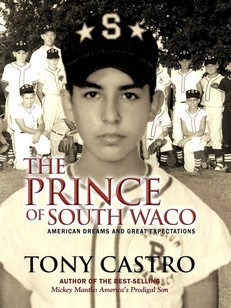
"The Prince of South Waco: American Dreams and Great Expectations" is coming of age memoir about growing up in Texas in the 1950s and 1960s.
IN A PERFECT UNIVERSE, theirs might have been the perfect love story from two separate worlds. But in the heart of the Bible Belt South, in mid-20th Century America, their young love was forbidden, all because of the color of their skin.
She was white, lovely, privileged, growing up in a Tara-like Victorian home that had been built for patrician landowners of the American South who had been slave owners in the 1800s. He was Latino, dark-skinned, working class, and the grandson of a Mexican revolutionary who had fought with Pancho Villa.
And an innocent waltz in a school May Fete that they were not permitted to dance together came to symbolize their society’s racial divide. It also became a young writer’s unwavering motivation for pursuing success and a life that he believed would ultimately win him his first love, as well as overcome any objections in a world where race, ethnicity, heritage, and religion were often its arbiters.
The Prince of South Waco: American Dreams and Great Expectations is author Tony Castro’s sensitive rite-of-passage memoir of growing up Latino in the segregated South in the age when being different in America before often brought with it the cruel, hard reality of the time – and with it heartbreak and despair. Castro recounts how, as a child in an era before bilingual education and affirmative action, he overcame speech and learning disabilities and an inability to speak English to become an honor student with a penchant for literature, the classics, and writing. Throughout his youth he also remained discreetly close to the lovely teenage ballerina who had captured his heart as a youth.
All the while, he encountered ugly warnings of violence and harm – against the two of them – should they see each other and defy the ages-old prohibition in the South against interracial relationships. As a precocious teenager passing himself off as a college-age reporter on one of his hometown newspapers, he vowed to become among the best journalists in America. If he were that, he believed, who could deny him the girl of his dreams, color of skin notwithstanding.
Castro’s first book, Chicano Power: The Emergence of Mexican-America (E.P. Dutton, 1974) is now viewed as a seminal work in the contemporary history of Latinos in America. Publishers Weekly hailed it as “brilliant… a valuable contribution to the understanding of our time.” The New York Times called his second book, Mickey Mantle: America’s Prodigal Son (Brassey’s 2002), the best biography ever written of the New York Yankees’ baseball legend. A graduate of Baylor, Castro was also a Nieman Fellow at Harvard where he studied under Homer classics scholar Robert Fitzgerald and Mexican writer and future Nobel laureate Octavio Paz.
Professional Reviews
A Love Story Without End
Tony Castro has written a poignant coming-of-age book that provides startling and frequently disturbing insights into growing up Hispanic and talented in central Texas in the 1950s and 1960s. He lays bare the tortured and sometimes heartbreaking soul of his youth and life as a young adult. Those of us who grew up in Waco can readily identify with the descriptions of a small city being dragged into the 20th Century in terms of race and culture.
I must disclose that I am mentioned briefly in the book. The wedding to my wife of 39 years is described in vivid and idealist terms. Tony was best man at that wedding. Some years later, I was best man at his. I was also witness to many of the events described in the book as Tony has been a close friend of mine for more than 40 years. Any bias in this review is strictly mine, and I alone am responsible. Yet, this is a book that transcends the stereotype of books about youth of any age. As well, it transcends descriptions of the racial issues that plagued the United States in a former age and, to some extent, continue to this day.
The human condition is by nature filled with heartache and difficulties, some of our own making and some not. With a sense that borders on the Kafkaesque, Tony reveals his painful and stinging awareness that he is different in terms of skin color, religion, and culture. In his flowing prose, Tony frequently offers a background richly textured in Western literature with which he is intimately familiar. It is a painful self-examination of a life that, ultimately, is fueled by a passionate optimism to succeed and to be self-fulfilling. It is beautifully written and a fascinating emotional and intellectual exploration of times past, present and future. It is a love story without end.
Tony Pederson
Professor
Belo Distinguished Chair in Journalism
Southern Methodist University
Tony Castro's Dazzling Memoir
Tony Castro has written a compelling rite-of-passage memoir. His story of growing up Latino in Central Texas in the 1950s and 60s and overcoming learning disabilities and language barriers embodies the essential American story of cultural assimilation. His perseverance in finding his own path has helped him become one of our very best writers. This is a riveting story that I cannot recommend highly enough.
Bob Vickrey, Columnist, Waco Tribune Herald
A Gatsbyesque Prince
"Readers who step into Tony's Time Machine, 'The Prince of South Waco,' are in for a thrilling, lyrical ride, a true tale of romantic woes and raucous rebellion that will break readers' hearts," writes Preston Kirk, the former United Press International reporter who covered Texas.
"Castro's coming-of-age story is a painfully poignant memoir of romance, racism and self-discovery fraught with recollections of lynchings, Jim Crow-ism, no-white-girl speeches, growing up Chicano and excelling as one of the best and brightest of emerging young journalists of his time. 'How do you reclaim your destiny when it has been so connected with a love that has been lost?' asks the author. And therein lies this soulful impasse."
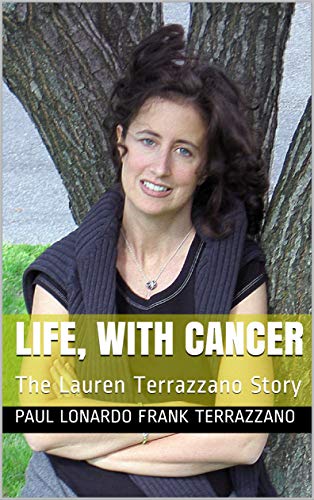
Through interviews with Lauren's doctors, along with those of other physicians, researchers, and clinicians who specialize in lung cancer, readers will have a better understanding of the disease.
With the same passion and honesty Lauren exhibite