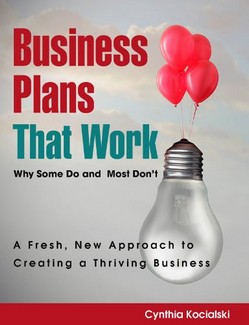
A Fresh, New Approach to Creating a Thriving Business
Every 50 seconds a new business is started with high hopes, and every 60 seconds a business closes with disappointment. It’s a scary fact when starting a new business.
There’s the old route of writing up yet another business plan, but guess what? Look at the results - half of all businesses fail within the first 5 years.It’s not necessary for a business to succeed!
Business Plans That Workis not the boring step-by-step approach to writing a typical business plan, but something quite the opposite … learn how to replace the standard business plan with something that is easier to create and more appropriate for a new business.
The typical business plan of the past was a mere fairy tale, full of guesses, estimates and assumptions of what mightbe. No real facts only made up numbers. And that is not a plan for success.
So what is this new approach then? Entrepreneurs should start with a concept plan first.
Unlike a business plan, a concept plan takes all the guesses and estimates and carefully organizes them and prioritizes them upon how much of an impact they will have on a new business.Then at that point, it devises a plan to prove it’s a viable business idea and/or concept that one can move forward with.
Business Plans That Work provides useful statistics, case studies and a simple six-step Concept Plan formula to help budding entrepreneurs create a starting point for setting a new business on the right path from day one. And if they already have a business plan, that’s ok too. The book shows how to convert it over to a Concept Plan.
Professional Reviews
Must Read for entrepreneurs
Writing a business plan is a necessary part of starting a new business, because all of the how-to-start-a-business books say that it is. Even the best business plan is little more than fiction. There is an alternative.
A concept plan helps to identify the guesses and estimates in the average business plan, and helps to eventually turn them into facts. The idea is to help discover the right business model and right product. Find a way to test your product before actual customers, so that you will have something factual to show to potential investors. If your product, or your whole business idea, neeeds major changes, it's better to find out now, instead of after several years of struggle and money losses.
When it comes to deciding on a purpose or vision for your company, please come up with something better than "the leading supplier of (your product)." What business or consumer problem does your product solve? Do some consumer research to find out what sort of actual problems your product can fix. Are you ready to sell this product, and remain passionate about it, for the next 20 years? What will the product look like? Doing a demo with an actual example of your product will help greatly. Who is your customer? Why should they buy from you, a start-up, instead of an established company? Who are your competitors?
It's never too early to start marketing. How will you make your money? There are many different ways to do it. What is your pricing strategy? How will your product actually be made? If overseas, how will it be shipped from there to here? What about all the other parts of running a business, like accounting, HR and funding?
This book is short, and it is excellent. Written by a Silicon Valley veteran, it is full of information for start-ups of any kind. This easily reaches the level of Must Read for entrepreneurs.
Outlines the Best Approach to Starting a Business
There is something fundamentally wrong with the way entrepreneurs are starting new businesses. If you compare the number of new business starts to the number of business failures, the number of starts is only slightly more than failures. The result show most new businesses fail. This is a trend that has continued for decades, in fact, for as long as records have been kept. What are entrepreneurs doing wrong?
Look at how most entrepreneurs start new businesses. First, they decide they want to be a business owner or entrepreneur. Next they brainstorm for a product idea. Then they investigate, research, and write a business plan. And finally, they execute the plan to closure. The question posed in this book is why this approach doesn't work and what a better one is.
Let's look at the second step - choosing a product idea. Here's what happens most of the time. The person brainstorms and they pick the best idea. Then they research the market opportunity for the product. What if all the ideas are duds? What if they are picking the best of the duds? The original dream of most entrepreneurs is a thriving business that will carry on for years and decades. In that time, there is one business but many products. Products have life-cycles that are fairly short. The order should be reversed. First, pick the market and then chose the product. Markets last much longer than products and often outlive even companies.
Let's look at the third step - writing a business plan. Most are fairy tales. The would-be entrepreneur often researches, investigates, and analyzes data. Most of the information in a new business plan is a mountain of assumptions, estimates, guesses, what-if scenarios, and very little facts. It should begin with "Once upon a time". They have no direct experience with the customers, market or product - but they have five year projections on revenue, break-even calculations, headcount growth, and so on. Why bother? They should ditch the business plan and replace it with a concept plan. This type of plan is simplified for a new business. It aims to identify the assumptions that are the most impactful on the new business and to devises a plan to validate or disprove these. The goal is to prove that a viable business exists first. It creates a process for the entrepreneur to discover the right product for the right market. Only after this proof of concept phase has been completed can the entrepreneur write a business plan that is relevant. These are the steps entrepreneurs skip.
Once walked, the path of the Inner Compass leaves everyone transformed. Uncover a future with unlimited leadership possibilities. Master your ego
https://www.amazon.co.uk/dp/B09ZRRPFW5/