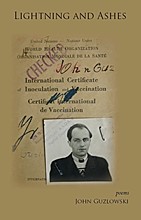
This verse memoir tells the story of two Polish farm kids who were taken to Nazi Germany as slave laborers.
The verse memoir covers their lives from the time of their capture in Poland, through their experiences in the camps, to their journey to America after the liberation.
Excerpt
WHAT THE WAR TAUGHT HER
My mother learned that sex is bad,
Men are worthless, it is always cold
And there is never enough to eat.
She learned that if you are stupid
With your hands you will not survive
The winter even if you survive the fall.
She learned that only the young survive
The camps. The old are left in piles
Like worthless paper, and babies
Are scarce like chickens and bread.
She learned the world is a broken place
Where no birds sing, and even angels
Cannot bear the sorrows God gives them.
She learned that you don't pray
Your enemies will not torment you.
You only pray they will not kill you.
Professional Reviews
A Son of Prisoner by Czeslaw Milosz, Nobel Laureate
What the War Taught Her
My mother learned that sex is bad,
Men are worthless, it is always cold
And there is never enough to eat.
She learned that if you are stupid
With your hands you will not survive
The winter even if you survive the fall.
She learned that only the young survive
The camps. The old are left in piles
Like worthless paper, and babies
Are scarce like chickens and bread.
She learned that the world is a broken place
Where no birds sing, and even angels
Cannot bear the sorrows God gives them.
She learned that you don’t pray
Your enemies will not torment you.
You only pray that they will not kill you.
A very Polish poem, summing up a few wartime experiences of a particular generation. And yet, no. It was not written by a Polish poet. Its author, John Guzlowski, is an American poet who writes in English. He is not only a poet but also a professor of English and American literature, and the author of works of literary criticism. I cited the poem as it was translated by Bohdan Zadura and chose it from the bilingual volume entitled Language of Mules and Other Poems, published by B.S.K. in 2002.
I usually do not venture beyond poetry in Polish in my column, but I am making an exception because this case is exceptional. The author was born in Germany in 1948, into a family of agricultural forced laborers (the father was from Poznań, the mother from near Lwów/Lviv). He himself does not remember those times, but through some kind of osmosis or empathy the stories and memories of his parents keep returning. It is somewhat unusual, this seeking of ties with the past, when in Poland the modern generation of poets are not very eager to remember. Of course, Guzlowski is no longer really young-today’s youth was born around 1980.
In Guzlowski’s poems the land of his parents and the work camps are always present, although at the same time they are only part of his poetic repertoire. In the volume which I have at hand, there are a lot of completely different poems, completely free of the burden of the past. This slim volume even astonished me with its doubleness. The first part summons precisely the camp images from the life of the author’s parents, who were treated by the Nazis like beasts of burden. Their awkward language, because they were both half-illiterate, was for the Nazis a language of mules. The second part reveals an enormous ability for grasping reality with some distance, somehow objectively, and I cannot resist citing a poem titled “Melon” which could have found itself in my anthology, A Book of Luminous Things, true to my poetic ideal, which is something in the nature of a response to the Dutch “still lifes” of the XVII century.
Melon
To Gabriel Josipovici
When I see a melon on the table glinting
in the morning light, why does my heart leap up,
go out to it as it does? Why do I want
to sketch this melon, put it down in words,
or set it down in short melodic phrases?
Sometimes, I think that by doing this I’ll
possess this melon in some way, not in the sense
of buying it, that’s not what I mean,
but in the sense of seeing that this melon isn’t
a part of me, not of me, can never, in fact,
come closer to me than it is now,
at this moment when I see it before me
on the table like some small world I dreamt
as a child in my sandbox of dreams,
and seeing it as this world, I am taken by it,
possessed by it as surely as the spring
takes the elm, thawing it until the winter
is nothing in its life, until the skin
of leaves it’s lost is nothing. I become
the melon’s then, exist only to admire
its beauty, its lime white skin and cold sweetness,
its Bethlehem and Golgotha, exist only to admire
its otherness, and see my self a part from it,
never closer to it than I am now, never freer
than now of my own place of skulls.
Translated by Anita Shelton
This review of John Guzlowski’s poems first appeared in Polish in Tygodnik Powszechnny, no. 31 (3 August 2003). It is hereby published in translation by the author’s permission.
The Tear Stained Poems of John Guzlowski
The tear-stained poems of John Guzlowski
(Lightning and Ashes, John Guzlowski, Steel Toe Books, 2005, 86pp, $12)
This is how an innocent project turns into a horror show.
I read many books of poetry that I enjoy and often admire. But I’m not moved to write something about them unless I think I have something illuminative to say. Lightning and Ashes is one of those books that riveted me but did not move me to write about it, not at first. It sat on my coffee table with several stacks of books until I picked it up again and began reading it from the back to the front, a perverse habit formed in childhood.
This time I understood why John Guzlowski’s poems called me back to them. They have an innocent fragility about them, the kind of fragility that moves you to fear for certain children, for young adults whom you fear may not thrive in the hurly-burly of life. On first or second glance, that is. But closer consideration reveals a fibrousness that would stop a scythe. They are fibrous when living them, but reflecting on them is like opening a tear-stained book.
The poems called to mind an encounter years ago in New York City with an Auschwitz survivor whose luminous beauty came of having survived evil and finding each moment precious. The poems are celebrations of survival—and the triumph of human nobility.
I can’t explain what happened at this point. I had read the book twice. There was nothing in it, nothing overt, to prompt me to do what I did next, but I began searching the web for information about Nazi marching bands, bandmasters, drummers, haughty Glockenspielers, the whole goose-stepping cast of characters from a March of Times newsreel. I wanted to know what had happened to these strutters who had intimidated capital after capital. What were they thinking then? What were they thinking later?
Some of them, of course, were killed, like the millions of people their armies, political police and Einsatzgruppen killed. Why did I want to know this? It had nothing to do with the book. Or did it?
I remembered particularly the German drummers on the Champs Elysées when Paris fell. Is this what they had wanted for their musicianship? Did they see the fear and despair in the faces of their onlookers? Did they care? And, finally, why should I give a damn about the awful lot of them?
As I searched the web I found a horrid answer. There are thousands, perhaps millions of people who care, a vast, fetid swamp of people who feed on Nazi nostalgia, who buy and trade Nazi paraphernalia, who yammer about how wonderful were the SS, Wehrmacht and Luftwaffe (curiously, little mention of the Kriegsmarine). And floating in this swamp are filthy, racist words: “We’re coming back to rape all the frog whores....we’ll take care of the sand niggers....we’ll straighten things out....”
We? I doubt they’re all German revanchists. But they’re all haters, they’re all drunk on venom, and they all approve of murder. Carl P. Paladino, the thuggish Republican candidate for governor of New York, had just threatened to “take out” a pesky reporter—a death threat in public, and no prosecutor is stepping up to the plate. What would have happened to me if I had told a reporter I was going to take him out? Would people have thought I meant to an Italian restaurant? Where is our public decency?
I wondered if this decadent obsession with Nazism is merely coincident with our American retreat into a la-la America that never existed—a whiter, more unjust America—or whether it is part of a white and racist response to successive waves of immigration that have transformed European and North American demography, a change embodied in the election of an African-American president.
The ascension of the Nazis in 1933 was the result of a longing for a wholeness and purity of purpose that Germans felt they had lost as a result of their defeat in World War I, a national wholeness they'd never really had. They came to believe all too willingly that broadly assimilated Jews who had shared Germany’s destiny for a long time stood in the way of this identity with a purpose. Isn’t this exactly what underlies much of the Tea Party speechifying? And isn’t it even more bogus than it was in Germany? Germany was, after all, far more homogeneous than we are. African-Americans, Jews and many other peoples were present at the birth of European America, albeit the African-Americans unwillingly. But there was from the outset an impulse to anglicize the country, to ignore multiethnic and tolerant New Amsterdam and to mythologize intolerant and homogeneous Plymouth and Jamestown. And this impulse is today resurgent in spite of our obvious diversity, and the impulse’s survival depends on the silent acquiescence of our most assimilated minorities—the Irish, Italians, Slavs and others. It even depends on the silence of African-Americans who remain anything but assimilated. Without the tacit approval of these minorities this revival of ethnocentrism masquerading as a popular movement will fail at the polls. And as for New Amsterdam, well, New York City is still demonized in parts of the nation as something apart and not quite American.
So here in my head, with my fingers turning the pages and my eyes sorrowing, was this nexus of poetry, hatred and today’s politics. It was to me an example of the power of poetry to project us towards astonishing speculations. A poem sets off a sequence of events in our minds and there is no telling where we will wind up. Guzlowski’s elegiac poems stand in stark contrast to today’s vogue for sentimental, intellectually flaccid poetry.
He had not meant to sound political alarms, although his book was published in 2005, an alarming time. What times are not alarming these days? But I’m sure he would not be surprised that a reader should think of the Nazis and the shadow they cast over today’s events. We know, after all, that when all rhetoric is parsed the Tea Party and the fabulously funded right-wing revanchism we are witnessing is about racism, not taxes or big government or big spending. We know the ascent to the presidency of an African-American set it off. (What we don’t know is why our minorities are strangely silent about it.)
It’s probably not fair to turn an appreciation of a book of poems into political discourse. On the other hand, it might be a tribute to the poems, which in their elegant progress from one song to another, one elegy to another, inspire such speculation. Poetry, art and performance are much more current than the news, more cogent. They put our minds to work, the last thing politicians want. The state of our culture is not in the news, it’s in the arts.
John Guzlowski’s poems are naked, as were the gas chamber victims, and in their naked, plaintive beauty they call into question everything that shouts, dolls up, sneers and bullies. The Nazis were masters of deceit and disguise. Even vanquished they looked victorious. "A booted and buckled fool with his assortment of variously propelled junk," Vladimir Nabokov had memorably called the Nazi in That In Aleppo Once. I concur with him on Monday, but on Tuesday I see the Nazis as superb actors. I begin to fall into the Stockholm Syndrome thinking about them, the syndrome into which our right wing would like the rest of us to fall. Charlie Chaplin gave us the comic-opera Nazi, but the Nazis gave us an enduring metaphor for menace, and it is celebrated today on the web with a vengeance.
As I studied the faces of those booted drummers and their godlike bandmasters I remembered the story of a German soldier who every day for weeks escorted people to the gas chamber, and then one day he undressed and marched to his death with them. How many of those Wehrmacht and SS musicians were like him? How many were killed? How many suicides? How much evil can we (for we are them) stomach? And are we about to find out here in America?
I read and reread John Guzlowski’s poems about the war coming to his native Poland, the slave labor camps, the death camps, the starvation and brutality, and finally a new but haunted, broken life in America. And I kept thinking of church liturgy; it’s beautiful and memorable, but Jesus would have preferred these honest poems whose astonishing beauty comes from witness, from unutterable pain, the pain of the cross. This is the way we should speak to God, I thought. This is what God will hear. Guzlowski's poems stand out like the red letter passages of the New Testament compared to what we must attribute to others.
I have always thought the act of writing a poem, the work, is prayer. John Guzlowski has affirmed me in this conviction. Listen:
Dear Baby Jesus,
If You have any pity left
bestow it, please, on my wife.
She suffers from the war.
....So the poet imagines his father's prayer. This terrifyingly honest poem gets even more harrowing.
But my wife Tekla—
she is one of your sparrows
and the pain she feels
has nowhere to go
so she beats our daughter
sweet Danusha
and is cruel to our son
who she also loves.
God then is cruel to us because we are loved? It's tempting to make that our sardonic refrain, but more likely we are witnessing the crux of the psychiatrist Alice Miller's writings, that cruelty is a generational legacy and the horrors perpetrated by Stalin and Hitler can be traced to a brutal parent.
Hope is/the cancer no drug can cure, the poet writes in "My Father Dying." My mind ranged over the terrible suffering his parents had endured and witnessed, suffering he had had to glean and process as one who loved them but had not shared their time on the cross. The Germans came and six million Polish Jews and Catholics were to die in the camps. The half-human politicians who had ignited the war—those who started it and those who were slow to act—fell silent as ordinary people, housewives, foresters, farmers, tradesmen were consumed in the conflagration.
And now once more the politicians are talking far too much, stealing our money, pandering to the oligarchs while a vast tide of sentimentality for the awful Nazis rolls across the web—fellow human beings whose hearts are stirred by unspeakable cruelty and wanton murder. This too is what the cross symbolizes, and this too is a crucifixion.
And indeed John Guzlowski does recall Saint John of the Cross. Mysticism is not mumbo jumbo, it is the very plaint of our inmost selves, and it may speak as plainly as barroom palaver or as hieratically as a Delphic oracle or as enthralling as Gerard Manley Hopkins.
Guzlowski’s poems are lyrical, stanzaic and unrhymed. But plainspoken as they are, they take on the aspect and sound of plainsong and therefore we experience the odd sensation of remembering them as rhymed. In this sense, whatever their salute in the direction of formalism, they are thoroughly modernist. They rely on the reader’s knowledge of rhyme, the reader’s memory of rhyme as their own device, and so the reader unconsciously supplies the rhyme.
"The Third Winter of War: Buchenwald" appears in Part Three of Lightning and Ashes and is the most extended poem in the collection. The Germans, as in other poems here, appear as specters. Their indifference to the suffering of humans is ghoulish. I think it is this facet of the book that turned my mind towards the Wehrmacht musicians. I was searching for humanity in dark places. Perhaps I even felt resentful that an entire race should be cast so uniformly, as it were. But the poet was constrained to speak of what he knew, and what he knew was what Germans had inflicted.
We soldiers are only human. We love
to kill. It is the hidden God in each of us.
This chilling coda concludes "German Soldiers Come to My Mother's Village." It could hardly be more current as our own army investigates allegations that five American soldiers, coming to an Afghan village, had murdered Afghan civilians for the sheer fun of it.
But not just Germans, it should be said, because life in Chicago after the war wasn’t easy. There was yet another language to contend with, other mores, other prejudices.
I see long lines of people—never mind their nationalities—holding candles and chanting these poems. No liturgy, however magnificent, ascends to this witness.—Djelloul Marbrook
Lightning and Ashes Review--from Barn Owl Review
John Guzlowski's book, Lightning and Ashes, chronicles the lives of Guzlowski's parents in WWII and post-WWII Europe, where his mother and father were placed in labor camps and later filed away as Displaced Persons before eventually immigrating to The United States, where many of these poems are also based. In many ways the poems of this book are historical, political poems. Yet Lightning and Ashes also meditates on the connections between generations, from mother-to-son, father-to-daughter, and how the wires and signals of experience get crossed in good ways and bad. There's a temptation to consider or label Guzlowski's work plain, sparse, gray. But there's a reason for that. Because Lightning and Ashes attempts to answer a question not often posed by poetry nearly enough anymore: How does one utilize imagination in an effort to record terror, hostility, depravation, when experiences like those of Guzlowski's parents render metaphor and simile out of place, if not entirely useless? In light of this question, Guzlowski decides to let such devices take a backseat, not an easy thing for a poet to do, and lets the facts of the story do the work for him instead. Only on occasion do these poems employ tactful artifice. “German Soldiers Come to My Mother's Village,” for instance, marks a drastic shift in perspective as Guzlowski assumes the voice of a German soldier who tells us of a group of Poles:
There is no fat for their lamps. The sole light
you see comes from a candle in a cellar
where a woman in rags searches for roots.
This is the only world they'll ever know:
these huts, and the mud road that brought us here.
The opening to “There Were No Miracles,” however, embodies the tact of the majority of this book:
Men died where they stood
Children were left
for the dogs and the pigs
At its best, Lightning and Ashes is a book concerned with lessons learned. Sometimes the learning may have taken half a lifetime, however, and most often it isn't a political or historical lesson. In “Chores” Guzlowski reflects on an exchange with his mother:
One day I asked my mother,
“How about an allowance
for sweeping these stairs?
A quarter once a week?”
When his mother denies him, Guzlowski remember how:
She grabbed my broom
and went outside and stopped
the first kid she saw on the street,
a kid I hated from school,
and she gave him a quarter
just for doing the stairs
I would've done for free.
Perhaps this is Guzlowski reflecting back on a lesson learned decades ago. Perhaps it's a reflection of a lesson learned only now, decades later. Either way, the moment has stuck with him, and for good reason, just as many of these poems stick with the reader.
On February 20, 2003, pyrotechnics at a rock club in West Warwick, RI set off a devastating fire that roared through the crowded club, killing 100 people and injuring hundreds more. Gina Russo was one of the survivors, and she retells her harrowing e
A passionate and poignant memoir written by a woman whose life has been guided by the words: "I am here to learn how to love well." The book is a deep examination of relationships, family, motivation, and honoring of the Self.