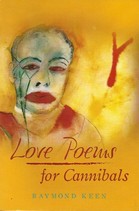
"Love Poems for Cannibals" expresses the thoughts, feelings, quandaries and wonder of an American poet very much alive to the darkness and light of the 21st century.
As the reader moves through "Love Poems for Cannibals," he/she will find poems of war (in this case Vietnam), poems dealing with current spiritual issues (Christianity, Buddhism, spiritual doubt and the soaring-singing human spirit), dysfunctional family relationships and feelings, portraits of great spiritual figures in contemporary human history presented with candor and wit, poems that rage against the omnipresence of human hypocrisy, and poems that present American/Western civilization under a glaring light -- with the single redemptive quality that this author's truth sings.
Excerpt
"Soul Star"
Why would I
not sing to you
in tears of
vermillion fire?
Sing the fires of blue flame,
sing the rage of form.
For these words
no location
in the blood-red
depths of an apple-green
paradise.
Yes, yes your azure eyes
speak mine.
You breathe Bordeaux.
Your body is a rainbow
in this gunmetal world.
Heather me, feather me
in this gunmetal world.
Your seraphic soul
a star sapphire,
your roots a verdant green.
Awaken me
you do
in this
most pale night.
You cry out in me.
Professional Reviews
Kirkus Reviews -
KIRKUS REVIEW
Startling, cynical, satirical free verse about life among the postmodern ruins.
Keen’s debut poetry collection arrives at the party already a little drunk, a bit raucous and talking a mile a minute, but the longer the night goes on, the more sense it seems to make. After all, he’s not out to hurt anyone; he’s just trying to figure out where it all went wrong for all of us. With considerable energy and tightly coiled wit, Keen ranges across the political, spiritual and pop-culture landscapes only to find them all a little disorienting and largely bereft. “There is no sadness,” he writes, “But the fear of sadness. / There is no despair, / But the distraction from despair. / There is no suffering, / But the avoidance of suffering. / We’re living in bad times, / Biochemically speaking.” Regardless of where he looks, nothing essential remains. Love is sold “in bottles now, / and smells like aftershave,” Christ is “lost in all the traffic” and “so far away from now.” Even your sense of self is suspect: “In this cellular moment, / This eternity / Among strangers, / You see / Yourself / In bits / And / Pieces, / Impossible to describe.” Trapped by the postmodern condition and yearning for the teleologically secure time “before the world was shattered,” Keen’s narrators respond in seemingly the only way available—playing their own language games, answering absurdity with absurdity and papering over fragmentation with pastiche. Meditations on death are peppered with popular advertising slogans, and the apotheosis of Western civilization is reduced to Michelangelo’s David infested with maggots. With no certainty, even of the self, the poems join in the cannibalizing of culture, seeking irony in unexpectedly ironic situations. Amid the brutality arises humor, and Keen ably joins a long tradition in American avant-garde poetry of lampooning demagoguery with poems like “The Demystification of Henry Kissinger” and “Even at Night All Snakes Swallow Their Prey Whole: Looking Back at Arafat & Some of His Peers.” Supporting the politics, satire and social commentary is a more than capable, sometimes beautiful verse that relies heavily on repetition—from anaphora to choral refrains—and startlingly precise imagery (“sway-backed surgeons, / Peeling human skulls like eggs”) for great effect.
Thought-provoking, incisive and entertaining; a remarkably well-rounded debut.
The VVA Veteran - Books in Review - Review of
Love Poems for Cannibals by Raymond Keen
Posted on March 15, 2013
Raymond Keen spent three years as a Navy Clinical Psychologist, with a year in Vietnam from July 1967 to July 1968. Love Poems for Cannibals (CreateSpace, 166 pp., $9.95, paper) is Keen’s first book of poetry, although he has published poetry in twenty-two literary journals. The book consists of about 140 pages of poetry with a few prose pieces at the end, about ten pages worth.
The book is arranged in eight sections. The first, “The Vietnam War is not dinky dau. (1967-1968),” was of the most interest to me as a Vietnam War veteran and author. There are a half dozen poems presented in this thirteen-page section. I loved them all.
The section starts off with a long poem, “Dream Frag of Robert Strange McNamara.” It’s a dream come true for this veteran, a poem in which McNamara deservedly gets fragged for his part in designing and prolonging the Vietnam War, which resulted in the deaths of tens of thousands. Of course, McNamara lived a long, healthy life, and cashed in on the war with a best-selling and self-serving book of too-late apologies.
The poem begins powerfully, with the lines, “McNamara, with his shit-eating grin/McNamara shit out of luck,” and gets better from there. Keen displays a “Keen” facility with Vietnam War jargon, used to great effect. In a short space we encounter: wasted, R&R, ticket-punching, Donut Dollies, rack, FUBAR, skull fuck, absofuckinglutely, and Dogpatch.
The other poems in this strong section also demonstrate Keen’s poetic and effective use of language. These poems take place at 1st Med Battalion, some of them in the neuro-psychiatry hut, in Danang. My favorite in this section is “Grabass With China Beachball Here In A Sitdown: On Point With The REMF.” Because I am the author of the novel, REMF Diary, this poem held a lot of interest for me, and I read it with great care.
It starts off this way: We got it covered/Here in the rear/Because we’re in the place you want to be./Here in the rear we are AKA/The Rear Echelon/Mother fuckers./Do you have a problem with that, Bushman?
Actually, the grunts did have a problem with that, as attested to by rants in hundreds of memoirs and novels written by combat troops about REMFs and their entitlements: good food, sex, beach volleyball, air-conditioning, regular mail, clean sheets, etc. Keen addresses that and more in this great three-page poem.
I enjoyed the poems in the other sections of this book, too, often sensing the influence of the Vietnam War in the words and tone of poems such as “Still Life with Shit in a Wine Glass,” “Irony Is The Cross Upon Which Meaning Is Crucified,” “In the Ronald Reagan Lounge,” and “Why Aren’t More People Screaming in the Streets, America?”
I highly recommend this beautifully written and edited book.
The cover features a watercolor by Francesco Clemente called “Fire.” Keen chose this amazing painting of a clown-like human face for the cover, he tells us, because “it embodies the mysterious luminosity, exquisite vulnerability, and a bit of the enigma of being human. I only hope that some of these poems come close to doing that.”
They do come close, and for that reason, I want you to buy and read this fine book of poems.
The author’s website is http://raymondkeen.com/
— David Willson
Vietnam Veteran and author of REMF
(Rear Echelon Motherfucker) series: REMF Diary (Black Heron, 1988), The REMF Returns (Black Heron, 1992) and the prequel In the Army Now (Viet Nam Generation and Burning Cities, 1995).
“Love Poems for Cannibals Blends Poetry and History” by Kate Newton
It may have been over 40 years in the making, but Raymond Keen’s first volume of poetry hardly fails to resound in the here and now.
Love Poems for Cannibals, which Keen self-published using the Amazon company CreateSpace, is the result of decades of accumulated inspiration. His dabbling in writing began when Keen was finishing grad school in the early ‘60s, but hit a peak when he spent a year serving as a Navy clinical psychologist in Vietnam. He filled entire notebooks with “sentences and particles” during his time there, a rough framework of poetic snippets that resurfaced in 2011.
The framework began to evolve into a full volume of work, and in the meantime Keen’s work was published in a series of literary journals, including the American Poetry Review in 2005. Publishing a book, though, remained a goal, and CreateSpace proved a relatively easy outlet for achieving just that.
Described by Keen as at times “topical and political,” other times “dark and difficult,” the poetry of Love Poems for Cannibals is often a bitter reflection of a lifetime of experiences. Controversial figures from Richard Nixon to Charles Manson are referenced and routinely mocked, immersing readers in moments of history that often leave a bad taste their mouth.
“A lot of my stuff is about actual human figures (in history), but by the same token I’m writing in the 21st century,” said Keen. “...The stakes are higher because of the damage we can do, so quickly, to each other.”
This “take-no-prisoners” approach to digesting contemporary society through poetry can be bitter and provocative, but also have its moments of thoughtful reflection. The second section of the book, "Est Deus in Nobis," is comprised of poems written from 1969 to 2012 that have a religious and spiritual theme, in stark contrast with the Vietnam war imagery in the previous section. And the last section, “Prose Koda,” contains perhaps the most controversial poem of the book: a 3-page prose piece meant to mimic an anti-American “fatwa” by Osama bin Laden. Satirizing the voice of one of the most hated figures in history is no easy feat, but Keen simply sees it as a humorous dimension of his writing.
“Some of the poems are just outrageous, but because they’re so outrageous I think they’re almost funny,” Keen said. “There’s a lot of wit in this that redeems the anger. ...That seems to come easy to me.”
Exploring broad issues from the focal point of a single historical event is another recurring theme of Love Poems for Cannibals, seen perhaps most strongly in “Saying Goodbye to John Lennon,” a poem Keen wrote in the 1980s shortly after Lennon’s death. In the poem, a gossipy radio announcer fixates snidely on the petty details of celebrity’s lives, and at the end of his broadcast offhandedly mentions, “John Lennon was killed last night, in America. I’m not surprised. ...Let’s go to commercial.” The poem was partially inspired by the films of Jean-Luc Godard, and the filmmaker’s recurring theme that in a commercially-driven life, everything is for sale...including humanity’s ability to truly mourn the loss of a fellow human being.
Having served as a psychologist around the world (his former places of residence include Germany, Turkey, Panama, and Japan, to name a few), Keen is well-trained in the art of observation and took it upon himself to subvert the clichés he’d encountered throughout his career. Transcending the “banal and unimportant” into something profound served as the driving purpose of Love Poems for Cannibals, and Keen has taken it upon himself to give readers a much-needed break from the talking heads of mainstream media.
“It’s cool when we can say as human beings something that’s never been said,” Keen said. “If my poetry is about anything, it’s about trying to escape (these clichés).”
Keen now lives with his wife in Sahuarita, Ariz., and is working on self-publishing his play, The Private and Public Life of King Able. You can buy Love Poems for Cannibals on Amazon here or visit his website to read some selected works featured in the book.
Love Poems for Cannibals, Raymond Keen, 155 pages, CreateSpace Independent Publishing Platform
Kate Newton - Friday, April 12, 2013
THE RANGE – The Tucson Weekly’s Daily Dispatch
Each person is but a grain of sand resting beside the sea. This thought sets the tone for Jill Eisnaugle’s latest poetry collection, Beside Still Waters.
Perhaps "..Quiet Storm" will help rekindle old flames buried and long forgotten or express the love so deeply locked inside of your soul longing to be released.
Regardless of where you may be found in love this beautiful masterpiece can be