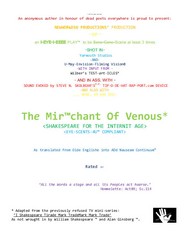
King Able thinks he is alone and abandoned in his palace. But evil men dressed identically in white masks and lab coats are watching him.
My play is about a king who lives alone, seemingly abandoned in his palace. He is a very old king, but sprightly for his age. He makes vague, accusatory references to the queen who has left him. It is not clear if the queen is his wife or mother or fantasy.
He is an “unreal” king. Short and rotund, he wears a kingly uniform, maybe even with white fur collar and cuffs, red silk, etc. He may even remind one of “The Little King” cartoon. Yet in some of what he babbles, there may be a little of “King Lear.”
The king is named “King Able.” He considers himself an “able” king. He works hard on his radio addresses to the people, and expresses good thoughts (clichés). He could also be considered “King Abel,” for he is a victim of the “forces of Cain.” Throughout the play there will be anonymous men in masks who appear to be watching him in silence. They are dressed exactly alike, their white coats and masks projecting an insidious and possibly malevolent clinical detachment. So he is an apparent victim of anonymous men observing him throughout the play who, at the very least, pose a mysterious threat.
This “abandoned king” is an “undifferentiated everyman.” He speaks in clichés, ruminating about his situation, and remaining utterly clueless about who he is. The king is a victim of his own lack of self-knowledge, as he lets himself be duped through the many years that his radio program is getting through to the people. He is duped by his own language: What he says has almost nothing to do with a real understanding of his situation and plight. For years he has remained alone in the palace, ruminating and babbling for self-comfort, but doing nothing to understand or change his dire circumstances. He is a victim of what he tells himself, a “victim of language.” The king’s “tragic flaw” is that (not unlike Oedipus) he believes what he says is reality. He is blinded by language. The king does not realize he speaks only words, not truth.
Although the king is tragically unable to get beyond the reality of words to any kind of authentic self, there is at least in scene one a sense of “freedom” in his speech.
The usual “public and private” is reversed in the title, The Private and Public Life of King Able. The irony of the play’s title is that the king has neither a private nor a public life. He is always being watched and monitored, so there is no privacy; his human contact with the people through his radio addresses is a fiction, so there is no real public life.
Everything has apparently been running smoothly for King Able for “decades.” When things stop going smoothly for the king, he at last makes a tentative decision, maybe even a brave and “tragic” decision at the end of the second scene, to leave the palace.
The Private and Public Life of King Able is character-driven. No poem could contain the depth of my vision of such a foolish old king, helpless against the evil/impersonal forces covertly marshalled against him. The action of the play proceeds ineluctably, as the words of King Able fly up in seeming irrelevance to all that transpires. King Able, the only actor in the play who speaks, cannot say anything to help or ameliorate his situation. The silent men who watch King Able move and work efficiently and effectively to get what they want. So the drama uses language as a counterpoint to meaningful and effective action. The only character who speaks seems to be caught in his own “fog of language.” King Able uses language to distract, deny, distort, and obfuscate his real situation, about which he remains clueless. His language of “self-comfort” is his mortal but unacknowledged enemy, an enemy of the truth.
The Private and Public Life of King Able follows in the tradition of the Theater of the Absurd --- a good example of that kind of theater being Waiting for Godot by Samuel Beckett. The language of King Able is full of nonsense, ambiguity, madness, and a kind of profound babble. The men in masks in the play could symbolize the anonymous bureaucratic forces that control and deaden individual lives without their even knowing it.
Excerpt
Good afternoon, royal subjects. This is your royal official self, his Royal Majesty, speaking to you once again from the Royal Palace. (Pause. King begins to read speech.) I love the sciences, royal residents. I remember as a royal boy how I loved them. Growing into royal manhood renewed my love and appreciation of these items. When I was a royal child, I remember how few scientists lived in the neighborhood. To be quite honest, I can’t remember a single one. But by royal adolescence we had three or four down the block. Today, royal contemporaries, today, well suffice it to say there are more than I can count.
Our Queen, and royal historian, has noted our age as being highly innovative. That is not to say that there have been no mistakes, but we have learned from these mistakes. Our vaccinations are at an all-time high. Indeed, prophylaxis has become a household word throughout our Kingdom. Yes, the days of bloodletting are over thanks to our medical friends.
Some say our era began with the crossbow. Others say with the cannon, which came shortly after. But soon to follow was the machine gun, the airplane, and the airplane with machine gun attached. So who is to say? These gifts from our past, along with the laser beam and the electric oven, have given us complete control over our environment. And all these things have come upon us so rapidly that we have no choice but to agree with the Queen that we are in the midst of what she has called, “The Scientific Revolution.” For the first time we, the human team, have the power to create, as well as destroy. I am told that the scientists are continuing to collect the data . . . . (brief dramatic pause) The final results are not in as yet, but it looks like a good season for humanity!
Professional Reviews
Review of The Private and Public Life of King Able by Alan Catlin, Misfitmagazine.net – Issue No. 18.
This remarkable short play thoroughly entices the reader. An older, but still spry and alert seeming king, is sitting on a throne in full royal regalia. At his back, to his right, is a wading pool, and at his feet, a CD player. The king is holding the player’s remote as he begins to speak. He addresses remarks to an unseen audience, pauses, waits for a reply but hears nothing. Gradually you become aware that this is a monarch without a kingdom, the speech addressed to people, largely in his imagination and memory. The only response to his speech, realistically, will be one that is self-generated from the tape recording.
In a mere few pages, Keen has conjured a setting and situations that recall Samuel Beckett, that channel “King Lear,” and has stage directions by the Dadaist, Alfred Jarry. Is this “Krapp’s Last Tape”? Or is this a Shakespeare knockoff? “Ubu Rex” or a Lost Elizabethan History play found on the other side of Alice’s Looking Glass? The only way to find out is to read on and decide for yourself.
I contend it is all of these and much more. In the second scene, silent masked men dressed in white lab coats, like guards, or attendants, appear. Now we are in the territory of Peter Weiss’s Marat/Sade and the poetics of madness and totalitarian politics. As in Weiss, the madhouse is a metaphor for society on the whole, and the rulers in hell are not only dispossessed but clinically insane.
Simply reading a play and visualizing the narrative without the expressive cues is challenging, as seeing what is written expands what is said. On the page, intonation, gestures, expressions can only be inferred. Still what is on the page is a remarkable achievement. Keen takes great pains to create a viable, visual narrative that makes the reader yearn to see the play live.
In particular, as with Beckett’s plays, it is difficult to see the potential humor in the words, until you see how the author/director’s intentions are fully realized on stage. I suspect there is more humor involved here than the ominous setting and situations suggest. As with Beckett, as we near the end of civilization, of life, we must laugh, because life is absurd and absurdity is, or can be, extremely funny. The way black humor is funny. You are either king or you’re not. You either go on or you don’t. You either laugh or you cry. It makes no difference in the end. King Able would understand.
KIRKUS Review of
Keen (Love Poems for Cannibals, 2013) portrays two days in the life of a paranoid king in this debut play.
King Able is the nominal ruler of his kingdom, but it’s vague how much power he actually possesses. It’s unclear, even, whether he has any subjects or courtiers; in Keen’s minimalist three-scene play, Able is the sole speaker, and the only other characters are masked men who spend much of the drama leering out from the background, seen by the audience but not by Able himself. Able’s powerlessness is on display as his royal requests go unanswered: “Where is the royal catalogue? (Pause. Flamboyance continues.) Where is the royal thermometer? (Pause.) Bring in the royal book of phrases. (Long pause.) Where is the court prognosticator? (Pause.)” The play highlights his insecurity during his daily radio address to the kingdom; he’s able to keep his composure during his prepared remarks, but when he’s unable to shut down the microphone afterward, his demeanor cracks into a paranoid rant that includes his suspicions that the queen is keeping him prisoner. He eventually decides to make an escape, but the trap he’s in—whether built by the queen or simply by the playwright—won’t release its prey so easily. Although the king’s frantic dialogue lies at the heart of the play, Keen’s precise set and stage directions are arguably more central to its themes, execution, and emotional resonance. The long silences, use of audio recordings, and simultaneous actions on different parts of the stage reveal the work as not a series of monologues, but rather an intricately orchestrated puzzle. Readers are left to simply imagine the effect of all of this in a live venue, which strips the printed text of some of its power. Upon reaching the end of this short drama, they will want nothing more than to see a staged production of it, particularly its final moments. Still, for such a brief work, Keen manages to pack in an impressive amount of tension and implication, leaving readers to question who’s really pulling the strings.
A clever, creepy drama about paranoia and control.