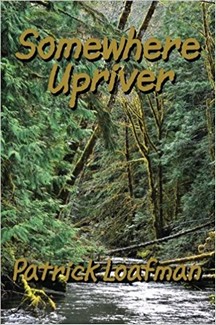
It's about amphibians and herpetologists; it's about white-man Afros and Bigfoot; it's about the Queets rainforest in Olympic National Park; it's about a puff of medical marijuana; it's about salamander toxins, and how newts and pufferfish and ancient Haitian mythologies are all interwoven to a bearded biologist in the northwest corner of the U.S. - or something like that.
A humorous novel following wildlife biologists into the foggy world of the Queets rainforest of Olympic National Park as they chase after salmanders and frogs and maybe even the fountain of youth. It's a story rich with natural history, a bit of governmental conspiracies, a little mystery and adventure and a lot of quirky, neo-hippie characters.
Excerpt
Chapter 10, from "Somewhere Upriver"
Veronica was at my apartment door when I arrived home from the Queets late that Sunday night. Her long black hair was soaked and her clothes clung to her. I had just returned from a riotous adventure in the field with Peter, while she looked like she had the worst week of her life. The whites of her eyes were riddled with red and her dimples were nowhere to be found.
“Where’s your raincoat?” I asked.
She shook her head. “We need to talk,” she said.
We need to talk, the four words most feared by males. I fumbled for my keys, opened my door and flipped on the lights. The room was empty, except for unpacked boxes; the scientific papers that Peter had given me sat in a tall stack; an unwashed plate and drinking glass lay on the floor where I had eaten dinner a week ago. I didn’t have any furniture, no place for Veronica to sit, but she didn’t want to sit, she wanted to talk.
“Do you want to change out of your wet clothes?”
“I spent the week in Portland. I needed some space.”
“I was worried,” I said.
“I stayed with my friend Sam,” she said.
Ah yes, I thought. Sam, her best friend whom she also had a relationship with during her senior year in high school, who now was just a friend. Veronica had told me all about Sam. Sensitive and feeling Sam. A man who was not afraid of the phrase, we need to talk, but rather, looked forward to talking. The type of guy who makes a normal man look like an ape or even Bigfoot.
“It was not that way at all, Douglas,” she said, as if my anti-Sam sentiments were scribbled upon my face.
I nodded as the re-runs of “Sam, the Sensitive High School Sweetheart,” starring Sam Hansen and Veronica Crane played in the theater of my brain: they were cuddling on a bed with too many pillows; they were dancing at the prom—Miss Crane in a stunning red dress and Mister Hansen in a Tuxedo; and then the final episode where Veronica tearfully leaves for college and a degree in wildlife biology and a life of outdoor adventure, while Sam goes to Portland to work at his uncle’s pillow factory.
“Douglas? Are you even listening to me?”
“Of course. How’s Sam doing?”
“It has nothing to do with Sam! Douglas, we’re talking about us! Our future! If there is one…” she trailed off, as some tears began to form, but somehow she sniffled them back in.
“I love you,” I said. It just came out, almost like a burp. Why was I
acting like this? My mind was buzzing with activity and I couldn’t slow it
down. Brain food. That was what Peter called his homemade beer. I had a
few with him after coming out of the woods and felt as though my mind
had been fed.
Veronica looked at me and squinted as though I were out of focus.
“I love you, too.”
I nodded and smiled, holding back a tear of my own.
“But,” Veronica continued.
The but is less of a conjunction and more of a warning, like the butt of a rifle, I imagined, steadying myself.
“But I’m not sure we’re ready, you know, to get married. Maybe we’re just too young?” Veronica shifted her weight from one leg to the other and then back.
I was actually glad to hear that, because I had been thinking that off
and on ever since I’d proposed to her, but …
“Douglas?”
“I love you,” I belched out once more, and again, she had a puzzled demeanor.
“I just don’t want to lose you.”
We hugged, her scent washing over me like a freshly mown lawn, while my own body odor was a stew of unwashed socks and pickled mustard greens, an essence that failed to combine with Veronica’s manicured lawn, like oil and water mingling but not mixing. At one moment I smelled a meadow after a spring rain, becoming aroused, the next moment I smelled a sewer and my arousal faded. My penis was doing push-ups like a lizard. Up, down, up, down. I leaned in for a kiss, but Veronica turned her face and my lips merely brushed her cheek.
“I could take a shower. Or better yet, we could take a shower. I have a luffa sponge.” The luffa is the inside of a gourd, a fact that Peter, the gourd-fanatic, would have explained in detail if he were there.
“Douglas,” she said, stepping back. “It’s not that, but… Well, you do stink.” Her toothpick dimples made a brief appearance. “Sam and I decided…”
My manhood retracted like the head of a frightened turtle, so far in fact, it was like the penis’ version of an inverted nipple. I could see it so clearly in my mind that it was disturbing. Again, Veronica could read my face, or maybe she heard my balls clunk onto the floor and roll away at the mention of her best friend/exlover and her making some grand decision together. Another image so clear that I believed I heard the clunking and turned my head, looking for my testicles.
“I didn’t mean it that way. This has nothing to do with Sam. What I meant to say was I realized some of my own feelings this weekend.”
“I see,” I said, shaking my head as if to contradict myself.
“We need to slow things down. Just date each other.”
I leaned in to kiss her and this time she did not turn away. I started to unbutton her wet blouse, but she gently grasped my hands.
“I’m serious, Douglas. Let’s take it slow.”
“Let’s take it slow” places a close second to “We need to talk” in the hierarchy of four word phrases that men never want to hear. In fact, “Let’s take it slow” has no real translation in the male language and men are dumbfounded by this phrase, as if the woman had just sung like a sparrow. I stood there not knowing what to do or say, and this time it was my manhood that sighed and shook its head.
“I need to look for a place of my own. I need to be by myself for a
while.”
I tried to smile.
“Sometimes I think there’s a lot more going on in your head than I realize.”
I nodded and swallowed another I-love-you belch, imagining my balls had rolled beneath a cardboard box.
“Like what are you thinking about right now?”
“Nothing,” I said, not wanting to tell her how I was too vividly imagining my balls rolling around the apartment. Why was my mind so distracted?
She sighed. “We need to get to know each other better, and I don’t want sex to complicate things.”
I nodded. My penis, fatigued from all of the push-ups, fell asleep, and Veronica looked at me as if she could hear it snoring.
Professional Reviews
Somewhere Upriver Reviewed by Terence Kuch
Somewhere Upriver is a story of the Olympic Mountains of coastal Washington state, of the wildlife and sometimes-wild people who live there. Douglas Mortimer is the young scientist narrator who comes of age joining in the improbable adventures of the man who becomes his mentor, Peter Vernon. Peter is a dedicated naturalist who knows everything about salamanders, and soon the reader does, too. If this sounds like an improbable course for a novel, think of the best-selling books that taught us all we know about whales, great white sharks, elevators, velociraptors, viruses, and seagulls; Somewhere Upriver joins this popular and illustrious crowd.
The novel divides into three distinct parts. First the salamander-search, as the scientists look for new species. Gradually we recognize Peter as the center of the novel, larger than life, a gentle force of nature, a guru and shaman as wild and untamable as the mountains he roams in: a great naïf, innocent of his constant disruption of everything around him.
An incident of apparent poisoning leads to the second and best part of the novel: the trial of Peter Vernon for murder. Peter acts as his own attorney, disrupting the proceedings in as strange and entertaining a trial as you’re likely to encounter since Arlo Guthrie’s, but for much higher stakes. About to be convicted, Peter pulls off a scientific surprise and is freed.
In the last part of Somewhere Upriver, Douglas and Peter stumble across a hidden government installation protected by what has got to be the USA’s most inept FBI agent. The agent takes several people prisoner in a cabin in the forest, but thanks to Douglas’ heroics, the hostages escape.
Wonderful touches fill this novel, especially the imaginative imagery of textures and tactile sensations: “The morning sky, blanched and anemic, fell to its knees. Wisps of clouds stretched their fingers outside my window as if searching Seattle for the strongest cup of coffee, a jolt of caffeine so the clouds could lift themselves off the city streets and return to the sky where they ought to be.”
And the couple who live underground, cautiously raising a moss-covered periscope to see what’s happening in the world outside.
But Peter Vernon remains the center of this tale: “I get into a little trouble now and then,” Peter says, “but at least you can’t say I’m boring.”
And none of this novel is boring, either: wonderful characters, action, humor, a little sex, and a vivid picture of one of the last American rainforests.
It's great testimony that I really cared how the characters fared in the years that followed, as told in the epilogue.
And oh, yeah; I almost forgot the toads. We learn a lot about toads, too!
Terence Kuch, author of "The Seventh Effect" and "See/Saw."
Somewhere Upriver Reviewed by Diana Somerville
A memorable mind-altering venture of wildlife biologists exploring Washington’s rainforests, forging hilarious new trails beyond the beaten track, revealing secrets hidden beneath the skin of salamanders.
Diana Somerville, author of "Inside Out Down Under: Stories from a Spiritual Sabbatical."
Five years have passed. The sequel to the award-winning Chapel of Eternal Love, this book revisits the same couples in the first book, and where the lives have taken them since they left the altar at The Chapel of Eternal Love
The gifted and fascinating Urban Poet, Asa D Seeley, once again speaks. He introduces a New Genre of Poetry...Reality Confrontation. Juxtaposed with Essay and staying true to his unique style, Asa brings a breath of...fresh air...to the world of poet
South Baltimore serves as the backdrop for this gripping story of three brothers leading very different lives but joined forever by the secrets of a painful family past.