Kindle Edition
Amazon
Whatever you wanted to know about France, the French, Paris and me
Category:
Crime
Publisher: Raven Crest Books
ISBN-10: 0992670004
Type: Non-Fiction
Pages: 415
Copyright: Feb 7, 2013
ISBN-13: 9780992670009
Price: $4.99 (eBook)
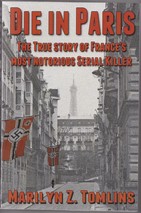
The story of WW2 French serial killer, Dr Marcel Petiot.
A spring night in Paris.The most beautiful city in the world is dark and silent. Uncertainty devils the air. As does normality: war time normality. The Nazis' Swastika flutters from the Eiffel Tower. The Parisians are huddled indoors.
Suddenly the night's stilness is shattered by sirens and excited voices.For days foulsmoke has been pouring from the chimney of an uninhabited house close to the Avenue des Champs-Elysees. Police and firefighters are racing to the house to break down the bolted door. They make a spine-chilling discovery. The remains of countless human beings are being incinerated in a furnace in the basement. In a pit in an outhouse quicklime consumes still more bodies.
Neighbours say they hear banging, pleading, sobbing and cries for help come from inside the house deep at night. They say a shabbily-dressed man on a green bicycle pulling a cart behind him comes to the house, always at dawn, or dusk.
The house belongs to Dr Marcel Petiot - a good-looking,charming, caring, family physician who lives elsewhere in the city with his wife and teenage son.
Is he the shabbily-dressed man on the green bicycle?
If so, what has he to say about the bodies.
Excerpt
The house had a basement. A second staircase in the hallway led down to it. The fire fighters were going to go down to see what was there, but a glass door drew their attention.
The door was closed, but not locked.
It opened onto a small, dark, oblong courtyard. The locked gateway was at one end of the courtyard. At the other was an archway. A second larger courtyard could be seen beyond it. A narrow metal door also led off the courtyard. The door was ajar. Behind it was a set of narrow, cracked stone steps. The men knew that those would lead down to the town house’s basement. They started to descend, stepping carefully so as not to trip in the semi-darkness.
It had been chilly in the courtyard; going down the steps, the air turned hot and foul, fouler than what it had been in the house.
There was a door at the bottom of the steps. It, too, stood ajar. Judging by all the open doors, the house’s proprietor seemed to have left the townhouse in a great hurry.
In the excitement of that moment the firefighters did not think of looking for the electrical mains to switch the electricity back on; in Paris townhouses, the mains were always in the basement.
By flashlight they saw that the basement consisted of a short, narrow, low-ceilinged corridor. Several doors led from it. Those were closed. The men opened one after the other; again not one was locked. Behind each was a tiny roughly-cemented room. The rooms were all empty. Flashing their lights into the last room on the corridor, they knew they had found the source of the stench.
The room in front of them was approximately four metres wide and three metres deep. Rusty water pipes and flyspecked electrical wires ran up its walls and into a ceiling blackened with soot and blistered with damp. Two old and dented coal and wood burners stood against one of the walls. One was much larger than the other. The smaller was rusted and it had neither door nor chimney; it was obvious it would never work again. Coal was smouldering in the furnace of the larger one. A burnt log, or what looked like one, protruded from the coal. The firefighters covered their noses; the air was really foul. They stepped into the room,
Boudringhim leading. They had to have a closer look at the burner; they wanted to see if there might be something else in its furnace. Boudringhim poked at the log with his flashlight; he wanted to free it, but only ash scattered to the floor.
He groaned.
What was protruding from the coals was indeed not a log; it was an arm. The hand was still intact: the fingers, swollen and black, were clearly discernible. They were pointing at him. It was as if they were beckoning him to come closer; to come and see what was going on and to do something about it. To help.
He leant forward and another groan escaped him.
In the furnace, flames were devouring a human skull, its eye sockets empty and its mouth agape. It was as if the skull, too, was making a final effort to call for help, to yell for help.
There was more horror.
In a corner of the room lay a pile of human remains.
The fire fighters flashed their lights at it. They saw a foot, a rib cage, a jawbone, another arm, another skull; the complete torso of a woman.
“What could I have done in such a place?” Boudringhim would later ask.
He motioned his men to get the hell out.
Terror speeds the legs.
Within moments, the four put their hammers to the gateway’s precious lock.
The lock, smashed, they staggered on to the pavement.
The two patrolmen were waiting.
“Messieurs… you have some work ahead of you!” stammered Boudringhim.
The fire chief wanted to say more, tell the two what he and his men had seen, but the words would not come. One of his men was vomiting against TODT’s garage. The other two had sunk to their knees in the gutter.
In the morning, in his statement to the police, Boudringhim would say: ‘After exploring the ground and upper floors of the house, we went down to the basement and, guided by the smell, we came to a room with the two burners. There we saw human flesh burning in one of them. We also saw some human remains lying on the floor. A fleshless arm stuck from the lit furnace. I think it was the arm of a woman’.
|