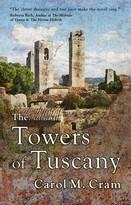
Set amid the twisting streets and sunlit piazzas of medieval Italy, The Towers of Tuscany tells the story of a woman who dares to follow her own path in the all-male domain of the painter’s workshop.
Trained in secret by her father to create the beautifully-crafted panels and altarpieces acclaimed today as masterpieces of late medieval art, Sofia’s desire for freedom from her father’s workshop leads her to betray her passion and sink into a life of loveless drudgery with a husband who comes to despise her when she does not produce a son.
In an attack motivated by vendetta, Sofia’s father is crushed by his own fresco, compelling Sofia to act or risk the death of her soul. The choice she makes takes her on a journey from misery to the heights of passion—both as a painter and as a woman. Sofia escapes to Siena where, disguised as a boy, she paints again. When her work attracts the notice of a nobleman who discovers the woman under the dirty smock, Sofia is faced with a choice that nearly destroys her.
The Towers of Tuscany unites a strong heroine with meticulously researched settings and compelling characters drawn from the rich tapestry of medieval Italy during one of Europe's most turbulent centuries. The stylishly written plot is packed with enough twists and turns to keep readers up long past their bedtimes.
Anne Fortier, author of the New York Times bestseller "Juliet" and "The Lost Sisterhood" calls "The Towers of Tuscany a delightful escape to the Siena we all love. Carol Cram has crafted a delicious story about a strong woman torn between her secret past, her love of painting and the forbidden charms of her rich patron. Hard to resist and highly recommended!”
Roberta Rich, bestselling author of "The Midwife of Venice" and "The Harem Midwife" states that "The Towers of Tuscany has all the elements of a wonderful historical novel--a talented, frustrated heroine, a treacherous, feckless husband, and a promise to a dying, much loved father who orders the heroine on a dangerous mission. Carol is a first rate storyteller. The research is well done. Every chapter displays a fine knowledge of painting technique of the 14th century, and customs and mores of the age. The details of dress, fabric, food, are flawless. The clever dialogue and fast pace make the novel zing along."
Excerpt
Chapter One
Sofia did not blame her father for allowing her to marry Giorgio, but not a day went by when she did not blame herself.
Every night as Giorgio grunted and thrust, she imagined wrapping her hands around his thick neck and squeezing. His dull eyes would widen in the moonlight, then bulge as she dug her thumbs into the swell of his throat and smiled when his lips turned a pale, pure blue.
But most of the time, Sofia tried not to think about him at all.
A shaft of sunlight fell across the small panel of the Nativity she was painting. Sofia snuffed out the candle and paused a moment to watch a curl of smoke spiral to the wooden rafters. She wanted to be the smoke—light enough to escape through the tower window and out into the fields, away from her husband, away from San Gimignano, away from her household with its incessant demands, away to paint every day in peace. But such thoughts were fancy, and hadn’t her father scolded her often enough for preferring fancy over fact?
Sighing, she loaded one of her smallest miniver brushes with terre-verte. Giorgio was out hunting, which meant she had until the next bells to paint. Using tiny, precise strokes, she added touches of the green-tinged pigment under the Virgin’s chin and down her neck to suggest a shadow. Delicately, between two fingers, the Holy Mother lifted the fold of a sheet. Sofia added more white lead to the edge of the sheet to give it an illusion of movement, catching Mary at the moment she leaned forward to keep her child warm. Sofia wondered if she would ever lean over her own child, hear its cries, feel her heart swell with the love Caterina was always rattling on about.
She hoped not.
The bells for Nones caught her by surprise, as they always did. The only part of her day, her week, worth living was already over. She pushed back from the table and rose to her feet. Massaging with one hand a knot in her shoulder, she stepped to the narrow window. Between the two closest towers, the countryside beyond the town was just visible as a slit of green and gold. The commune of San Gimignano fairly bristled with towers—more than seventy the last time Sofia counted. Day after day, the pounding and clanging of endless construction filled the air, along with dust so thick that on windless afternoons citizens squinted across the Piazza della Cisterna.
“Wife!”
Sofia gasped. Giorgio sounded as if he were halfway up the first set of ladders. She looked at her hands. A daub of ochre streaked one finger, a parody of the late afternoon sunlight flooding the tower room. If her husband made it up the ladders, he would destroy the pigments and brushes, destroy the painting even. No! He would never be so stupid. The small panel of the Nativity belonged to her father. Even Giorgio knew enough about the painter’s trade to respect the rights of a patron. And he would never dare anger her father.
But he could make sure she never painted again.
Professional Reviews
Hard to resist and highly recommended!
“The Towers of Tuscany is a delightful escape to the Siena we all love. Carol Cram has crafted a delicious story about a strong woman torn between her secret past, her love of painting and the forbidden charms of her rich patron. Hard to resist and highly recommended!” - Anne Fortier, Author of The Lost Sisterhood and the New York Times bestseller, Juliet
Lush descriptions and intriguing characters
“Carol Cram's lush descriptions and intriguing characters bring this dramatic tale of medieval Tuscany to life. If you love Italian art, a feisty heroine, and a page-turning plot, you will adore this novel.” – Deborah Swift, Author of A Divided Inheritance
A wonderful historical novel
The Towers of Tuscany has all the elements of a wonderful historical novel―a talented, frustrated heroine, a treacherous, feckless husband, and a promise to a dying, much loved father who orders the heroine on a dangerous mission. Carol is a first rate storyteller. The research is well done. Every chapter displays a fine knowledge of painting technique of the 14th century, and customs and mores of the age. The details of dress, fabric, food, are flawless. The clever dialogue and fast pace make the novel zing along. - Roberta Rich, Author of The Midwife of Venice and The Harem Midwife
Available Now! Rated 5 ***** by readers and listeners.
Sweet Revenge is a powerful and romantic saga of th mid 1800's, recalling pirates and those trying to rid the seas of such vermin. Shawn, a debonair captain, gets caught up in