Kindle Edition
Amazon
Category:
Action/Thriller
Publisher: Self-published
ISBN-10: 0989950816
Type: Fiction
Pages: 244
Copyright: October 8, 2013
Price: $4.99 (eBook)
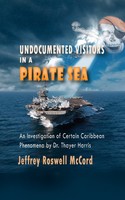
A professor hired by U.S. Naval Intelligence investigates the suspicious death of a Marine on a Caribbean island, taking readers on a fact-filled journey through historic pirate waters and modern-day maritime UFO facts and sightings. History, science and national security politics merge in a thrilling story of New World-Old World contact and its dangerous consequences.
A dead Marine washed ashore on a Caribbean island has a flying saucer and the letters “JFK” tattooed on his chest. With Vietnam War-era dog tags as the corpse’s only identity, local police contact the U.S. Navy. Some in Washington are uneasy about retired Gunnery Sergeant Roger Baskins’ death and tats.
The repose of maritime historian Thayer Harris, PhD, a tenured university professor in the U.S. Virgin Islands, is broken by the visit of a naval intelligence officer who hires Dr. Harris to secretly investigate the death of Gunny Baskins. He uncovers a 60-year record of UFO activity in the Caribbean basin in the process. His discoveries of phenomenal events during the Cuban Missile Crisis, on Grenada and in other times and places raise questions the professor can’t answer.
With Dr. Harris’ sleuthing nearly complete, the true adventure begins with a dramatic phenomenal encounter at sea. Following his subsequent Naval Intelligence debriefing in DC, Dr. Harris is targeted by other security agencies and parties who want his information. A life and death confrontation unfolds in a tropic bay.
Drawing on such credible sources as U.S. Navy records, declassified British and Russian UFO reports, the testimony of Navy personnel and the first Prime Minister of Grenada, “Undocumented Visitors in a Pirate Sea” weaves a thrilling fictional tale out of historical and scientific threads. Told by the professor in the first person, this entertaining story strikes a chord with lovers of Arthur Conan Doyle and Nelson DeMille.
Excerpt
Chapter One of Undocumented Visitors in a Pirate Sea
“The New Frontier is here, whether we seek it or not. Beyond that frontier are the uncharted areas of science and space, unsolved problems of peace and war, unconquered pockets of ignorance and prejudice.”
— Senator John F. Kennedy, Democratic Party Presidential Nomination Acceptance Speech, July 15, 1960
Feet propped up on the gray, steel government-issue desk, sweat dripped from hands as I tapped on the keyboard. A whirling, humming ceiling fan did little to cool the room. Lethargically, I was fine-tuning lecture notes for the next term. But the view of the palm-fringed beach down the hill from my office was more enticing than struggling for new anecdotes and humor to engage students in Caribbean Maritime History 101. Sailboats swinging in unison to their moorings, as a breeze propelled white clouds across an azure sky and turquoise bay, were hypnotic.
Finally, drowsiness and a sinus headache caused, no doubt, by various molds growing in the former Navy barracks housing faculty offices drove me outside. There a fresh wind and strong midday sun startled the neurons and synaptic clickings in the old memory banks and I was fully awake again – despite the heat and humidity.
Suddenly, remembering the day of the week and items on my calendar – a challenge at times in these slow, warm latitudes – I looked down the brick paths for my scheduled noon day visitor. It isn’t every day the maritime history professor of the Territorial College of the Virgin Islands gets a visit from a U.S. Naval Intelligence officer. A glance at my watch revealed he was late and that was a good thing.
I had no idea why he was coming to visit me – Thayer Harris, a historian whose last significant research had been completed years earlier. That work, done back in Washington, D.C. when I was an American University post-doc adjunct professor, had concerned Cold War naval activity in the Caribbean. It had also covered the phenomena of unidentified submersible objects – still unexplained, still unidentified.
Now securely tenured, I was more interested in family, sailing and exploring sugar plantation ruins in Virgin Islands National Park than career development. My six foot, lanky (albeit, filling-out) frame and salt and pepper hair were easily recognizable to Park rangers.
While waiting, I surveyed the college grounds. Above the campus the mostly green mountain sides were speckled with brown and yellowing trees and bushes. With April already upon us, leaves were dying and dropping. Funny how “Fall” occurs in the Spring down here. Spent Bougainvillea flowers were falling, floating around lawns like crinkled pink, yellow, red and orange tissue paper. And, the first of the “mists” formed by Saharan dust carried across the Atlantic on the Trades had appeared just a week earlier.
Today, though, was clear.
No question. Summer was approaching. Tourists and snow birds were flying home. Red, orange and yellow flamboyant trees were blooming as humidity levels rose. The loud, cackling Ada birds – big and black as crows, but with longer tail feathers – had arrived. Soon the laughing gulls and terns would pass through on their way back north from wherever they spent winters even further south of here.
As I watched pelicans circling above the bay, a white Ford SUV (the government vehicle of choice in these islands) drove through the college gates and ascended the hill leading to the scattered wooden barrack rectangles. Above these former enlisted men’s quarters, stood the old officers’ row of two story white brick houses that made up the rest of our campus. The structures, built before World War II, and the land under them were a post-Cold War gift to the United States Virgin Islands from the United States Navy.
On a hill overlooking the grounds, an old stone wind mill testified to the 18th and 19th century years when the principal islands of St Thomas, St John and St. Croix had been colonized by Danish sugar planters, merchants and traders (mostly Danish, Dutch and English) and administered as the “Danish West Indies.” In 1917, the United States bought the islands for $25 million because of their strategic location vis’ a vis’ the newly built Panama Canal and north to south shipping lanes. St Thomas’ outstanding deep water harbor was a big plus and the Navy built a formidable base and airport there.
The SUV arrived, parked in an oval of shade, and a suitably clean-cut, 30-something man emerged. He quickly climbed the steps to the History Department’s lofty offices where I awaited him on the stoop. A gold-plated belt buckle and various badges glistened on his summer white, short-sleeved uniform. He stopped and saluted.
“Dr. Harris, Sir?”
“Lieutenant Taft, I presume?”
With introductions over, I invited him into my pale green plywood office and looked over his ribbons.
“Are those from Iraq or Afghanistan, Lieutenant?”
“Both, actually. I did two tours based in Bahrain as an intelligence analyst and managed a couple of fact-finding and other missions in both Iraq and Afghanistan. Now I work at the Office of Naval Intelligence in Washington, D.C.”
I had read about the rigors and perquisites of headquarters life in Bahrain – the Fifth Fleet’s base and one of the wealthiest and most luxurious principalities in the world.
“Well Lt. Taft, what brings you from Washington to our humble tropical outpost? Not too many Pashtuns or muhjardins here. And, no sightings of Taliban naval craft that I know of. Still, plenty of sand.”
He wasn’t amused and we hadn’t yet established eye contact. Without responding, he abruptly pulled a typed manuscript out of his brief case and plopped it on my desk.
Bloody hell! It was my paper on Unidentified Submersible Objects – USOs. No good would come from it, my wife Mary had warned years ago. Was she to be proven correct?
“Your former History Department chairman at American University had the sense to pass this on to the Office of Naval Intelligence. Thirty years ago, it was considered one of the more credible, objective analyses of these mysterious objects or craft. You mostly relied upon mainstream media reports and the few military officers and defense contractors who spoke about them. And, of course, the UFO buffs were sources. I gather that people spoke more openly about such things in those days.”
Yes, I recalled vividly. People were more forthcoming back then, less worried about non-disclosure pacts and secrecy laws; and, of course, the abuse and ridicule associated with open discussions of USOs or UFOs had not yet been institutionalized in the media.
An image of Dr. Mecklenburg, American University’s history department chairman, mailing my paper to Naval Intelligence came to mind. Or, perhaps, the wizened old academic merely ambled with his cane across campus on a nice day, traversing Ward Circle and Nebraska and Massachusetts Avenues to personally drop it off at Naval Intelligence offices. They were only a block from our campus, after all. Now the property has been subsumed by the Department of Homeland Security and the old Naval Observatory, a few blocks away, is the official home of U.S. vice presidents.
Like so many well educated white men of military age, good breeding, and above average intelligence in his era, Dr. Mecklenburg served as a naval officer during World War II – probably in intelligence, given his academic achievements. No doubt he kept-up his contacts in the “club” after the war.
But, Dr. Mecklenburg – God rest his soul – couldn’t be faulted. And, Lieutenant Taft sitting here before me was both insightful and disarmingly forthright – a young innocent, perhaps. I thought of something to say about Dr. Mecklenburg’s generation.
“People were more open and honest in the post-World War II years. Today, do we have anyone like Admiral Roscoe Hillenkoetter – an early CIA chief, for goodness sake – who publicly said UFOs are real and called for Congressional hearings? Or, would a British Admiral of the Fleet such as Lord Hill-Norton, the former head of the Ministry of Defence, today publicly say as he did that UFOs are real and then badger the House of Lords into holding a hearing on them, as they did? But, Admirals Hillenkoetter and Lord Hill-Norton were World War II vets and heroes. Not ones to be intimidated by bureaucratic functionaries or secret operatives.”
“I agree, Professor. And, I learned about them in your paper.”
“You’re probably too young to have heard about the UFO sightings by Presidents Jimmy Carter and Ronald Reagan. I bet those incidents never made it into your history books at Annapolis.”
Having noticed his Naval Academy ring, I felt free to opine self-righteously.
“On the other hand, I’m sure you were taught that Jimmy Carter served in Admiral Rickover’s nascent nuclear submarine service. The President was very proud of being a submariner.”
“I knew President Carter was an Annapolis man and submariner, but must admit I had no idea he and President Reagan had witnessed UFOs,” he said a little skeptically. “But, we did learn the protocols on how to deal with reports of unidentified flying or submersible objects, as I believe you know.”
I did know the military once had instructions on how to handle sightings and reports, but was out-of-date on the details.
“I knew the Air Force and Navy had protocols, but heard they had been rescinded when researchers made them public. Are they, or revised versions, still ‘operative’, as you people say?”
“That’s a question I am not at liberty to answer,” he said off-handedly. “How did you learn of the Carter and Reagan sightings?”
“Well, Jimmy Carter told his story to several newsmen, freely admitting he had no idea what it was that he saw; but said he did see a maneuvering object in the sky. And, Ronald Reagan described his tale to no higher authority than the Washington bureau chief of The Wall Street Journal. Carter and Reagan were both governors when the incidents occurred, and, of course, they, too, were of a generation of leaders who spoke their minds. Right or wrong, you knew where they stood.”
I made a note to myself to check on the details of the Carter and Reagan sightings. More information might now be available.
As I thought about the Presidents, I realized I had been rambling on, but still didn’t know why the Lieutenant was sitting in my office.
“So, I assume you’re here because of my paper.”
“Yes, sir, I am. It’s complicated. I’m investigating the death of a retired Marine Corps gunnery sergeant. His name is Roger Baskins, age 65, place of birth: Gulfport, Mississippi. His last base was Pensacola. His body washed up on St. John’s East End on April 5th.”
Since my family and I live on St. John, we knew about the body. In fact, we had actually seen the rescue squad and EMS Boston Whaler respond to its discovery out at the East End, where we happened to be snorkeling that day in Hansen Bay. Later, an ambulance boat brought the remains over to Charlotte Amalie, the capital of the US Virgin Islands on St. Thomas. That’s where I work. I get a kick out of telling visitors from New York or Washington about my hellish commute. It’s a ten minute jeep drive across National Park mountain ridges with majestic views on either side; then a 20 minute ferry ride to St. Thomas watching smaller mostly uninhabited islands slide by while sunning on the top deck.
I replied, “Yes, I heard a little about that, but no details. What does a deceased Marine have to do with me? Or, for that matter, a Naval Intelligence officer?”
“Sergeant Baskins was last seen alive on April 2nd on board the ‘Willy T’ – that floating bar in the harbor on Norman Island. Three days later his corpse was discovered in the rocks near St. John’s Privateer Bay.”
Ah, the Willy T! Formally known as the William Thornton, she’s a 100-foot steel schooner anchored in The Bight, the sheltered harbor of Norman Island. She’s served boaters’ liquidity needs for decades. Willy was named for a Tortola planter, amateur architect and British citizen who improbably submitted the winning design for the United States Capitol building in 1792. George Washington himself praised the plan for its “grandeur, simplicity and convenience.” For his effort, Thornton was awarded $500.
Today, we can only guess what Squire Thornton or President Washington would think of “Willy.” When planning our first sailing trip from St. John to Norman Island, my wife looked up the floating bar on a travel advisory site and found a few indecorous reports. Allegedly, any woman who takes off her shirt and dives into the water from its pilot house is given a round of applause and a free T-shirt. Free drinks probably follow.
We deleted Willy from our itinerary on our first sail to Norman. In any event, rather than half-naked girls, Norman Island brings to my mind Long John Silver and his mates searching for treasure. Most consider the uninhabited British Virgin Island the model for Robert Louis Stevenson’s “Treasure Island.” Pirate loot was actually found there around 1800. We have snorkeled in the very sea caves where treasure was found hidden behind a false rock wall.
OK,” I said to the good Lieutenant. “I fully understand why a retired Marine would hang out at Willy’s. But, surely this is a matter for BVI officials and the U.S. Virgin Islands Police Department.”
“They have investigated it,” Lt. Taft replied with a slight grimace contorting an otherwise well sculpted face. Had Taft been British, I’d have pegged him as an aristocrat.
“The problem is,” he continued, “the Brits have no record of him entering the British Virgin Islands. We do know he flew to the US Virgin Islands. He caught a direct flight from Dulles airport in Washington, D.C. to St. Thomas on March 26th. That’s ten days before he was found washed up on St. John. He has no family ties in D.C. or anywhere else that we could find. He received his pension and social security checks in a Northern Virginia post office box.”
“It’s not unusual for someone to ‘forget’ to clear B.V.I. customs before visiting Norman,” I observed. Since Norman is only a two hour sail from St John’s Coral Bay, some people neglect to first make the longer trip to Tortola, the main BVI island, to clear customs and immigration. After all, the USVI and BVI are part of the same archipelago, separated only by the relatively narrow Sir Francis Drake Channel.
“So, some intrepid person must have sailed or motored directly to Norman Island with Sergeant Baskins aboard – they probably departed from Coral Bay,” I continued.
“That’s what the police believe, but no one has admitted taking him over and Virgin Islands Police Department has no budget or incentive to investigate further. The coroner ruled death by drowning with no evidence of foul play. We got involved because the Sergeant’s only identification was his Vietnam War era dog tags and a fascinating tattoo on his chest: a disc-like image that looks like a flying saucer with “JFK 1971” beneath it. On his bicep was another tattoo - an anchor astride the world and ‘Semper Fi’.”
To say I was surprised would be an understatement. The Lieutenant handed me photos of the tattoos.
“JFK and a flying saucer? Could this guy have been a conspiracy nut and a UFO nut?”
As a conspiracy buff myself, I was enthralled by the possibilities. Fortunately, the sight of the tidy, earnest young man sitting opposite me arrested my wild speculations. There must be a plausible explanation for the Marine’s pictogram.
“It is a very distinctive tattoo,” I agreed. “And the dog tags. I assume some vets proudly wear their old tags as sort of souvenirs or good luck charms. And, we all know they like tattoos related to their service. JFK? My guess is he once served on the old aircraft carrier, the U.S.S. John F. Kennedy. Correct?”
“All true,” confirmed Lieutenant Taft.
A wave of self-satisfaction washed over me. My Sherlock Holmesian deductions were on target and my interest in this matter was soaring.
The lieutenant continued, “Sergeant Baskins survived unscathed during two tours in Vietnam that included long range reconnaissance patrols into the highlands. They were the most dangerous missions of the war. He was then assigned to the U.S.S. John F. Kennedy’s Marine detachment responsible for vessel security.”
I had read of the horrors of long range recon patrols – vermin, poisonous snakes and centipedes, spiders, constant threat of ambush, heat exhaustion. Service on an aircraft carrier must have seemed like resort living by comparison.
“One question, lieutenant. If the dog tags were his only ID and he hadn’t cleared BVI customs, how do you know Baskins was on Norman Island?”
“Elementary, my dear doctor!” He said it with good humor. “He paid his bill on the Willy T with a credit card that we easily traced. But, the card and a wallet he
probably carried it in were missing when the body was found.”
I was surprised Willy took credit cards.
“One other noteworthy point about the body – its pants zipper was closed. The Coast Guard tells us that many men fall off boats while in the act of relieving themselves over the side – particularly when intoxicated. But, the zipper was closed and an autopsy revealed he’d likely had only two or three beers, hardly enough to incapacitate an old Marine gunnery sergeant.”
Fascinating about the zipper, I thought.
“So, what about the flying saucer, Lieutenant?” I asked
Taft actually squirmed in the straight backed, wooden chair as he looked over my desk, establishing direct eye contact for the first time.
“We’re not sure. We believe it’s possible that the saucer and even Sergeant Baskins’ death are related in some way to his service on the U.S.S. John F. Kennedy, which was tattooed under the saucer as I said. During 1971, Baskins’ tattooed year, the Kennedy was in the Caribbean and had even docked here in Charlotte Amalie at the old Navy yard. The crew enjoyed a 48 hour liberty during their week here.”
“Why not just check the ship’s logs and records?”
The lieutenant crossed and uncrossed his legs, seeming to be in pain as he explained.
“Part of the log for certain dates and hours during that cruise are highly classified. Worse, the only other related records I can find have been heavily redacted. Unfortunately, I am the only one assigned to this case and I don’t have the clearance or rank to locate the original classified sections and unredacted docs, even if they could be found. Sadly, the Captain during that period who likely ordered the classifications – possibly after secure radiophone conversations with superiors – is deceased. Yet, reading between the lines, I conclude that something phenomenal happened to the ship in the Caribbean that year, but can’t prove it.”
Taft’s problem was not as shocking as it might seem. In today’s federal government, hundreds of millions of pages of documents have been classified. Millions more are added each year. With the deaths and retirements of senior military officers or government executives who may have witnessed “secret” events or collaborated in classifying incidents, orders or policy decisions, it’s inevitable that some records evaporate from history – particularly when they date from pre-desktop computer and e-mail days.
“Let me make sure I understand this,” I said. “You can’t adequately investigate a retired Marine sergeant’s death and resolve your suspicions about it because you, a commissioned intelligence officer in the U.S. Navy, are denied access to or can’t find the Navy’s own records?”
“That is correct.”
“So, that brings us back to the flying saucer tattoo. You must think that is indelible evidence – so to speak – of a possible phenomenal event.”
“That is correct and that’s why I came to see you, Dr. Harris. Although it does appear to be a flying saucer, it could also be an unidentified submersible object. It is possible Sergeant Baskins may have witnessed or been involved in some way with a USO or UFO incident during the U.S.S. John F. Kennedy’s 1971 Caribbean cruise.”
“And, now you are interested in trying to recover that lost knowledge about the hypothetical incident. Is that it?”
“Yes. Several of us mid-level naval intelligence officers think its time we – I mean the Navy – seriously study and evaluate whatever evidence we already have in-house about UFOs and USOs. We might then build a case for more open reporting of these phenomena in the future. Some day we hope to bring in the broader scientific community to assist. The material could be provided to the President, as a possible prelude to public release.”
A remarkable statement. And, if true, a very promising development.
“Quite laudable. But, where do I come in?”
“We liked your paper. Liked it enough for me to come down here with a proposal. It’s now April 15. Your spring semester will soon be over. We’d like to give you a sub rosa grant to investigate Sergeant Baskins’ last days, any links he and the Kennedy may have had to unidentified flying or submersible objects, and uncover any new or previously unreported evidence related to the phenomena.”
“Interesting assignment,” I replied, suppressing my excitement. “But, how do I get compensated?”
Also, would Mary give her blessing to such research?
“We believe the Annapolis Institute Press might be persuaded to generously fund research into the role of the U.S. Navy during the Cuban Missile Crisis. Such funding would be more than sufficient for you to also investigate the more important subject at-hand.”
“So, let me get this straight. I write an article on the Navy and the Missile Crisis and, at the same time, clandestinely investigate Sergeant Baskins, the U.S.S. John F. Kennedy and any UFO/USO connection?”
“Precisely, Dr. Harris.”
My family had no definite plans for the summer break other than sailing, working on the house and avoiding hurricanes. Assuming the money was good, this sounded enticing.
“How ‘generous’ is the grant we are discussing?”
The grant, paid in monthly installments, was most generous – exceeding my salary – and one month would be advanced immediately.
“We would require regular progress reports sent directly to my attention and, at the end of four months, we will want a paper with your findings and conclusions. Of course, discretion is paramount.”
As interesting as it sounded, I had to discuss it with Mary before accepting. And, it might be a hard sell.
“I must discuss this with my wife since it will affect our plans for the summer,” I explained.
“By all means,” the lieutenant replied, giving his cell phone number and the name of his hotel. I agreed to get back to him the next day.
That night, during cocktails on our deck while watching the sunset, I eased into the subject. Mary, a petite blonde with a big heart and strong mind, did voice misgivings about such research.
“What if the Dean heard you were studying UFOs? What would he or, for that matter, other faculty think?”
“This would be very confidential research for a reliably closed-mouth client,” I assured her. “And, as far as anybody knows, I’m simply researching and writing an article for the Institute Press.”
“Nothing is confidential on this island for long,” she said. “You know what they say, ‘if you don’t know what you’re doing, someone else does.’ And, if it got out that you believe in these things, it could harm your reputation.”
She had a point. Her justifiable concerns brought to mind the mixed feelings of one of the few journalists in recent years to study UFOs. In her well-regarded 2010 book, UFO’s: Generals, Pilots and Government Officials on Record, Leslie Kean recalled that she was increasingly concerned about keeping her expanding interest in UFOs quiet:
“I began to feel as if I were covering-up something shameful and forbidden, like the use of an illegal drug . . . The subject carried a terrible stigma.”(1)
I replied to Mary that my client had no interest what-so-ever in making this research public. She asked for a bourbon refill, took a sip and replied: “Well, everyone here knows you’re a professor and somewhat eccentric.”
“That’s right, honey, and who on this island isn’t eccentric?”
Finally, Mary agreed to my taking on the project, as long as I didn’t talk about it outside our home and I kept her informed.
I phoned the lieutenant immediately.
“When do I start?”
“Not so fast,” he intoned. “We need you to sign a non-disclosure agreement and contract with the Institute to produce the Cuban Missile Crisis article. Fortunately, I happen to have both documents with me.”
“Sounds like a done deal to me,” I answered.
We met the next day over lunch at Tickles, a waterside bar and grill overlooking Crown Bay Marina and the new cruise ship docks and shopping complex. It was a highly appropriate venue. The Marina and cruise ship center had been carved out of the Navy’s old docks, yards and even a submarine base.
That oversized concrete cruise ship dock, just a few hundred yards across the water from where we sat, was likely the very spot where the U.S.S. John F. Kennedy had once tied-up for liberty and re-supply.
The U.S.S. John F. Kennedy was a beautiful ship born in a poignant, family ceremony. Nine-year-old Caroline Kennedy had to swing the champagne bottle twice to break it across the bow and christen the Kennedy on May 27, 1967 – two days before what should have been President Kennedy’s 50th birthday.
Caroline’s younger brother, John Junior; their mother, Jackie; uncles Ted and Bobby; and Aunts Joan and Ethel were all there. Even grandmother Rose attended.
As though it were the christening of an infant, the ceremony was overseen by clergy. In this case, Cardinal Richard James Cushing, Archbishop of Boston, who was no stranger to the Kennedy clan.
Aside from immediate family, John Glenn, the World War II Marine flying ace and pioneering astronaut attended the ceremony as did President Lyndon Johnson and Secretary of Defense McNamara.(2)
The largest and last U.S. aircraft carrier propelled by conventional power, the U.S.S. John F. Kennedy was built in Virginia by the Newport News Shipbuilding Company and officially entered service a year later in 1968 – the year Bobby Kennedy would be assassinated as his big brother had been.
The Kennedy, though, was just springing to life. Her eight petroleum-fueled boilers drove four propellers that pushed the ship at cruising speeds up to 34 knots. She measured 1,052 feet overall.
By comparison, with an overall length of about 652 feet, on her first and last voyage in 1912 – just 56 years before the Kennedy’s launch – the R.M.S. Titanic was driven by three propellers powered by 29 coal-fired boilers. She could only reach and maintain speeds of 21 knots.
When the Kennedy called at the port of Charlotte Amalie in 1971, she was virtually brand new. No doubt, Gunny Baskins and his buddies walked around joking and looking for bars and other diversions in the very waterfront neighborhood in which Lieutenant Taft and I sat talking and downing beers.
Back then, President Kennedy’s roots as life-long sailor and combat Navy skipper were fresh in every seaman’s mind. His comments on why the sea is so special to humans, delivered in Rhode Island in 1962 on the occasion of an America’s Cup race, are hard to argue with or improve upon:
“I really don't know why it is that all of us are so committed to the sea . . . I think it is the fact that the sea changes and the light changes, and ships change; it is because we all came from the sea. And it is an interesting biological fact that all of us have in our veins the exact same percentage of salt in our blood that exists in the ocean, and, therefore, we have salt in our blood, in our sweat, in our tears. We are tied to the ocean. And when we go back to the sea, whether it is to sail or to watch it we are going back from whence we came.”(3)
After long and eventful service, the U.S.S. John F. Kennedy was decommissioned in 2007 and now rests mothballed with the reserve fleet at the old Philadelphia Navy Yard. Many hope she will become a floating museum.
“So, Dr. Harris, just one final item,” Lieutenant Taft said, interrupting my reverie. He opened his brief case and pulled out a USB device.
“Before you send me an email or open one of mine or send emails to third parties related to this case, please plug this encryption card into one of your USB ports,” he explained, handing me the whirligig.
“A bit dramatic, don’t you think?”
“It’s standard practice in Naval Intelligence research. In fact, when you phone me, please use this number. It’s a secure line. If I don’t answer, feel free to leave a short message simply asking me to phone you.”
I took his business card with the number written on the back and assured him I’d follow the procedure. Pure bureaucratic nonsense, I thought.
After Lieutenant Taft and I had shaken hands, I caught the ferry back to St. John. It struck me as ironic that I had to sign a non-disclosure agreement and conduct secret research to (hopefully) serve the cause of greater government transparency about UFOs in the future.
And, of course, even if I didn’t honor the non-disclosure agreement, my work could still be very plausibly denied by the Navy as the product of a whacko academic. On paper, I was simply researching and writing a story on the history of the Cuban Missile Crisis. While exploring anything further, I was on my own.
Still, why not keep a log of this investigation? It might come in handy, serve as a useful record and help me sort out my thoughts as I proceeded. So, I started this narrative.
I had no idea then, just how dramatic and potentially dangerous this investigation would become.
|