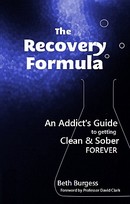
The Recovery Formula is an essential guide for anyone who is addicted to alcohol or drugs and wants to do something about it. The book will help you understand your problem, make decisions about treatment, avoid relapse and set yourself up for success. The Recovery Formula is a framework that anyone can use to achieve a happy and successful sobriety.
Are you tired of the guilt, shame and pain of addiction? Are you sick of the constant relapses? Do you yearn for happiness, freedom and a better life?
People can spend years trapped in addiction unnecessarily, because, despite all their efforts, they just don't understand what you really need to do to recover.
Despite attending rehab, counselling, groups and fellowships, many addicts remain stuck in the cycle of addiction, because they are not told some very basic facts about recovery. For some reason, many of the facts about successful recovery have remained a secret - until now.
Beth Burgess has written THE book on addiction recovery, having struggled as a serial relapser and become frustrated about having to learn by trial and error. She saw too many people around her doing the same thing, and set out to write a book which shared the secrets of addiction recovery, that most addicts take a long and painful time to learn.
After studying what successful addicts were doing to get better, and looking at the lessons she learnt from her own journey, Beth decided to share what really works and what doesn't when it comes to getting clean and sober.
The Recovery Formula is an essential guide for anyone who is addicted to alcohol or drugs and wants to do something about it. The book will help you to understand your problem, to make decisions about treatment, to avoid relapse and to set yourself up for success from the start. The Recovery Formula is a framework that anyone can use to achieve a happy and successful sobriety.
Receiving high praise from addicts and addiction professionals alike, this is THE book to have if you want to get clean and sober forever.
Your recovery starts here.
About the Author: Beth Burgess is a Life and Recovery Coach and the founder of Sort My Life Solutions (Smyls), providing private coaching, consulting, workshops, training and speaking.
Her missions include helping as many people as possible to achieve an amazing recovery and ending the stigma toward people with addictions.
Visit Beth at smyls.co.uk or bethburgess.co.uk
Excerpt
A lot of us fall into certain traps when we decide to sort out our drinking or drugging and these jeopardise both our sobriety, and in turn, any chance of recovery; so it is very important to be aware of them.
Controlled Using
Some people believe that they would be alright if they could just curb their addiction a bit, and this might mean controlling their drinking or taking fewer drugs. Maybe puffing instead of snorting, or perhaps smoking rather than injecting. I went down that route myself for a while, until I realised that the alcohol was firmly in control and I could only count the number of times I was ‘victorious’ over it on the fingers of one hand. There were a few times when I managed to drink and it wasn’t that bad, or I didn’t go massively overboard, but trying to control my use was an unpleasant experience overall.
I can laugh when I look back at it now, as I desperately tried to control my drinking. It was such a big effort and ultimately a waste of time. I had several methods, which I was convinced were going to be my saving grace, but they all failed me one by one.
First I made rules for myself about when I was allowed to drink, and I told myself, for example, that I would only drink in company. Of course, that meant I saw my friends a lot more in the beginning – but I was still drinking almost as much as before, and the consequences were often bigger because I got other people involved.
Then I decided that I would only drink down the pub – of course that led to me swiftly downing pints and following up with secret triple Cognacs whenever I went to the bar. It was ‘my round’ surprisingly often. Again, I got into more trouble that way than I had when I was drinking at home.
So then I decided to scrap the ‘when and where’, and chose only to drink after a certain time of day. Cue binge drinking at 5pm on weekdays and then again at noon on the weekends when I told myself I was being a bit hard on myself with this new rule!
The next genius idea I came up with was buying some measuring cups like those you see in the pub or bar. I’d limit myself to a certain number of ‘measures’ of whisky every day. Of course, when I saw the size of the measly things I quickly changed my allowances, and of course, more often than not, it was one measure for the glass and three for me straight out of the bottle. I even bought a decanter once, as if that would add a touch of normality and middle class-ness to my drinking. It didn’t of course, as I’m sure you concluded before I even told you.
The final thing I tried was switching to ‘weaker’ drinks. I decided that it was the whisky that was making me particularly unpleasant and so I swore off that. And then later on I decided to ditch all the spirits when they seemed to be making me as bad as the whisky. So I downgraded to lager – not that really weak stuff, mind. It had to be premium. And I have never felt so dissatisfied with my drinking in my life. I found it was like drinking water.
Disappointed with my choice, I briefly flirted with alco-pops, until I discovered that they were making me fat rather than drunk. And so I moved up to wine. Now I hated wine really. I found the white stuff too sweet and the red stuff too vinegary. But I was an alcoholic and so I convinced myself to like it for the sake of my ‘controlled drinking’. I even managed to pick myself a ‘favourite’ wine, as if that would help. I realise now that I only liked it because it packed a stronger punch than the others and tasted less like a ‘pretend’ drink.
But the hangovers I got from wine were horrendous. And I was putting weight on again. So there was nothing for it but to go back to spirits. And so I was back to where I started - and probably worse than before.
Professional Reviews
Wynford Ellis Owen, CEO of the Welsh Council on Alcohol & Drugs
"A wonderfully effective guide that every addict should read as they take their first steps into sobriety and recovery. I am hugely impressed by this book."
Dr Robert LeFever, founder of Promis, the first UK rehab centre, and author of 26 books on addiction and depressive disorders
"Beautifully written. A moving and insightful book that will help a lot of addicts understand how to start recovering successfully."
Michaela Jones, Community Director at Wired In To Recovery
"A brilliant mix of inspiration and information. If you're an addict and don't know where to start with sobriety, read this book."
We all know how to plan our actions, but we aren't always able to carry them out as we had planned. That's because things happen that we don't plan, and those things cause us to react. How do you control your reactions? God has all the answers in His