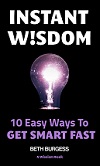
No. 1 Bestseller on Amazon. Blending science, psychology and philosophy, this book will teach you easy tools and techniques that will make you smarter in mere minutes or seconds. The strategies include methods that geniuses and peak performers use to get amazing results.
Excerpt
Question Everything
Socrates was famous for a few things: sporting an astonishingly curly beard, rarely bothering with footwear, pondering, and stopping total strangers in the street to quiz them on their beliefs.
The philosopher was also famed for admitting he didn't know anything, except that he knew nothing. This doesn't bode well for a book about wisdom so far, does it?
But context is everything, as we will discover in this chapter, and acknowledging your own ignorance can pave the way to greater wisdom.
On his personal quest for insight, Socrates sought out teachers who he hoped could guide him. But he was disappointed to discover that people who claimed to be wise talked absolute waffle when he met them.
He found that while politicians might 'know' things, it didn't mean they were wise. (I'm with Socrates here; some right nit-wits get into government.)
And poets have the power to create verses which move people, without there necessarily being any meaning to their words. (A bit like some of The Beatles' songs.)
After finding that people who declared themselves to be wise were actually pretty stupid, Socrates thought it better to admit what he didn't know, rather than purporting to be some brainiac.
Although many people do tend to think of Socrates as a wise man, in truth, he wasn't a guru. If he had been, he wouldn't have gone around searching for wisdom.
Socrates was a philosopher, someone whose very job description means they do not have all the answers. When his disciples called him a teacher, he refused the label, because he wasn't giving formal lessons, but trying to figure things out himself.
He did, however, come up with a very clever way for doing just that: the Socratic Method. It is basically a dialogue, where you question beliefs, hypotheses, and assumptions in order to get closer to the truth.
It is important to question everything, because we can all have faulty beliefs and innate prejudices that are so deeply entrenched that we don't even recognise that we have them.
And we often fall prey to cognitive biases and logical fallacies, like thinking that all taxi drivers are lunatics, just because we had one bad ride.
We make generalisations and blanket statements, and imagine that things are simply common sense, when there is often no such thing.
These very human flaws make us assume that certain things must be true or false, even if they aren't. And we rarely even realise that we are basing our opinions and conclusions on false presumptions and beliefs.
For example, when hiring white-collar workers, many employers favour candidates with a degree, especially if it's from a top-class university. Often it doesn't even matter what subject the degree covers. It could be anything from Physics to Parapsychology. (Yes, you too, could become a real-life Ghostbuster – several credible unis in the US and the UK offer this course.)
Employees just assume that graduates must be more disciplined and brighter than people who didn't go to university. That is a massive leap in logic and unfair on people without a degree.
There could be any number of reasons why a genius didn't complete university. They may have had family obligations or struggled to find the time or money to go.
Some may have been prevented from graduating due to unfortunate circumstances, such as ill health or suffering from a bereavement before their final exam.
Research shows that many super-smart people hate formal learning. Classrooms can be very stifling and boring if your IQ is higher than the other students'.
And not everyone wants to get a degree or go to the 'best' university, even if they would be quite capable of doing so.
I got good enough college grades to get into Oxford or Cambridge. My teachers were stunned that I didn't want to apply. But I hated the atmosphere of over-privilege and the silly, archaic traditions, so I was set on a less hoity-toity university in London.
After all, who wants to parade around singing about ducks or beat a load of stones with sticks on a certain date? Yes, those are genuine Oxbridge traditions that still carry on, and they don't sound very smart to me.
Using the Socratic method of questioning, here is how the philosopher might have handled someone who'd made the sweeping statement that graduates must be cleverer than non-graduates:
Socrates: “Do you not consider the invention of the electric motor, the generator, electrolysis and electro-plating to be rather clever?”
Someone: “Yes, they are amazing scientific feats.”
Socrates: “Would you deem the inventor of all these things to be intelligent?”
Someone: “Well, obviously.”
Socrates: “Do you think this person studied science at university?”
Someone: “For sure.”
Socrates: “Have you heard of Michael Faraday?”
Someone: “He was a scientist, wasn't he? I seem to recall now that he invented some of those.”
Socrates: “Did you know that Mr Faraday had no formal education at all and worked as a bookbinder?”
Someone: “No, I didn't know that. How did he come up with all that stuff then?”
Socrates: “Forgive me, but did you go to university?”
Someone: “Er, yeah, I did.”
Socrates: “And what have you invented?”
Someone: “I invented a drinking game once.”
Socrates: “Do you think you are smarter than Mr Faraday?”
Someone: “Look, I haven't really had time to go around inventing stuff, because I've been working at McBurgerHut. I've got a student loan to pay off, and I still owe the bar some cash for damages after that drinking game got out of hand...”
Socrates: “So, we can not assume that non-graduates are not as clever as graduates.”
Someone: “OK then, so how did he come up with all that clever stuff?”
Socrates: “He read the books he was binding.”
Someone: “Aha, so he was kinda taught then, even if he taught himself. We had to do a lot of reading for ourselves at uni, you know.”
Socrates: “Hmm...do you know much about genes?”
Someone: “Yeah, a bit. About DNA and stuff.”
Socrates: “Have you heard of Gregor Mendel, who originally discovered genetics?”
Someone: “I'm guessing he was someone else who read a lot, if he didn't go to uni.”
Socrates: “No, he was a monk who liked gardening and happened to notice that his baby plants inherited certain traits from the parent plants.”
Someone: “Oh.”
Socrates: “Well then, we can conclude so far that some non-graduates can be just as clever as a graduate, either by self-education or having an observational mind. Let's carry on then. Have you heard of William Herschel?”
Someone: “Er, I would Socrates, but I think I'm going to be late for my shift...”
Want to review or comment on this book?
Need a FREE Reader Membership?
Reviews for "Instant Wisdom: 10 Easy Ways to Get Smart Fast"
A well written, informative volume to help those who are interested in becoming a better person. Common sense suggestions for seekers of wisdom and life changes.