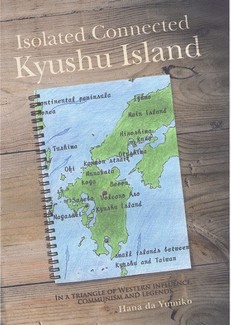
This book of historical fiction reaches from World War II to the early years of the twenty-first century, telling a family’s dramatic story of life on Japan’s Kyushu Island.
Isolated Connected Kyushu Island weaves together the history of the people of Kyushu, Japan’s third largest island, and the stories that author Hana da Yumiko learned from her elders while she was a little girl. Spanning the years from the end of World War II to the early years of the twenty-first century, Isolated Connected Kyushu Island tells a story of transitions from the closing of the age of the samurai, to the rise of militarism, and finally to the coming and flourishing of democracy. The family’s story illustrates how the land’s Hiding Christians kept their faith in secret, how women worked on their own without the support of men to encourage social change, how the ebbs and flows of many countries’ histories combined to influence the story of this land, and how a missionary and a local belief in a savior influenced religious life. If you hunger to hear a story of universally human motives, joys, and fears told about a family living in a remote and unfamiliar land, then this book will satisfy that hunger with an account that both educates and inspires.
Excerpt
The winners, the Allied forces, didn’t kill and didn’t touch women, at least not in that area. Some American soldiers gave canned foods to the losers who were trying to commit suicide. P29
Even in his tiny village, GHQ jeeps appeared. Many people came out to watch the creatures that came from another planet. P37
“But she said the value of every life is equal in the eyes of Deus.”
“De, ze?”
“Deus. Probably a kind of god. I’m not sure. Um, this is what Francis Xavier told her poor ancestors in the strict class society three hundred years ago. P52
More than 3,000 Christians in Nagasaki were arrested and sent one by one to far places on Main Island to make them assimilate. P58
Tom-O, a former-soldier, felt ashamed. Is it a shame I worked for my motherland? P137
She was very moved to learn that an American woman born in Vienna, Beate Sirota, had pushed through women’s rights in the new constitution though the makers, the occupation army was made of men. P159
My pa and ma say I must not play with you. You’re a soldier’s child. P188
“There must be many wealthy families who had to pay 75 percent tax.” Hisaharu said. The tax system had been devised by Carl Sumner Shoup, an American economist, soon after the war. It produced the middle class and economic growth, which Shoup had aimed for. It was the basis of democracy, human rights, and the rule of law. P192
There must be order in society, in a family, between kin. Brutes in victorious nations have depraved our traditions.” Shiro closed his mouth. He knew nobody could destroy this order that had come from China. He couldn’t hear the blaring guitar sound from his grandsons’ room, practicing Jimmy Page, Jeff Beck, and Eric Clapton. P236
Why was I taught to attack American tanks with only sharpened bamboo and no shield? (when he was 9) P303
“The Ministry of Welfare called me just now. A former American soldier handed over a flag to the Houston consulate.” P324
You’re a man and haven’t been to Europe or America. I mean, you have no experience of sexual or racial prejudice. P329
I can say without shame abroad that my father was a veteran. An American man expressed respect to my father for the first time in my life. P347
Professional Reviews
Kirkus Review
Spanning nearly 60 years, this work of historical fiction chronicles the multitude of cultural changes in Japan after World War II from the perspective of a conflicted family of three.
Labeled a “half-fiction” by its author, Hana da’s debut takes place in postwar Japan, depicting a once-militaristic country rushing toward Western modernization. Hisaharu and his wife, Misao, (based on the author’s own parents) face great hardship in this new, ever shifting culture, both having grown up in small villages before the fall of Japan’s militarism in which their own ancestors’ histories had only begun to transform into legends. They have one child, a reserved girl named Jericho, and the family finds itself regularly uprooted by Hisaharu’s poorly paying position in Japan’s new, stigmatized Defense Force. Paralleling the family, Japan itself remains unsettled, with communism spreading rapidly among its neighbors while Western ideas conflicting with the shriveling tenants of traditional lifestyle begin to alter views on religion, agriculture, and the roles of women in this new society. The novel deftly limns its protagonist; though Hisaharu’s life is used as the story’s framing device, it still portrays him realistically—a thoughtful but not unimpeachable devourer of books with a work ethic cultivated from traditional thinking. Misao is also tied to the past. Her upbringing during wartime grants her spirit and inner strength while at the same time limiting her ability to adjust to new times. And when her parents’ stubbornness gets somewhat tiresome, Jericho subtly changes tack. Even characters who appear fleetingly—an ill-prepared American missionary, a sexually broken classmate, a disheveled teacher, and so many more—both accentuate and stand separate from Japanese history. Those unfamiliar with postwar Japan will find the story approachable and informative with its engaging core centered on the difficulties of raising a child in a changing world.
An impressive use of one family to intimately portray the history of social and cultural changes over three generations.
Available Now! Rated 5 ***** by readers and listeners.
Sweet Revenge is a powerful and romantic saga of th mid 1800's, recalling pirates and those trying to rid the seas of such vermin. Shawn, a debonair captain, gets caught up in
Encountering danger, romance, heartache and tragedy, Catherine Merit strives to fit into a world filled with prejudice, hatred and violence where she is forced to kill a man in order to save herself. Third book of the Indignities Series.