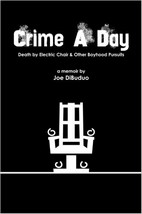
“Bold and frank, Crime A Day tells Joe DiBuduo’s story of growing up poor and hungry, of the redemptive power of love, and one man’s ability to change his life of circumstance to a life of choice. A fascinating glimpse into the seedy underbelly of mid-20th Century America." — Michaela Carter, author of Further Out Than You Thought
By turns unsettling, witty and tragic, Crime A Day: Death by Electric Chair and Other Boyhood Pursuits exposes the harsh consequences of childhood poverty, educational deprivation and social marginalization. DiBuduo went from a hard-working 6-year-old paperboy to a 22-year-old ex-con with a history of incarceration spanning nearly a decade. An unforgettable memoir about tough gangsters and hard drinkers, corrupt police and cynical judges, and the hungry, hardscrabble kids who survived “Hano”— once Boston’s roughest and most impoverished neighborhood.
Joe DiBuduo led a troubled childhood and spent time in reform and training schools. As an adult, the house of corrections beckoned him, and he spent time there too. A quick turn of fate led him to California and then Chicago, where he married and had children. He spent the next thirty years working as a construction painter in many states, heading wherever the jobs could be found.
DiBuduo is now retired and lives near Prescott, Arizona, where he studied Creative Writing at Yavapai College. Anger used to be a daily part of his life until he began to write. Now if something upsets him, he writes about it.
DiBuduo is the author of A Penis Manologue: One Man’s Response to The Vagina Monologues;Cryonic Man: A Paranormal Affair, a children’s storybook; and collections of flash fiction and "flash fiction poetry.". He’s also the author of poetry, short fiction, and children’s stories published in online journals and print anthologies.
Excerpt
Prologue
I grew up in Hano, also known as Hanoville, one of the most impoverished neighborhoods in Boston at the time. Deprived is a good word. I was deprived of educational toys and books, a fair education, and respectable role models other than my hardworking but absentee father. I also grew up without food, soap, and other basic needs that most Americans take for granted.
If you’ve never experienced stomach-wrenching hunger with no sign of rescue, or an excruciating toothache or earache with no access to medical intervention, then you may never understand what I’m about to tell you.
You might think that my choices in life were caused by laziness, impulsivity or my inability to “pull myself up by
my bootstraps.” But, you’d be wrong. In order to accomplish that feat I would have needed to know which way was up. In Hano, there was no up; there was just Hano. No one I knew dreamed of a better world, a better place.
Professional Reviews
A Necessary Tale, Warts and All
by Roderick J. Williams on January 1, 2016
Format: Paperback
This memoir is a sometimes harrowing, sometimes funny, thoroughly engaging account of DiBuduo's impoverished upbringing in the Hano neighborhood of Boston in the 1940s and 50s. The narrative is brisk and deceptively easy to read (I literally almost couldn't put it down; finished it in two nights); "deceptively" because the writer takes a matter-of-fact, unsentimental, and unapologetic look at the brutal effects of growing up poor and hungry. Most of us have an intellectual understanding of what "being poor" means, but this story hammers home the raw experience of being born into a disadvantaged environment and a dysfunctional family. What struck me as most chilling about DiBuduo's descriptions was his nonchalant, that's-just-the-way-things-were, we-didn't-know-anything-different tone throughout the book. Theft and violence and deprivation and hopelessness formed his ideas of "normal," with no context or clue that a better life might be somewhere outside his immediate neighborhood. And unfortunately, it translates to our modern times: poverty in the world's wealthiest country remains an ugly stain on our national pride, we're still having discussions and mixed emotions around the tactics and prejudices of police officers, we still use our prison system to warehouse rather than rehabilitate. That DiBuduo survived his childhood and adolescence, and has even thrived in his later years, is a testament to his core decency, his resilience, and his open heart. This is one of my top five books of 2015. It's not a pretty story, but it's a necessary one.
You Have to Read This Book
by Nancy Owen Nelson on December 29, 2015
The title of this memoir reflects the irony of this narrative, which follows in detail the path of a young boy who spends much of his first two decades of life committing petty theft and felony. Happily, the narrator never experiences the electric chair, but he tells of men he knew who faced it in the Cook County Jail in Chicago. The narration is in an unabashedly direct and colloquial voice and relates the hunger of his childhood which led him to steal as young as six years old. The narrator emerges throughout the narrative as (ironically) a kind-hearted person who loves children and animals but who will not turn away from a fight when challenged. We see him gradually give up the life of crime for a life of family, art and writing.
I recommend this book for its rendering of the harsh reality of the “other life” of poverty which many do not experience or realize.
Inspirational
April 20, 2016
"Crime a Day" was chosen by our book club for April, 2016. This book is, by far, the best book our club has read since I have been a member. Joe DiBuduo told his stories in a format that made me feel as though I was sitting at the kitchen table listening to many of his significant life experiences. I kept wanting to read more to discover how Joe was able to overcome such obstacles.
On those days that you begin to feel sorry for yourself, I suggest you read Joe's book: it will make you count your blessings!
Asa D Seeley, a young Afro American man, shares his struggle to leave his past behind as he reaches for his future. In his one-of-a-kind style, he searches for answers...from the visible & invisible. A Memoir in Poetical/Prose form.
Asa D Seeley, a young Afro American man, shares his struggle to leave his past behind as he reaches for his future. In his one-of-a-kind style, he searches for answers...from the visible & invisible. A Memoir in Poetical/Prose form.