Kindle Edition
Download to your Nook (eBook)
Amazon
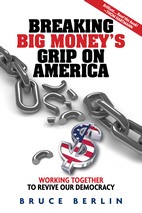
Breaking Big Money's Grip on America
Indiebound
Category:
Political Science
Publisher: Our Time Books
Type: Non-Fiction
Pages: 160
Copyright: Jan. 1, 2016
ISBN-13: 9780996623209
Price: $8.95 (eBook)
This book is an urgent call to all Americans to focus on a critical issue: huge sums of money unjustly influencing US elections and public policy.
Some people see the United States as a plutocracy run by and for the very rich. Breaking Big Money’s Grip on America
provides convincing evidence to support this view and explores how a nationwide Democracy Movement can overcome Big Money’s control and convert our government into one that serves the needs
of the American people. It also demonstrates why breaking Big Money’s grip is critical to solving other crucial issues like gun violence and income inequality. Whether you are a conservative, moderate, liberal, or progressive, your participation is vital for fixing our broken political system.
Excerpt
What is meant by Big Money? It is the power of vast sums of money to influence
the outcome of elections and the formation of public policy to favor special interests.
Breaking Big Money’s Grip on America is a wake-up call to the people of the United States. Deep inside, many of us believe that we, the people, deserve more than a government that disregards us, media that misinform us, and huge corporations that profit off of us. We see the corruption, greed, ignorance, and self-interest that are poisoning our nation, destroying our environment, eliminating our jobs, devaluing our work, foreclosing on our homes, and killing our youth in needless wars. And we feel powerless, overwhelmed, or unfit to tackle such huge issues.
We are also aware of the ever-growing influence of Big Money on our political system and how it controls governmental policy at the expense of most Americans. Due to Big Money, the needs and desires of the great majority of us are not well represented by our government officials, unlike what we would expect in a truly democratic society. Nevertheless, while many people get involved in public issues or social improvement programs to help better our country in one way or another, most Americans go about their separate lives either unaware of Big Money’s harmful influence over our nation or believing they can do little or nothing about it.
Like a great many Americans, I feel that I have very little, if any, say in what policies our federal government adopts, how those policies are implemented, or what impact those policies may have on my community or on me. This hit home for me especially in 2008 when the Great Recession depressed the US housing market, affecting the value of a residential rental property I had owned since 2000. My plan had been to build equity in my rental unit as an education fund for my young daughter’s future college expenses. Just before the Great Recession my rental property had been valued at roughly $300,000 and I had about $100,000 in equity in it. I believed that by the time my daughter, then an eighth grader, entered college her mother and I would be in pretty good shape to afford her college expenses by selling the rental property. However, in the fall of 2008 my plan disintegrated practically overnight when the value of my rental property tanked and I lost all the equity that had built up over the previous eight years. Misguided government policies, combined with unregulated and unscrupulous mortgage and banking practices, had rendered my daughter’s college fund bankrupt. An innocent victim, I was angry and disillusioned. I could only imagine how the millions of Americans who had lost their homes or jobs felt.
In fact, millions of lives were shattered. Whether a person had been earning minimum wage or a middle-class salary, it became difficult to make ends met. Many people had their health insurance canceled or their cars repossessed for failing to keep up with their monthly payments, while countless others lost their incomes altogether. Although those working in construction or manufacturing suffered the greatest hardship, almost everyone except the economic elite felt some loss. My outrage only increased when our government not only failed to come to the aid of average Americans who had been hit hard by the financial crisis, but instead bailed out the big Wall Street banks that had been, in large part, responsible for the economic mess the country was in.
Then in November 2008 Barack Obama was elected president. Since he had promised “change we can believe in” during his campaign, I thought there would be no more sweetheart deals for corporate giants similar to the one the too-big-to-fail banks had received from the George W. Bush administration. But I was wrong. First, the Obama administration failed to hold the bankers and mortgage lenders accountable for the fraudulent practices that had been largely responsible for the collapse of the housing market. Then President Obama negotiated a watered-down healthcare bill with the insurance industry and pharmaceutical giants, the Pharmaceutical Research and Manufacturers of America (PhRMA), which met their needs more than those of the American people. To me and many other Americans who had believed in Obama’s campaign, he had become just another politician who allowed corporate sponsors to steer the ship of state.
Looking at my experiences during the Great Recession in a larger context, I realize that as a lifelong political activist and student of American government and history I have periodically been dismayed and, at times, even outraged by our nation’s increasingly anti-democratic political process. In fact, at one point I felt so disheartened that I considered moving to Costa Rica, Panama, or some peaceful tropical island. But upon further reflection I saw that such an easy escape would not contribute to freeing our government from the grip of Big Money or be faithful to my longtime commitment to help build a truly representative democracy in our nation. Instead, I decided to do what I could to reverse the takeover of the United States by Big Money and corporate America. My goal was to fight their use of wealth and power to buy elections and unduly influence government officials to create and maintain the kinds of conditions that favor them rather than the American people.
|