
Kindle Edition
Download to your Nook (eBook)
Amazon
Barnes & Noble.com
Amazon
EdProtzel
Category:
Historical Fiction
Publisher: TouchPoint Press
ISBN-10: 1946920312
Type: Fiction
Pages: 246
Copyright: Feb. 2, 2018
ISBN-13: 9781946920317
Price: $4.99 (eBook)
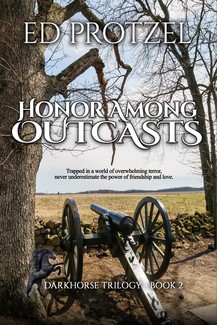
An abolitionist from Mississippi forms a colored Union army regiment with a dozen runaway slaves in guerrilla-infested Missouri, only to find himself accused of spying for the Confederacy.
After a harrowing escape from Mississippi, abolitionist Durksen Hurst, his fiancée Antoinette DuVallier, and their friends — a group of undocumented slaves — land in guerrilla-infested Civil War Missouri, the most savage whirlwind of destruction, cruelty, and death in American history.
Honor Among Outcasts_FRONT.jpg
Trapped in a terrifying cycle of murder and revenge, scarred by Quantrill’s cold-blooded Lawrence massacre and the Union army’s ruthless Order No. Eleven, Durk and everyone he cares for soon find themselves entangled in a struggle for their very survival.
Honor Among Outcasts takes readers on a pulse-pounding journey of desperate men and women caught up in the merciless forces of hatred and fear that tear worlds apart, and the healing power of friendship to bring them together.
Excerpt
Chapter One - The Color of Chaos
1863 Camp Macon, Eastern Missouri
The April sun performed its slow, irrevocable descent behind the western hills, a miserly ogre hoarding the remaining daylight, leaving the fecund Earth below in shadow. With night falling, the rich green thicket surrounding the Union Army camp rapidly faded to a foreboding forest of horrors infested with malevolent, ghost-like guerrilla bands bearing sudden death and horrendous mutilation.
Activity slowed in the camp, becoming restrained and random, as the clatter of hooves and heavy caisson wheels, the tromping of boots, and the smack of metal against leather died away. Rifles and equipment were abandoned in front of tents. Wood was leisurely gathered, and the air became thick with smoke from myriad cook fires. For the moment, a looming insurgency, more brutal than the soldiers had ever imagined, seemed far away.
At the corral, a worn-out Durksen Hurst closed and tied the gate, relieved to be done with his duties training cavalry horses. After weeks of failed attempts, he was free to make his big move, having arranged to see the general. Luckily, that day no wounded mounts needing attention had returned to detain him. Brushing off his hands and stained civilian work clothes, he crossed the clearing to where Big Josh Tyler sat on a tree stump waiting anxiously for him.
Durk, as he was called, was five-foot-eight of slim, hard muscle made evermore tighter from four years of manual laboring. He had thick, black hair and a strong-set jaw. His high cheekbones, dark eyes, and broad nose reflected his mother’s Seminole heritage. Raised by his white father until he was ten, self-educated Durk was well-spoken enough, enabling him to front for his dozen black cohorts.
The strange group of thirteen, Durk and a dozen black men, generally kept to themselves, never discussing their singular arrangement with outsiders, which made the soldiers in camp suspicious. People thought it curious that the others never held back in voicing their opinions to Durk: an oddity that caused rumors to spread. Durk was believed to be a former plantation owner, which none of the thirteen denied. Many suspected he was a fugitive with a price on his head for robbery, or even some dastardly act performed in a dark alley with a pistol or knife. Stories around camp speculated that the odd-looking interloper had never really owned the twelve former slaves with whom he camped, and one popular yarn actually claimed he’d kidnapped them. There was even talk that Durk wasn’t white at all, but rather a creature of unknown, profoundly-sinister origins.
Seeing Durk coming, bear-like Big Josh rose to greet him, in no mood to be disappointed. Since sun-up, Josh had been working with a pick and shovel on the camp’s earthen fortifications. His neck muscles and shoulders were sore and his temper short. Josh spoke with a stutter. That added to his girth and skin color, and white men paid him little heed. But it wasn’t uncommon to see Josh openly reprimanding Durk or issuing what seemed to be orders to him, just as Josh did with the other blacks in their cabal. Such seemingly upside-down interactions made the soldiers scratch their heads… and secure their belongings.
Passing between the rows of tents, Durk and Josh headed toward the general’s quarters, speaking quietly. They were hungry, a never-ending discomfort thanks to the meager rations the army supplied its black labor; they could smell brewing coffee and fried fatback wafting in the breeze, yet they ignored their stomachs’ urgent cries.
They reached the camp’s main road, stepping gingerly over the ruts driven deeply into the mud by artillery caissons, supply and ambulance wagons, and the tramping of marching boots. Nearing the surgeon’s tent, Durk slowed in hopes of catching a glimpse of Antoinette, who was working with the medical units, treating the sick and wounded. He hadn’t seen much of her lately and missed her terribly. Typhoid was running rampant throughout the camp, and soldiers were falling sick, many dying. She wasn’t where he could see her, so he continued on, disappointed.
When they reached the general’s tent, an armed guard blocked the entrance.
“Durksen Hurst to see General Sparks,” Durk stated formally.
“And who is this?” the guard asked with a sneer, indicating Josh.
“Josh Tyler, my right-hand man,” Durk replied.
As the guard left to check with the general, Josh studied Durk’s face, which was shadowed in doubt, a very bad sign. Talking the general into permitting them to join the army would be difficult enough, even if Durk tried his best. In this case, Durk had an inbred aversion to violence and didn’t necessarily want to succeed.
“Durk, you gotta get us into this army,” Josh whispered. “We voted, remember? I knows you c-can do it.”
Durk merely sighed, clearly not convinced.
Two years earlier, Durk and his dozen black comrades, accompanied by their women and children, with Antoinette at Durk’s side, had arrived at a Missouri Union military outpost, having fled the South under peculiar circumstances, looking to aid the Union cause. They called their strange group DarkHorse, but only they knew what that meant. In short order, smooth-talking Durk had gotten them attached as adjunctive labor to the army. Since then, the DarkHorse men and their women had worked faithfully and hard for the Federal military, suffering deprivation without complaint. With Durk beside them, sharing their hardships, they’d cut down trees to lay corduroy log road through snake- and mosquito-infested swamp, constructed fortifications, dug ditches, and skinned supply wagons — whatever tasks the army required of them.
To explain their unusual union, Durk’s black companions had posed as contraband laborers whom Durk had “liberated” from their masters. At other times, depending on Durk’s strategies-of-the-moment, they’d posed as “freed former slaves,” based on dubious manumission papers Durk had signed. Actually, Durk had never owned these men, making their documents and their so-called freedman status problematic.
In truth, the men had secretly been partners back in Mississippi, building and working their own plantation together, which they had named DarkHorse — a name they’d kept. In the four years since, they’d lived under no formal hierarchy, making decisions by consensus. Nevertheless, with the resourceful Durk to navigate the white world for them, they’d managed to survive together, South and North. Often the group’s greatest boons, and occasional stumbles, were a direct result of Durk’s wild imagination, which had a tendency to overwhelm his better judgment.
Ironically, when President Lincoln’s Emancipation Proclamation became effective in January, its provisions applied only to those states in rebellion, and, technically, Missouri was not one of them. Although the state was under martial law, the proclamation had not freed the state’s slaves, not even those belonging to active Confederate soldiers, guerrillas, and Southern sympathizers, making the women and children of Durk’s partners officially still property, mere chattel. They could only hope their legal owner, and the damning records branding them such, were hundreds of miles behind enemy lines.
Durk’s partners’ ultimate dream had been to wear the uniform and fight to free their people from bondage. And just recently, their dim hopes had brightened. At Lincoln’s behest, the Union had begun accepting black men as soldiers, both freedmen volunteers and slaves who’d managed to escape their masters and reach an army outpost. But with active slave catchers patrolling the region, any attempt by a slave to take flight was still an extremely risky venture. Throughout the country, the formation of black regiments was hit-and-miss, entirely dependent on the whims of the general commanding any given military district, and no black regiment had yet been established by General Sparks in this region of Missouri.
Durk himself had no military ambitions. He’d never fired a shot in anger, abhorred violence of any sort, and, moreover, was well aware of his own cowardly streak, often noting that courageous rabbits didn’t live long. Despite all that, in 1863, colored army units were required to have a white officer. Knowing that many commonly abused their black charges, Durk figured that if he continued to front for his partners, if he took the officer role in the unit, their service might be less humiliating. It could, in fact, be noble and worthy.
The guard returned, and the pair was permitted entry into the dry, musty tent. General Sparks, a quarrelsome man in his mid-fifties, was seated at a table covered with maps with an open bottle of whiskey and a half-filled glass before him. He sported a black mustache and Van Dyke beard, which jutted forward from his chin at a sharp angle. He was a political general, more concerned with his own ambitions than the Union cause: a man whose military incompetence hadn’t yet met a situation challenging enough to cause his being assigned to a more appropriate post, where his activities would be less fatal for his underlings.
“Thank you for seeing us, General. My name is Durksen Hurst, and this is my future Number Two, Josh Tyler.”
“Oh, yes,” the General said, looking up. “I know of you, Hurst. I understand you’re quite a horseman. You’ve done wonderful work with the stock.”
“Yes, sir. Thank you,” Durk replied. “As my appeal noted, I am prepared to form a cavalry regiment. I already have sixty men willing to enlist, with more coming into camp every week. My men have two years’ experience taking care of government mounts, and I’ve taught most to ride well. We’re ready to sacrifice, General, to contribute to our country’s glorious victory.”
The general scrutinized Josh. Finally, he barked at Durk, “Do you mean to form a regiment of colored cavalry, Mr. Hurst?”
“Yes, sir. The men are eager to fight against the rebellion.”
“Hurst,” the general growled, nodding to indicate Josh, “these people are the cause of my having to leave my family. If it wasn’t for them, there wouldn’t be a war. I’d be sleeping in my own bed at night.”
Durk glanced at Josh to see how he was reacting to such an indictment, but Josh’s face remained impassive, stoic, revealing no anger or hurt. “Sir,” Durk petitioned, “these men are brave and loyal. I assure you, they’ll give the secesh a real whipping.”
General Sparks drained his drink and refilled the glass. When he set down his glass, his face glowed bright red. “So, you want me to supply a mob of Negroes with uniforms, weapons, and horses, too. Is that what you’re telling me?”
“Yes, sir. I have sixty men, enough to start a regiment right now. We’ll have a full hundred within a month or two.”
The general took a deep swallow, then narrowed his eyes at Durk. “Hurst, understand me; this is not a Negro’s war. The rebels would have to spill every drop of blood of every white man in the North before Negroes will take up arms. Do you understand?”
“B-but, sir,” Durk stuttered, “the rules-the rules have changed now. These men will be as brave as any white man. They just want to prove they’re deserving of citizenship...”
“These people haven’t what it takes to be soldiers,” the general retorted, pointing directly at Josh. “Do they know anything? Why, I’d throw down my arms before I’d fight beside a black man. I’d rather be shot in the back!”
Durk hung his head, knowing there was no sense in arguing. He’d failed his partners. It looked like it was back to being simple camp labor for the DarkHorse men.
“Another thing, Hurst,” the general continued. “Those people get in the fighting, who knows what they’ll demand! Hell, they’ll want to vote like white men. Can you imagine a more absurd idea? Can you?”
***
The night arrived and nestled in, pulling a blanket of stars and a bright, full moon overhead. For supper, the men had eaten salt-horse, which the women had fashioned into a palatable kind of stew. Supplemented by hardtack fried in fatback, the humble fare had muted their bellies’ complaints. But surprisingly, Durk hadn’t shown up to join them. They’d almost finished eating when a Missouri State Militia orderly arrived to deliver a note from him, asking them to gather at their regular meeting place in a grove outside camp.
In keen anticipation of the news, the men finished quickly and traipsed the few hundred yards to wait around their modest fire, quietly speculating as to why Durk had called them together out here, especially in a note conveyed by a military private. Had another one of his schemes misfired and gotten them into trouble again?
When they heard Durk’s distinctively brisk footsteps approaching at his regular, confident pace, everyone sat up, alert. Jaws dropped as he entered the circle sporting a crisp, new Missouri State Militia captain’s uniform.
“Men,” Durk crowed proudly, smiling broadly, “we’re in the army, in the MSM!”
There were cries of jubilation and relieved laughter. The men leaped up, hugged, and back-slapped each other. It took some moments for Big Josh to quiet everyone down.
“We’re going to form our own regiment, the Ninth. Us and all the freedmen volunteers and the contrabands, too. I’m naming it the DarkHorse regiment, like we called our plantation. Gentlemen, DarkHorse lives again!”
Josh just shook his head in admiration and partial disbelief. Right after work, their friend had disappeared, as he was wont to do, seeking some advantage for them. Sometimes when this happened, he returned with good news. Usually he returned empty-handed, but this time he’d talked his way into an unexpected boon. And Josh couldn’t see any potential pitfall in the road ahead… yet.
“Even better,” Durk added, pausing for effect, “the MSM Ninth will be a cavalry unit. Cavalry! We’ll be riding, not marching!” There was more laughter and hugging, and it took some time for Josh to quiet them.
Josh puzzled over these earthshaking developments. Durk always announced his new conquests like Judgment Day had come, but often, devils hid within the euphoria of his pronouncements. This new revelation brought to mind Durk’s announcement in Mississippi that he’d gained title to Chickasaw land on which to build a “plantation” of their own. At the time, Durk’s quasi-legal maneuver had struck them like a miracle had happened. That was, until they ran into problems. Now the men were in ecstasy, but Josh knew from experience he’d better ask questions before they found themselves marching, or as cavalry, riding into quicksand.
“B-but Durk,” Josh stuttered, “wh-what you mean? The general say he won’t allow no colored soldiers in his district.”
“To Hell with General Sparks! He’s Federal Army,” Durk replied haughtily. “Fellahs, we’re in the Missouri State Militia. As of tomorrow morning, DarkHorse is the MSM Ninth Cavalry! Now the MSM don’t have the equipment the Federal Army has. The horses are broke down, and the weapons are ancient, but we can make do, can’t we? Just think, men, tomorrow morning you’ll be putting on new uniforms from the quartermaster. I already filled out the paperwork.”
“Yes, but the g-general say...” Josh interrupted, recognizing that familiar twinkle in Durk’s eyes. He examined Durk’s face and could tell his friend was withholding something. His expression evidenced his possession by one of his grandiose schemes, which, crazy as they sometimes sounded, had led to important gains for the group. But his notions had also put their lives at risk more than once. Josh surely didn’t want to see Durk’s mind flying off just when they were about to get into the war. As soldiers, their survival in this conflict was already going to be tenuous. “You hiding something, Durk. Wh-what’s the c-catch?”
“Well, it’s not a catch; it’s a bonus! See, Josh, we’re registered…” Durk quickly devised a way to break to his partners the twisty part of the deal he’d worked out. “We’re registered as a white regiment. Only way I could do it in this district, right?”
The men groaned as bewildered and distraught expressions supplanted the earlier joy in their faces.
“Listen,” Durk said, “the army pays thirteen dollars, right? But it only pays colored troops seven.”
“Th-that’s right,” Big Josh replied.
“So?”
“Well, with you on the rolls as a white regiment, y’all will make thirteen dollars, not the seven they would have paid you.”
Big Josh merely stared, unsure that he’d heard right.
“See, I got the idea originally from the Chickasaws. The tribe called you ‘black white men,’ remember? To them, y’all were white men, just black ones. So, I figure if I can promote y’all to being white, we’d be a white unit, and I could get you on the rolls at thirteen dollars — maybe better horses and arms, too — maybe better grub. Otherwise, it’s going to take an act of Congress to get you that extra six dollars.”
“Forget it, D-durk,” Big Josh said. “We just gonna have to wait on Congress.”
“Listen, Josh, once this war’s over, it’s still going to be hard to be a black man, no matter what. You know that’s true, ain’t it?”
Big Josh nodded. “It ain’t gonna be harder than being a slave.”
“Sure, I know that. That’s what we’re fighting for. But this idea is about more than the six dollars; it’s about years to come. See, if all the freed slaves are promoted to white men, it’s going to be easier for people to accept y’all.”
“This is you’ craziest idea yet, Durk,” Josh objected. “What we gonna do, p-paint ourself white?”
“Course not. But...”
“Listen, friend, we ain’t getting tangled in none of your tricks. All we s-suffer to finally get in the army, and you think we gonna risk it for six d-dollar? Durk, we proud to be colored troops fightin’ for President Lincoln, and that’s a fact. That’s who we are. Le’s just get all the slaves free, and then we just take our chances on getting that six dollar. Sides that,” Josh added, “I hear the colored soldiers in the east went on strike for that equal pay. Did you know they hung the black sergeant leading that protest? You heard that?”
“No,” Durk said contritely, “I haven’t...”
“You want us to chance getting hung for six dollar?”
“All right,” Durk said firmly. “Let’s take a vote. Forget the money. The paymaster will be happy to pocket the extra six dollars a man. The question is this: should we be a white cavalry regiment, or should I try to get us switched to colored cavalry?”
Bammer, a muscular man with a wife and two children, said, “Listen, we gonna die just like white men. No reason we shouldn’t get the six dollar. Our families is hungry.”
Josh stood to his full height, and, out of respect, everyone quieted down. “I say get our paperwork switched to be colored,” Josh said. “Listen, God, and Durk here,” he chuckled, which was parroted nervously by the rest, “has give us this chance to fight for our country, for our people. Some of us won’t see the end of this war, making our women and children widows and orphans. Some of us gonna be cripple’ for life. If we gonna die, be beggars on the street, let us be proud to be black men fighting for the Union, proud to go into battle to free our slave brothers. I don’t wanna be ashamed of what should be the proudest moment in my life, ‘specially not for no six dollar.”
They went around the circle, and a few others voiced an opinion. There was grumbling, but they voted ten to two to be a colored regiment. Then they came to the last man, Isaac, always angry, who merely spit in the fire and walked off. No matter, ten settled it. As soon as Durk could get their papers switched with the quartermaster, paymaster, and the other authorities, he’d do it… but it wouldn’t be easy.
“Well, if that’s how you feel,” Durk said, disappointed that his partners failed to see his vision stretching off into the decades, with them equal to white men someday. “It’s your six dollars,” he mumbled, vowing to himself that he wouldn’t let his notions get his friends into trouble like they had before, not without their permission, of course.
|