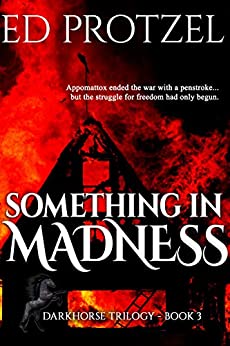
Returning to Mississippi after the Civil War, an abolitionist and his Black friends confront Southern resistance.
1865. After the Civil War, Durksen Hurst and three black friends return home to a devastated Mississippi, the sole survivors of a Union colored cavalry regiment. But instead of peace, they find unregenerate Confederates who reject emancipation still in charge.
Undeterred, Durk opens a law practice to help disenfranchised freedmen — only to be threatened by powerful planters and nightriders. A black school is burned; a petition march to Jackson is terrorized. And when one of his friends goes missing, Durk is horrified to discover Black Codes being used to force freedmen into brutal servitude. Clever Durk schemes to liberate them, but must contend with armed ruffians — and a rigged court system. Will fire and bullets prevail?
In this concluding chapter of Ed Protzel’s DarkHorse Trilogy, Something in Madness illuminates Reconstruction, the least understood epoch in American history, exposing the origin of America’s ongoing racial divide.
Excerpt
Prologue
On a quiet evening, when a pebble is tossed into a placid pool, scientists say ocean tides on the opposite side of the world are affected. Likewise, the courage and vision of a few obscure people can reverberate through time, moving us in profound ways of which we are unaware.
Such is the tale of Durksen Hurst, Antoinette DuVallier, and Big Josh Tyler. Their story is strange, complicated, as agents of change tend to be. In 1859, Durk, a lonely and ambitious drifter, a man we would call a hustler, rode into the hamlet of Turkle, Mississippi, needing to prove something to the town that years before had killed his father, leaving him orphaned.
Fortunately for Durk, he was taken in by the Chickasaw and raised to manhood. But with no roots in the outside world or formal education, he became an itinerate promoter of schemes he claimed would help blacks and whites throughout the South.
And this time Durk was lucky. He encountered a dozen slaves hiding in the Chickasaw swamp. Wary, but having little recourse, the men agreed to Durk’s proposal to build their own plantation — secretly as partners. But Durk would need land. So he swindled fifty square miles from a Chickasaw chief, and the clearing of forest and the raising of their mansion soon began. They named their venture DarkHorse after Durk’s Chickasaw name.
But Turkle’s power structure could not stomach the new rival. Looming over the town was the shrewd widow, Marie Brussard French, owner of FrenchAcres, one of the largest plantations in Mississippi. Ironically, the widow was hiding secrets of her own: she’d been a notorious quadroon in a New Orleans bordello who’d abandoned her small daughter, Antoinette, to marry a wealthy Mississippi landowner named French.
Once married and settled in Turkle, the young Mrs. French gave birth to another daughter, Devereau. Upon her husband’s sudden death, with the town’s notables poised to steal the plantation from the vulnerable widow, the wily Mrs. French seized on a ruse to ensure her control. She concealed the infant’s gender, thus forcing Devereau to masquerade as a male throughout her life, becoming, in effect, the late-owner’s male heir. Consequently, the pair’s grip on power was as tenuous as DarkHorse’s façade of legitimacy.
Sadly for Devereau, her male subterfuge allowed no room for friendships or love, which played havoc with her mind and emotions. By adulthood, she’d become increasingly erratic and uncontrollable, to her mother’s mortification.
Meanwhile, Antoinette, now grown, prospered in New Orleans, marrying and having a son, Louis Edward. Learning this, Mrs. French, desperate to assuage Devereau’s wrenching loneliness, resorted to clandestine means to “adopt” the boy for her.
Frantic to recover her son, Antoinette, now widowed, journeyed to Turkle, unaware that the child was already dead and buried. There, she encountered Durk and his partners, and they soon aided each other’s efforts. As fate would have it, Antoinette and Durk fell in love — galling a jealous Devereau, who was consumed with the notion of getting Durk for herself. One night, gripped by utter hopelessness, Devereau confronted her mother, shot her, and fled.
With the war raging, Durk pleaded with the townsmen not to throw their lives away on a fool’s crusade. But he failed miserably. Consequently, the town turned on Durk and his partners, forcing them to run for their lives north to Missouri.
Both the venerable FrenchAcres and the upstart DarkHorse plantations were no more.
By 1863, after working as contraband labor for the Union army, Durk and his partners established a colored regiment to help fight guerrillas, naming it DarkHorse after their lost plantation. Peculiarly, although blacks were encouraged to serve, according to the rules of the day, black units were required to be led by a white officer. Naturally, Durk agreed to serve in that capacity.
It is now 1865, and the fighting has ended. Durk and Antoinette, along with the two surviving partners, Big Josh and Long Lou, have returned to Turkle, with a young boy they’d rescued, Caleb, in tow. The opportunistic Durk hopes to recover the DarkHorse land. And with slavery abolished, Josh is determined to dedicate his new life to helping his people. Their aspirations seem within reach, so logical…
But what will they find waiting for them?
Professional Reviews
D. Donovan, Donovan Literary Services - Highly recommended
Something in Madness, Book 3 of the DarkHorse Trilogy, is set in 1865 after the Civil War, when Durksen Hurst, a half-Seminole, and three black soldiers return to their Mississippi home, only to find that the battle for freedom has not yet ended in that region.
Durksen Hurst built a plantation shared with slaves hiding in the swamp on land he swindled from a Chickasaw chief. Eventually forced to flee the town with his silent partners during the war, Durk and his band establish a colored regiment within the Union army, name it DarkHorse (after the bygone plantation), and eventually return home with the hope of resurrecting the plantation after the war.
Their homecoming to Turkle, Mississippi and the newfound conflicts they face there form the foundation of Something in Madness, which illuminates a deadly truth: "The slaughter on the battlefield had come to an end, but a scourge more insidious and enduring now descended upon the shattered land."
Whether he's describing unrequited love or battles, Protzel does a fine job of capturing the underlying nuances of interpersonal relationships against all kinds of backdrops: "So Durk’s back in Turkle! Her mood sank, hitting bottom faster than a boulder dropped into a shallow creek. Durk, the man she’d wanted from the first moment she’d seen him, who she’d pursued throughout Missouri, who’d cost her so much, even her freedom. Durk, who she must have but knew she never would — because of Antoinette."
From brutal treatments and relationships between generals, employers, and ordinary men and women to the continuing conflict between those free and others only recently freed, even after the war, Protzel's story follows a delicate dance between personalities, options, and different ways of coping with conflict.
Durk's struggle with rigged systems and the ongoing legacy of slavery pits him against people and systems alike as slavery continues to exert its insidious force against everyone despite the war's outcome and seeming conclusion.
This aspect of ongoing battle and confrontation is a seldom-explored result of the Civil War. The story offers invaluable lessons on the real roots of modern racial strife which never entirely left American soil and not only lay in wait for future generations, but emerges from dormancy like a living legacy of ever-present adversity.
The motivations, lives, perceptions, and challenged social structure of the South is deftly covered through the eyes and experiences of characters who juxtapose personal interests with bigger-picture thinking.
The result is an engrossing story not just for historical fiction readers, but for anyone who would better understand the roots of modern racism and the choices and impact it brings to all sides of the equation.
Highly recommended for civil war fiction readers and those with an interest in modern racial discord in America, Something in Madness stands out as a powerful saga of ongoing strife.
Terry Baker Mulligan, author of Sugar Hill and Afterlife in Harlem
Something in Madness is the third and final book in Ed Protzel’s DarkHorse trilogy about America’s Civil War. In this action packed volume, we return to Turkle, Mississippi after the war’s end, where some of Turkle’s diehard confederates balk at the idea of freed black men.
Many of the good guys from the first and/or second book reappear in this finale, including Big Josh and Long Lou, former slaves. Both men are friends and business partners to Durk, the former drifter, but principled do-gooder who propels the story and wiggles out of more deadly situations than a magician has tricks up his sleeve.
Also returning in book three is Devereau the disturbed woman whose evil mother forced her to live a lonely embittered life impersonating a man. Predictably, Devereau, as well as others pay the price for this deception. A new villain and antagonist to Durk is Colonel Rutherford, one of Turkle’s power brokers who personifies the Old South’s most reprehensible pro-slavery positions.
The DarkHorse Trilogy is historical fiction and in Something of Madness, Protzel regularly treats readers to snippets of history, as when he writes: “Every Southern town had a ‘Jew Store,’ a place to buy sundries like cutlery, pots and pans, Sunday suits, dresses and Easter bonnets.“
With Protzel’s vivid descriptions and realistic Southern cadence of black and white speech patterns, readers can imagine walking into the country store, or strolling along the river bank. For instance, Durk takes a brief impromptu tour of Turkle, and reflects on what war has done to the place he calls home:
“Before the war, sleepy Turkle had been familiar to him, like an old alligator sunning by the river. But in the light of morning it seemed more like a lifeless log snagged on trash…”
Despite the dark forces at work in Something in Madness, it is ultimately a tale of hope and determination against seemingly insurmountable odds. It is also a timely tale for these troubled times in our divided nation.
Jason Chase, a man filled with personal demons, only wanted to finish his manuscript. But all his carefully laid plans disappear when a stranger showed up at his front door claiming to be his long-lost father.