
Download to your Nook (eBook)
Download from Apple iTunes (eBook)
Download from Smashwords (eBook)
Barnes & Noble.com
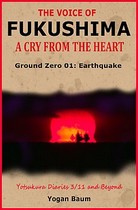
Yogan Baum - Author of eBook Serial The Voiice of FUKUSHIMA: A Cry from the Heart
Category:
Memoir
Publisher: Published by Yogan Baum at Smashwords
ISBN-10: 0152901221
Type: Non-Fiction
Pages: 86
Copyright: March 02, 2016
ISBN-13: 2940152901221
Price: FREE! (eBook)
In Part 1 of the ebook serial “The Voice of Fukushima: A Cry From the Heart” Yogan Baum, longtime resident of Yotsukura, a fishing village near Fukushima, relates how he experienced the M 9.0 Tohoku megaquake of 3/11/2011. Awed by the intensity of the experience he is unaware of its consequences. This ebook weaves a tapestry entwining both raw terror and some of the fruits of years of reflection.
“A Cry From The Heart” is what author Yogan Baum needs to share with all of you who care about the future. Wake up! he says, Fukushima is only the tip of the iceberg …
Yogan, after more than 30 years no longer a stranger in his adopted country, lived through the catastrophic events of 3/11 just 20 miles from the terminally ruined Fukushima Daiichi nuclear power plant.
Life changed dramatically on and after March 11, 2011.
Yogan was spared in many ways. The M 9.0 megaquake did not break him. The killer tsunami stopped short of his street in Yotsukura, a sleepy little fishing village twenty miles south from the Fukushima Daiichi nuclear power plant. And the triple meltdown of Dai-ichi miraculously came to a halt somewhere below the crippled plant.
Life changed all the more as it went on as if nothing had happened. This, the second catastrophe, is the real one, Yogan now thinks.
Not to go mad he began to write down what he saw. What his wife of thirty years and he had to go through since March 2011, just like countless fellow humans here. Writing it down Yogan began to understand about this mess.
He’ll try to tell the sad story of defeat as it unfolds in one man’s, one family’s struggle. He tells it to honor those who suffer in silence. The old. The children. The uninformed. The victims.
In Ground Zero 01: Earthquake - part 1 of his ebook serial The Voice of FUKUSHIMA: A Cry From the Heart - Yogan relates how he experienced the M 9.0 Tohoku megaquake of 3/11/2011.
Awed by the intensity of the experience he is unaware of its consequences. Ground Zero 01 weaves a tapestry entwining both raw terror and some of the fruits of years of reflection.
Just like the earthquake was only a prelude to trouble, Ground Zero 01: Earthquake is only a prolog to a chain reaction of fateful traumatic events in the weeks, months and years to come which will be covered in the upcoming releases of this ebook serial.
Fukushima 3/11 is the chronicle of a ensuing manmade disaster. A disaster that was mercifully not the absolute catastrophe it could have been. A disaster unfolding over the decades.
Chapter one: Chernobyl. Chapter two: Fukushima. Chapter three: Please select from a list of more than four hundred nuclear power plants. There is one near you, you may be sure …
Life is precious. It is fragile. We have to treasure it if we want to survive.
The Voice of FUKUSHIMA: A Cry from the Heart continues with those upcoming releases:
Ground Zero 02: Tsunami and Worse (due for release late summer 2016)
Ground Zero 03: Home but Home no More (due for release end of 2016)
Excerpt
Preface
Looking around me I sometimes feel like the only survivor of a shipwreck. I cling to a frail wooden plank and try not to think about the future, but then, there is nothing else to think about! All around I see water, nothing but water. A bottomless ocean stretches east and west. Then, there is fog – and through the mist I hear seagulls cry: there must be land somewhere near! Or are those gulls, I wonder in my dazed drifting, mocking me? Keeping a lazy eye on me, just in case? I’ve seen gulls in a feeding frenzy before, and don’t want to remember the talons and beaks tearing into those long dead salmons that had no way to hide, no way to go in the shallow mouth of the Kido river north of here. Too close to the sea, too close to the monster. The tsunami? Yes, that, too.
All alone I feel at times: trying not to go under in a deluge of people trying to forget their danger. We were cast adrift and are now caught in a flood of lies and deceptions. Nobody has the courage, or the means, to cut through the sordid web we, people of Fukushima, are trapped in. Nobody opens their hearts to cry out to their gods: silence reigns supreme. It is almost five years after March 11 now, and the monster looming less than twenty miles north of here is just not mentioned where human voices are heard. It is the nameless fear, it is “that which must not be spoken of”. It is taboo. Only engineers and politicians talk Dai-ichi.
Deep down we are all scared shitless. My elderly neighbors are. All our young mothers are. My wife is. I am. How could it be different when you know there are three molten-down cores of Uranium and Plutonium, weighing hundreds of tons, smoldering somewhere, in completely unknown state, underneath the burned-out ruins of Dai-ichi?
We live in fear, that is a fact. Things have cooled down, for sure, but the nagging remains. Looking around me I see Iwaki booming: disaster is good business, man! Not for the victims, though. What can a poor boy like me do, then? I started to write. Not to go mad I began to write down what I saw. What my wife of thirty years and I had to go through, just like countless fellow humans here. Animals fared even worse. I started to write down what I began to understand about this mess. The first year I was just stunned. After that I grew angry. Now I am almost resigned to my fate. Resigned to be a victim. Worse than that – to be a victim of victims! Big fish eat little fish, yes, but this one little fish at least is not willing to go down in silence. Will it do Mariko and me any good? I don’t know. It is of secondary importance. Important is to speak out.
This is the chronicle of a manmade disaster. A disaster that was mercifully not the absolute catastrophe it could have been. A disaster unfolding over the decades. Chapter one: Chernobyl. Chapter two: Fukushima. Chapter three: Please select from a list of more than four hundred nuclear power plants. There is one near you, you may be sure.
If not – there may be one planned. Better stop it. Before it is too late.
1 We’re not leaving!
It’s been more than 30 years since I came to Fukushima. Am I to leave, now?
“We’ll stay.” That’s what I said in an interview on national TV some time ago. The media were interested, very interested in Fukushima, for some time. For a very limited time. The time was early 2011. You will remember March 11, I hope?
“WE STAY!” - well, am I saying this with an undercurrent of hope these very words might open a way out of the desperate situation we are facing here in Fukushima? We being Mariko, my wife, and me. “Me”? Who am I, then? I wish I knew, I often feel. My wife calls me Giorgio at times. When she’s in a good mood. So, why don’t we stay with that? – Call me Giorgio.
We have a situation… Indeed, sir, we do. Of course a part of us wants to run from this blighted place, run as fast as can be. But…
“Why on earth are you going back there?” we were asked by all our friends and relatives in the old country when it gradually became clear that that was exactly what we were going to do in May 2011. “Are you crazy?!”
Why indeed? - We have no real alternative, my dear Louise. What else are we supposed to do? How could we make a living in the old country after 30 years abroad? How could I ask my wife to leave her family, how could we give up a life of thirty years as long as there was even a shred of hope? Back to Fukushima, it was.
2 Roots
After thirty years in one place a person grows roots that can not easily be cut. There is an attachment. Was our friend right? She regretted that our house had not been washed away by the tsunami. “It would have been so much easier for you!”
Fifty meters from here to the water lapping the village’s little fire station on March 11.
Right here, in Yotsukura, the tsunami was inexplicably low. Height about seven meters only. Average height for most of Iwaki City was even more than that. In some villages and towns nearby, both north and south of here the ocean came in much higher. We were spared. Nobody knows why. The ocean floor, maybe? A rocky outcrop north of Yotsukura port? Tsunamis have a will of their own.
The sea is only about 500 meters from our house, close enough to walk to the beach in flip-flops.
If the wind is right we hear the surf roar its mighty song; I remember one late night when it was so loud I actually put on my shoes to go and see what was happening outside. An overwhelming feeling of the ocean coming ashore. The funny thing was – as I got closer to the beach the surf sounded weaker until it almost faded out. A hill in the back of our house, the same hill I evacuated to on that Friday, March 11, amplified the sea sound and made it ring like a bell. Was this some kind of premonition, I wonder now.
We live in Yotsukura, city of Iwaki, in Fukushima Prefecture, Japan. Distance to Fukushima Dai-ichi, the stricken nuclear plant, just under twenty miles. Had evacuation been ordered and compensation been paid based on mile distances we should have been better off than we are now, sitting outside the thirty kilometers “evacuation recommended” zone. Twenty kilometers was obligatory. Everybody here fled the smoldering ruins of Dai-ichi, the American government advised its citizens to leave in case they were closer that sixty miles and the whole world was collapsing upon us in the days after the M 9.0 earthquake that shook northern Japan only to be followed by a tsunami that reached forty meters and killed almost 20,000. Some videos on YouTube are still unbearable to watch. In our own City of Iwaki, there were 347 deaths. In our home town, the fishing port of Yotsukura there were nineteen. One out of a hundred perished. We in Iwaki City were the lucky ones, compared to others.
Yotsukura. Our home town since October 1985. Coordinates: 37 degrees north, 141 degrees east.
You go far south from here, right off our favorite beach to hit Papua New Guinea after a long journey, then pass through the Gulf of Carpenteria to enter Australia, slide by Melbourne to exit the second driest continent on earth and sail the Roaring Forties before you go ashore on the driest: Antarctica. Where? At Cape Jules on King George V. Coast, during the early seventies location of the constantly moving Magnetic South Pole, and supposedly the windiest place on Earth. Go on through the frigid continent that once teemed with life and exit it to reach the vastness of the South Atlantic Ocean. Go steady and slice through Pernambuco, the easternmost province of Brazil, before you reach Greenland. Nothing but water and ice one more time until you go ashore again in eastern Yakutia, Russia. Your trip back home will take you very near Oymyakon, along with Verkhoyansk the coldest permanently inhabited place on earth. Both clocked the same temperature of -67.7 C and I’m glad it’s more temperate here. As we go south some more we finally pass through Sakhalin just off the Asian continent before hitting Hokkaido and soon after that the main island of Japan, Honshu. Welcome back – what a trip.
Sailing east from Yotsukura will take you near Monterey in beautiful California! From there it is Las Vegas and miles and miles of North America until you end up in Chesapeake Bay to cross over into the Atlantic Ocean. The voyage will take you into good old Europe next, to Portugal. Landfall at Cabo Sao Vicente. It is the same rock the ancient Greeks called Ophiussa, snake country. I stood high on this south westernmost point of Europe in 1981 and had no idea I was on track for Yotsukura, Japan. Coincidentally it’s there I heard the first words of Japanese in my life. They were: “Sagres! Naka naka!” and advertised a local beer. Ads were crazy even then. I lived and worked for several months in the nearby city of Lagos on exactly the latitude of here and now Yotsukura: 37.102 N. Much closer you won’t get. We’ll walk across southern Spain to reach the Mediterranean north of Almeria, scene of the 1966 crash of an American B 52 bomber that sent four atomic bombs type B28RI with a yield of about a megaton TNT each into the ground near, and the sea off, the village of Palomares. Again there is a strange coincidence to be observed: I walked down the eastern coast of Spain in 1981 with Rayun, best and truest of friends, and must have slept on exactly that beach. And only now did it dawn on me that maybe, just maybe, the cut in Rayun’s front paw that never healed might have been a souvenir of a radioactive infection from Palomares. Impossible? My well travelled, four-legged companion died of cancer in 1985. Those lost warheads held more destructive power than all bombs and shells, including the Hiroshima and Nagasaki bombs, of World War II ever packed. Two of those Palomares bombs, splitting open, poisoned Spanish soil pretty permanently as Plutonium has a rather long half life. We won’t look at this too closely as we don’t want to get scared right now, and cross some more water to return to Africa, after a journey of a hundred thousand years, just north of old Carthage before reaching the Greek island of Naxos where our whole little family of four slept on the windy beach for one glorious week in the hot summer of 2003. Naxos makes those precise 37 degrees northern latitude a curious fourth for me. Does everybody have this kind of attachment to a certain corridor of Earth, I sometimes wonder? On through Turkey and the whole width of Asia: the tiniest slivers of Kurdish Syria and Iraq, then northern Iran, southern Turkmenistan, the Wakhan Corridor in northern Afghanistan, Tajikistan, possibly one or two mountains north of the Hunza Valley of Pakistan and on into China. Tall mountains, Khunjerab Pass at 4693 meters, and say a little prayer before you cross the Karakorum Highway. Do we skirt what once was Tibet? I would like to think so… but we can’t stay, we move on.
Tasting saltwater again on the shore of Shandong Peninsula we are just an hour or two by plane from home: Incheon airport in Korea is on the line, too. Just a short trip across the Japanese Sea and the rugged and in winter extremely snowy mountains of Niigata Prefecture will take us back to what we still call home. Home away from home, but still home for the four of us: Mariko, me, May and Leon.
Is it preposterous to place oneself in the center of such a world-spanning net of lines?
Probably so, but, on the other hand, it’s indicative of the spider’s web we are caught in. Just like everybody who is not a wandering monk without a home other than his faith. Looking down between my feet, trying to imagine where the corium of exploded reactors 1, 2, and 3 might resurface after burning its way through crust, mantle and core and mantle and crust one more time, a China Syndrome, a nightmare, come true, I see and fear the cold, deep South Atlantic off the mouth of the Rio de la Plata.
We found our little house here in September 1986: and how happy we have been.
Leon, our son, who demanded this chronicle of me, ‘write things down before Fukushima will be forgotten’, was not even born. Our daughter May, who, incidentally had been pestering me even before to ‘start writing things down!’ was an adventurous toddler of ten months when we moved in, October 1st. Actually it was mainly because of her that we wanted out of our previous little apartment: the stairs up there were dangerously steep, practically a ladder – and little May loved them. We feared them, and when we were offered a house, “a real, traditional house, although it might be a little old…” we were interested. Yuko, the singer, a participant of one of my classes at the time, who in her turn happened to teach a merry chorus group of elderly ladies, took us to Yotsukura one fine September day. The landlord’s wife, dear Mrs. Aoki was expecting us and showed us our future home of almost 30 years. A little dark, we felt, and way too spacious for our still incomplete family of three. What misconceptions!
The old house, it must be close to a hundred years old, sits surrounded by shrubs, trees, a lawn that was just a stretch of dirt at the time, and a vegetable plot large enough to supply the best veggies you can imagine: once upon a time. We even tried to raise some hens for their eggs only to have had them disappear one by one. A fox? We never found out. The house itself needed some fresh paint and some scrubbing and oiling of its posts and beams to shine as probably never before. Japanese houses are built and forgotten. There is no DIY here and nobody would have walls painted or the woodwork cleaned! Still, houses like ours were built to last a lifetime. These days houses are built to last for no more than 30 years, they sometimes even have a 30-year-warranty, and are made of all kinds composite materials, that is to say, of ticky tacky. Little boxes, on the hillside. “Little boxes”: would you know Pete Seeger? “And they all are – just the same.”
You see, I am partial to a simple style of living, and I hate the rat race of “modern life” with its silly trappings. Plus, in singing the beauty of our old house I try to keep it alive as we were recently given notice: after thirty years here in these whitewashed clay walls with their lovely supporting cedar-wood frame the market, and circumstances, are forcing us out.
Now, here is the place to clarify something. This report was originally written in the space of two months, starting New Year’s Day 2012. I sat in front of my keyboard for days on end, in a frenzy of remembering. This came about only after both our children had urged me to start writing. I wrote a manuscript in a state of uncertainty, what with three reactors full of molten nuclear fuel in our backyard, 33 kilometers, about twenty miles distance to hell. “Cold Shutdown!” had been declared a month earlier but nobody could be fooled by that. Everybody here was aware of the government’s agenda, and everybody here had their suitcases packed. You don’t get fooled twice that easily. The highest concentration of nuclear reactors on this planet was and is way too close for comfort. Fukushima Dai-ichi had six working reactors, Dai-ni, ten kilometers closer, four. Two more were planned at Dai-ichi, plus an additional new plant a little up the coast. Think of the more than ten thousand fuel rods in cooling tanks and you have over fourteen thousand fuel rods in Dai-ichi alone, all ready to run wild if not constantly cooled. Add the thousands in Dai-ni to gain a more complete picture. March 11 brought the world much, much closer to unspeakable horrors than most people realize. Only by a certain amount of good luck, the courage of some good men and the grace of the gods, as former Prime Minister Naoto Kan said in a recent speech, were we saved.
To which I would like to add: more than anybody else this self effacing, truly honorable Naoto Kan himself saved his own country from ruin, and the whole world from catastrophe. We were saved by the courage of two men, the other being plant manager Masao Yoshida. These two practically conspired to save us. The TEPCO management, on the other hand, was and is ridiculously inept. Criminals they are, moreover, as will become clear during the course of the trials to come. Friends in high places – yes. But: the truth will out.
Kan’s finest hour came the night of March 15. Panicked TEPCO were down on their knees, as Kan and others remember, (this has been recorded, although some evidence has been destroyed, it seems) begging him for the permission to withdraw from Dai-ichi. Withdraw completely. Kan was not to be bent: for that one time in his life he stood his ground in the face of overwhelming adversity and ordered TEPCO to continue cooling efforts. This 2:00 a.m. shouting match made the difference. While Japan slept – the balance swung in humanity’s favor and complete disaster was averted through one man’s courage, and another man’s sense of duty. Yoshida testified he felt he was sure to die, but even though, he did not give up his post. Through his own personal example he got enough men to stay inside the ruined plant, literally crawling in the dark, to somehow save us all. These men, plus two or three scores of firefighters from Tokyo, were the legendary Fukushima Fifty. Legendary for several reasons, the main one being their number is pure invention. Because it rhymes so nicely, probably. That double “F” was just too attractive to some smart media savvy person, and it stuck. For a while. Well, fact is there were courageous men who did not give in to their fear. We owe them very much, those men and their Prime Minister. We are forever in their debt.
Confusion reigned during these days, and only after weeks and weeks the hard hit northeast of Japan gradually came to its senses, and gradually started to recover from the triple hit of an M 9.0 earthquake, the ensuing tsunami and the explosions at Dai-ichi. It’s amazing how hard Japan worked to recover. We were in shock for so much longer, “we” being the people in the vicinity of Dai-ichi.
On New Year’s Day, January 1st of 2012, I began to write down what I had experienced in 2011, warts and all, and the meandering course of those memories, as I reread them now to distil an English version out of this bubbling cauldron of fear and confusion, seems to adequately convey my state of mind at the time of writing. Getting down on my knees the Japanese way at the traditional, low desk I inherited from our landlord (nobody but us wanted to keep old stuff like that when her house was torn down after Mrs. Aoki’s death in 2003 and all the furniture given away) helped me to go back to mental near normal. Near the “New Normal”, which I still can’t accept. I hate it, this new normal. It doesn’t give us space to breathe. We are traumatized, to various degrees. Mariko seems to cope better, or maybe she just feels more responsible for her family than I do. They say a mother has supernatural strength at times, and I believe it’s true. Mothers are the strong ones for sure, but they are also the most vulnerable. When my first report finally appeared in print, six months ago, I showed it to some young mothers I know – and was stunned by their reaction to my proud achievement: silence. Fearful silence. I understood, and promised myself to never again open a wound that hasn’t healed at all. These brave hearts just don’t deserve to be confronted needlessly with their worst nightmare.
I can’t help them. Then, why do I write this at all? It surely must be more than the ramblings of an old man. Indeed there is a purpose to it! A dual purpose. First, admittedly, it is a therapy for myself. Half a lifetime ago it was an old tenor sax that saved me – this time around it is words. I had absolutely no life, no sense of direction left in me when I started typing on that New Year’s day. Words help. I have hardly anyone to talk to, alone in a foreign culture, but I do need to share my thoughts just as everybody else. “Gentle reader, abide with me”, someone from a more civilized age might have put it: a cry for attention I can’t very well express in my own words.
Also, I would like to think it is important for others to learn a little about what happens to people when their world falls apart. Mariko and I lived through a historic event that changed our lives. We experienced not only a natural disaster but a manmade one as well. A tragedy in the Greek sense: consequences arising from some fatal initial flaw. After Dai-ichi was built it was just a question of time before it would be hit by a tsunami. Engineers calculate in probabilities; their bet was called. Our coast here has destructive tsunamis every couple of hundred years – who would have thought…? Dai-ichi was a catastrophe waiting to happen! ALL nuclear power plants are. It is complete madness to neglect the slight probability of a mishap if this mishap has the potential to poison half the planet, to kill thousands outright, to ruin a country. It is insane – but is routinely done worldwide. The risk can’t be calculated, and that is exactly why no insurance company anywhere is willing to cover nuclear power plants. Governments build them, maintain and hide them for their own purposes, usually to be near stuff that can be converted to weapon grade material.
Visions of a nuclear free world? Didn’t someone get a Nobel for just this type of visual impairment? Well, that was years ago. Nuclear power is still with us, a backdoor to bombs, and a threat to each and every person on this lovely green planet, except maybe those lucky guys down under. Nuclear power is recently even being touted as mankind’s secret weapon to fight global warming. I know. I also know the kind of people that do the touting. I have gotten to know them all too well, and I know they lie. Everybody knows they lie; too often have they got caught red-handed. Fact, pure and simple. Not in this country only, nuclear breeds lies and deception everywhere, just look around you. Now here is one thing I realized about these people, these capable engineers and clever managers: I came to understand they lie to themselves. They are trapped in their own minds, in their own false sense of security. They really believe if an event has a probability of one in ten thousand it won’t occur. This is their rational, and this is how they build nuclear power plants. Plants that function to near perfection: a complete failure once every ten thousand years. This, however, translates into a catastrophe every 25 years if there are 400 plants around. Am I wrong? There are, incidentally. 400 and then some. Easy arithmetics – the next meltdown isn’t due before 2036. Reassuring?
One recent beautiful September day we took a visitor to the town of Futaba. The road up there is open again. Drivers are advised to keep their car-windows closed, no bikes are allowed, and just before entering Futaba town we saw a familiar silhouette looming through the trees on the far side of some rice fields. Part of Dai-ichi, the monster. The building that houses reactor 4. It was surrounded by huge cranes and made us feel really, really uncomfortable as we listened to the hectic clicking of our friend’s Geiger counter. No more than 4.5 microsieverts per hour, but still quite disconcerting!
Futaba has become famous for a huge banner-like signboard spanning its main street.
Advertising a forgotten glory it says something like: “Nuclear power – towards a bright future” and was never once intended to be gaped at the way it is eyed now. The pretty slogan was thought up forty years ago by a little school boy. Now this schoolboy is wiser and asks the passing motorists in bold, red letters, both Japanese and English, not to forget. “REMEMBER OUR FOLLY!”
There are things to be learned from the follies of the past. Those who do not learn are condemned to repeat their mistakes, or so I’ve heard. Without pain there is no wisdom. Another commonplace, but another deep truth as well. We here, in this our town so close to Dai-ichi will not forget. Let me try and share our fear, and our newly found wisdom.
The old schoolboy from Futaba, Yuji Onuma is his name, would agree with this, I believe.
We are victims. Have been victims for more than four years now: and there is no end to the cascading trouble. Strangely enough, our family are now victims of the second order. We are victims of victims…
Iwaki has become a boomtown. How so? Upwards of a hundred thousand evacuees still live in temporary housing, many of those here in our neighborhood. As they received compensation for their lost homes, however inadequate compensation in many cases, they swamped the market and have driven prices up at an all Japan maximum rate. Prices for real estate have doubled, apartments are unaffordable and the type of house we love is hardly there any more at all. The Japanese love new things, houses included, and after the earthquake many homeowners jumped at the chance the City of Iwaki offered them: cost free demolition. Depending on the amount of damage a house had sustained, owners, and even tenants were given financial aid to either repair a house classified as ‘seriously damaged’ or tear down the structure if it was ‘severely damaged’.
The former gave Mariko and me free repairs worth 4000 dollars, the latter is worth about 15,000 dollars. (All “dollars” USD) Too attractive to too many owners. The wreckers had the time of their lives, seven hundred houses went down in Yotsukura alone. The tsunami took a few dozen only.
We had some badly needed repairs done and were happy to have given this beautiful old place something back, we felt, for the hospitality it gave us over the last twenty-eight years.
When we were given notice, though, in 2014, Mariko didn’t want to fight the new owners, children of our original landlord couple. We “signed” an agreement to leave on good terms. Signed of course means that we affixed our registered seal to the document. A simple wooden rubber-stamp, but as it is officially registered – it is absolutely binding. For us, there is no way now to stay in this simple home we love so much. I am squatting on tatami mats in front of my low desk – a year from now the wind will blow sand across the deserted but pricey piece of real estate that was shelter and more to generations for a hundred years.
This house is one of the last relics of Sumitomo Cement’s company housing in Yotsukura still standing! Studying the 1984 Landsat photos of “Fukushima from Space” I found in a gorgeous book Mariko’s father gave me I see the whole complex as it was when we moved here. Narrow streets, no supermarket, no oversized parking, no nearby funeral home yet: affordable housing for the living. For about twenty low-income families: the rich did not live here. Our home looks good from space.
It used to be one of the better houses, the second best, in fact: a vice president once lived here. That’s why we have five rooms; a kitchen, an indoor bathroom, two tiny toilets and the numerous corridors not counted. Corridors half surround the house and provide insulation in winter. In summer they keep the infernal heat out. We don’t have air conditioning. For the cold season we have two portable little stoves and the traditional “kotatsu”, an electric version of the charcoal brazier. Those never warm a house properly, and so, for months, we live inside a giant refrigerator. Still we never wanted to move. There is a garden surrounding the L-shaped house with its roof leaking and its windows never properly closing, there are old trees and new flowers and memories of laughing children.
Mariko was heartbroken when she was first rudely told to consider leaving, and so was I. That was almost ten months ago and we still can’t believe what’s happening. It’s a bad dream inside a bad dream. And, there is no awaking. Only a miracle… Do I believe in miracles? YES! (- Don’t you?)
It’s a miracle I am here, alive and reasonably well, to tell my story! By rights all of Tohoku, that is, Northern Japan, should be a radioactive wasteland: but we are still here, and I am ready to tell my tale. Tempered after four years of no really, really bad news? A little.
Let the story begin on the morning of March 11, 2011. It was a beautiful morning, I remember perfectly well. March here is a month of easily changing weather. The frost of February is gone, and you are not unhappy to find the winter constellation of Orion disappearing into the west: but, it is still chilly. There’s a certain westerly cold wind, “first of spring”, that comes howling over the hills in March just as to let you know the cherry blossom is still some weeks away. March is the time for Mariko, or better say WAS the time, to get busy in her garden. She used to grow all kinds of vegetables in the plot behind our house. Large enough to feed a family it was never gardened to perfection but gave us plenty of first class organic food over the years. As she is an early riser she may have done some early gardening before we had a good breakfast together that day. Our breakfasts are gorgeous: she bakes bread, and nothing beats that. Friends sold us a little gas fired oven more than twenty years ago and this little, rusty thing works wonderfully. Good ovens are a rarity here in this country of non-bakers: rice just can’t be made into cakes or bread. That scent of fresh bread! Writing this very sentence I remember how I saw the bowl filled with dough, whole meal wheat and rye, ready to rise earlier today – and am looking forward very much to tonight’s kitchen warmth and sweet smells. Fresh bread! There’s nothing better in the world. Of course, as it is rye bread, it needs to be one or two days old to be really, really good.
After breakfast I sat in the kitchen and read: I used to be a voracious reader. All kinds of books, novels, science, history: lately more and more politics. Once you wake up to certain things it is hard to go back to sleep again, and that’s where politics come in. Not a pleasure. What I read on that blessed morning, the sun high and promising in the air, with my wife out on a trip to a new art gallery? I remember perfectly. I was reading two books. One, “Heat. How to Stop the Planet from Burning” by George Montbiot, the other ”The Revenge of Gaia” by James Lovelock. Both courtesy of our city library, 5th floor – a place that was only a couple of hours away from a deluge of books. Fifty thousand volumes scattered across the floor! It took them weeks to sort out the mess and nobody complained when I duly returned the checked out Montbiot and Lovelock, a little late. Two months later, that is.
Fully agreeing with George Montbiot about the dangers humanity faces in consequence of our own silly insistence on a “civilized” lifestyle that is too insane to be seriously considered at all I was fired up with good intentions and ideas about saving energy and reducing waste. We do try to lead simple lives, Mariko and me, and try not to fall for all the crap that is constantly being touted to all of us, whether we live in Japan or in India or in Brazil. Nobody needs SUVs or shopping trips by air. Nobody needs all those all night lit up cities and towns. What a shame most children have never seen a sky ‘ringing with the constellations of the stars’. Soon our children, huddling in their underground shelters, will read, in old books, about the Greenland icecap, and about sea ice and all those strange phenomena we take for granted. If we don’t act soon – this will happen. There is no way to stop climate change, there are ways though to slow it and avert the worst. If we act fast.
James Lovelock, the first modern scientist to conceive of our planet as a living being, is so worried about the changes Earth faces that he sees practically no way to avoid a catastrophic future. It is all too late, he says. What made me sit up in my chair, however, on that morning, was his endorsement of nuclear power as the only reasonable way to slow global warming. “I would gladly set up a nuclear reactor in my own backyard,” he wrote and I felt a gut reaction of ”this just can’t be true!” and threw the book on the old table in front of me. Salvaged, that one, as so much of our interior, from our landlord’s doomed house.
I have been against nuclear power all my life. It is a tragic mistake of ours to try and get “unlimited energy – for free!!!” as the new, promised land was advertised to us in the fifties and sixties. There is no such thing as a free lunch, they say, and in Japan it is said that nothing is as expensive as things offered for free. Beware! The Trojans should never have accepted the beautiful wooden horse the departing Greeks left behind – we know that by now, and still. And still we are so willing to believe in the most incredible nonsense, if only it suits us. When I was a child I read about flying cars and nuclear powered vacuum cleaners and was happy. Reality is different, as we learned. But, have we stopped daydreaming?
Well, unfortunately, no, we have not learned the lesson at all, I have to say five years after Fukushima. The wheels have not even slowed down. We are on a runaway train and all we ask for is more speed? Can it be true? Pinch me, someone, pinch me hard – I must surly be imagining things!
Going back to that sunny morning so full of hope and full of worries I see my wife return and me pack my books away. She had had a good time with the painter friend of hers who loved seascapes and for that reason had moved to Yotsukura some years ago. What a life that lady has had! Illegitimate niece of Big Man Kimura – three time governor of Fukushima Prefecture in the late sixties, the man who brought ‘nuclear’ here. He profited mightily, as they all have, and when years later embroiled in a scandal about black money had to resign and was actually tried and sentenced. The first provincial governor to suffer such an indignation. A tragic mistake somewhere, he is forgotten now, but: as insignificant as Yotsukura is, history was made here. Kimura was born here and lived here. His family’s clinic (he, too, was a medical doctor) still prospers a three minute’s walk from here. There is an ugly, forlorn statue of his in a neglected spot at the entrance to the old people’s home he owned – and this good man, as the inscription calls him without giving too many details, actually lived in the house our family has lived in for 29 years now. He sat right here in this room, and looked out at the same trees I see – for a time. He had his own house rebuilt, it’s just a stone’s throw from here, and as this one must have been vacant at the time, Morie Kimura found it very convenient to move here for a while. He did some of his dirty dealings in the very room I now kneel and write these sad pages in! I just couldn’t believe it when I heard our landlady mention this in passing! To clarify, though: it was not Kimura who brought me down on my knees. Not quite. Even if I hold him, to a certain degree, responsible for the disaster called ‘Fukushima Dai-ichi’ I defiantly say, and quote a line: “I’m still standing!” No, it wasn’t Kimura. It was our good old landlord, Mr. Aoki, whose low desk I inherited. My computer with the keyboard I’m hammering this out on sits on his low traditional Japanese desk, and it’s only the desk that makes me get down on my knees each time I get down to this sorry business of trying to make myself, and all of forgotten Fukushima, heard. It is not an easy job, this one. Well, I came to understand something about Japan: this is no country for beginners! So I try and try. I am not easily discouraged.
Morie Kimura was a man whose life spanned the century. Born in 1900, dead in 1996. Important and eminently respected in his time. A villain and a sentenced criminal. Anyway, his fortune (they caught him with some hard to explain three billion Yen, as is common local knowledge, although I can’t find confirmation for that figure. A hundred million dollars in today’s money. Doesn’t sound unreasonable given the fact a nuclear power plant used to take about five hundred million dollars in assorted monies to prepare the grounds: ‘nemawashi’ is the old Japanese gardener’s word for it.) – his fortune didn’t expand to Mariko’s friend who was in love with an American and followed this man to live overseas in absolute poverty for years before coming back with her two sons to settle and paint. What an irony her uncle, even from his grave, didn’t allow her to live out her life here! She fled the day after the earthquake, like so many of us, and never came back. Occasionally my wife gets a wistful call from the island of Shikoku, a thousand kilometers away, where she is now.
|