Kindle Edition
Amazon
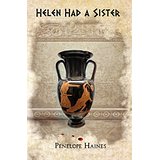
Penelope Haines
Amazon.com
Category:
Historical Fiction
Publisher: Ithaca Publishing
ISBN-10: 1517080312
Type: Fiction
Pages: 287
Copyright: Oct 1 2015
ISBN-13: 9781517080310
Price: $4.50 (eBook)
Nestra ‘s courageous spirit, passionate love and lust for life mark her as a unique heroine. From Homer’s Iliad comes the story of one woman’s fight for her family, her kingdom and her own survival.
She’s Helen of Troy’s older sister.
She’s a Spartan Princess.
She’s High Queen of Mycenae.
Her name is Clytemnestra.
In a world where women are submissive, she rules.
In a world where wives are loyal, she is unfaithful
In a world where honour and blood feuds abound she exacts the ultimate revenge.
An adventurous princess from a famous family, Nestra ‘s courageous spirit, passionate love and lust for life mark her as a unique heroine. From Homer’s Iliad comes the story of one woman’s fight for her family, her kingdom and her own survival.
Excerpt
PROLOGUE
It is pleasantly cool on the terrace. The balustrade and pillars hold the warmth of the day’s sun and press comfortably against my back as I sit on the railing here in the twilight. Beyond, in the shrubbery, I can hear the susurrations of little night creatures starting to go about their business. The scent of jasmine hangs in the still air and it is magically beautiful. Moonrise will be early tonight. Last night it was full and lit my room with its silver light.
The palace is hushed. The usual domestic sounds of food preparation, children wailing and slaves readying the house for the night are missing. Many of the servants have fled. Charis came in a while ago bringing a shawl, spiced wine and sweetened cakes, setting them out on the table as if laying places for guests. Perhaps she is. I would have refused the food, but I knew it kindly meant.
When she had finished, she came and knelt at my feet. “Lady, let me stay with you,” she pleaded.
I looked at her kneeling form, reached out and touched her soft, dark hair. I love this girl, she is all I have left of my eldest daughter. “You cannot stay. This is for me alone, Charis. If you stay, you will be killed. You must go.”
She looked up at me, her eyes red and swollen. “Lady, please, I beg you.”
“Go, Charis.” I was firm. “I need no innocents on this journey. Don’t weep for me. All here is as it should be.”
She sighed, but eventually left.
Aegisthus died some hours ago. The screams first alerted me. I sent Charis to investigate the uproar, and she came running back, white with shock, to report his bloody body lay in the forecourt. The slaves, after their initial outcry, faded from the scene. They will have found some safe place to hide and tomorrow will emerge to serve whoever survives the night.
My murderer is in the palace already. I wonder what he’s been doing in these hours. Has he gone to the bathhouse to pay his respects to the shade of his father? Does he pray? Is he afraid of what he has come to do? He must know I will not resist him. Of all who ever lived, he is the one man forever safe from me.
I have loved him most truly, treasured his embraces, valued his opinions and rejoiced and shared in his goals. He left me seven years ago, and the pain of missing him has been the greatest grief to me.
I feel Aegisthus’s presence, and it comforts me. He will wait until I join him so we can walk the dark road together. It won’t be long now. I try in these moments to steady myself. I seek some pattern or meaning in the skein of my days, but my mind is restless, its processes near inchoate. I remember myself as queen, lover, mother and avenger. How did I become murderer and monster; hated by my children and reviled? At the end I will die as a victim. If there was some plan or working to make me what I am, I cannot see it. Truly, we may simply be the gods’ playthings.
The sun set an hour ago, and I watched as its edge dipped below the horizon, knowing I saw it for the last time. I will not be alive when it rises tomorrow.
CHAPTER ONE
I was four years old when my mother, Leda, called my twin brother and me to meet our new siblings. We sat beside her on the bed as the nurse brought the babies across. Leda looked tired and a little rumpled, but she was smiling as she placed Helen in my arms, showing me how to support her head.
“Gently,” she laughed, as I nearly dropped the baby. “You’ve got to be very careful with her.”
I wondered, as I tried to balance the weight, that such a small creature was alive and was my sister. Castor held Pollux gingerly, looked him over with interest, but became bored quickly and handed him back to the nurse.
“Typical male,” the nurse snorted in amusement as she took the baby back to its cradle.
Leda gave her gentle laugh, her face soft as she watched me with Helen.
I stayed, watching as Helen’s swaddling bands were changed and Leda took her to her breast.
Castor and I had been the babies of the household, but now we were supplanted. He and I were children now, not infants, and our world was larger than the nursery.
With elegant efficiency Leda had borne four royal children for the House of Sparta from two pregnancies. Our father Tyndareus, who loved his wife and children, was delighted. Later, of course, there were rumours that Helen and Pollux had been sired by Zeus, who manifested as a swan. This was fuelled by the surprising symmetry of Leda’s birthing patterns, and by the undeniable fact that Castor and I were dark like our father, while Helen and Pollux were fair, taking after our mother.
I doubt if my mother betrayed her husband, even if importuned by a god. Leda was the model of a good Grecian wife – loving, modest, elegant and dignified. She was astoundingly beautiful, though her reputation was to be eclipsed by her younger daughter. In various measure she passed her beauty on to all four of us children.
There was only one affliction in my childhood: the names in our family are straightforward – Helen, Pollux and Castor. Even Leda, our mother’s name, runs straight and clean on the tongue. What inspired my parents to name their eldest daughter Clytemnestra? I blame Leda, of course. She probably wanted a fancy name for her eldest daughter and thought one with length would be imposing. As a small child, I couldn’t get my tongue around my own name. I called myself Nestra, and the name stuck. Eventually, the only people to use my full name were my mother, when she was angry, and my husband, for much the same reason.
We grew up as happy Spartan children, and when seven-year-old Castor went off, proud as a young hawk, to the discipline of the agoge, I was just as happy and excited to enter the girls’ school. I went skipping through the palace to tell Leda I was to start my education the next day.
I found her sitting with her women, twirling the spindle as she spun.
“Mother,” I shouted happily, throwing myself against her legs. “I start school tomorrow.”
Leda gave a slight grunt as she absorbed the shock of my body against her knees, but kept up her steady rhythm with the spool. Calliope, one of Mother’s youngest slaves, winked at me.
“You’re a big girl now, all right,” she said. “Going to learn to be a brave warrior princess?”
Calliope’s support encouraged me. I levered myself off Leda’s knees and picking up an empty spindle, I held it like a dagger and danced round the chamber, stabbing at invisible enemies. Hydra, the Minotaur, Cerberus were all one to me and fell beneath my onslaught.
“I’ve got one!” I shouted in triumph, stabbing it to death with determined enthusiasm.
Leda’s reaction was unmistakable. She gave a gasp of horror. “No!” she exclaimed as she dropped her spindle, stood up and rushed off to confront her husband. I tagged along in her wake, unnerved by her response and worried I might not be allowed to go to school the next day.
All boys and girls of Sparta have a public education, and for girls, this includes studies in arts, dancing, poetry, music and physical education. During the latter, girls, like the boys, train outdoors unclothed, learn the basic drills and disciplines of fighting, and are encouraged to be brave and forthright.
We found my father in the great hall, where he had been all morning dispensing justice to the citizens of Sparta. He smiled at his wife as she entered, but his smile turned to a frown as she spoke.
“Husband,” she said. “Nestra says she is to start her education. She must not. I refuse. No daughter of mine is going to a Spartan school. There is nothing such a place can teach them. The only things a young girl should be taught are spinning, weaving and household management, and they can learn that at home. You can’t let a daughter of ours do physical training. No daughter of mine is going to be allowed to behave so immodestly.”
My father, a true Spartan, was startled. He rose from the bench and came towards her. “Leda, this is what our girls do. It is how we bring them up. What is wrong that you find this so offensive?”
“It’s immodest. No girl should go unclothed in public. And why should a young woman train with sword and spear? Is she to be a warrior? Do you expect her to fight? And what happens when she’s older? Do you want her, once she has her menses, to lie on the cold ground and steal and forage what she needs to stay alive along with a platoon of men? Is this a suitable upbringing for a princess?”
Tyndareus gave a little laugh. “All Sparta’s daughters are reared this way. No, she won’t be a soldier but she will be the mother of soldiers. Our young men learn the skills and discipline of warriors. Our young women learn to be strong in mind and body so they can breed warriors. Why do you think Sparta’s armies rule supreme?”
Leda would not be moved. “She doesn’t need those skills. She needs to know how to run and rule a household.”
My father roared with laughter. “Why should any Spartan, let alone a princess, know such mundane matters? There is an endless supply of slaves who devote themselves to household tasks. Nestra doesn’t have to waste her time on foolish things. She needs to learn to be brave and be the mother of kings. If she grows strong and healthy herself, then she will breed better children.”
Leda’s voice dropped. “But she will not be a princess in Sparta, my husband. It is the fate of princesses to be married to kings and princes from other lands, as was I.” She took a deep breath. “I know you consider it appropriate for young women to walk freely, and talk with men, and have opinions and an education. It is not so in the rest of the Greek world. I had much to learn when I married you. You do your daughters a disservice if you do not teach them that other kingdoms will demand they stay in the women’s quarters and deal with women’s matters. Men will consider them coarse and unwomanly if they train with sword and spear. Worse, they will think them immodest whores. Do you wish your daughters to be the joke of Attica?”
I had never truly realised before this that my mother was a foreigner. I knew her father was Thestion of Aetolia. Such knowledge was part of our family tree. Where Aetolia was, or that their customs might be different, wasn’t something I had considered. Leda’s elegance and poise seemed innate, not the result of a very different upbringing.
Her speech must have hurt her husband. “Are you not happy here, wife?”
Leda’s voice softened. “With you, my lord, I am always happy. You know that. But our daughters are not ours to keep forever. They will grow and marry. Not all husbands are as kind as you. You had to teach me to be bolder. Other men will want to teach our daughters to be quiet and submissive. I don’t want them to have to learn through pain and misery.”
I peered round the corner of the tapestry where I was sheltering. Leda had moved close to my father and put her arms around him. “A woman should be strong, but sometimes she needs to hide this. I don’t have to dissemble with you, my lord, but other men may not be so understanding.”
Her words had pulled Tyndareus up short. He spoke thoughtfully. “Nestra must be educated with others of her age, Leda. She is a princess of Sparta and will be educated as one. But I understand your fear.” He pulled his wife closer into the embrace. “Nestra will train, but you will ensure she understands the duties of a household so she is not shamed if she marries into another kingdom.” He kissed Leda lightly on the forehead. “It seems I will need to choose carefully which man I allow to marry my daughter. I will think on this matter. They must be as happy as the two of us.”
Leda wasn’t mollified. Her daughters’ public nudity would remain a shame to her for the rest of our childhood, but she loved her husband and understood he had offered her a compromise. She was too wise to persist in a battle she couldn’t win.
Consequently, in any time spare from my formal schooling, I was put to learning the slave duties of carding, spinning and weaving. I learned about brewing and butchering, and the proper ways of pleasing the gods. In short, everything a conventional Greek bride would be expected to know. Naturally I was furious. Not only did this extracurricular education take up my spare time, but it exposed me to mockery by my peers.
“Here comes the helot, Nestra is a helot,” they would chant.
I had a miserable time until I taught them to respect my temper and my newly learned fighting skills. I felt deep shame at having to work with slaves - the real helots - and I grew sulky and rebellious with my mother, judging her responsible for my plight.
* * *
I enjoyed my public education. We were taught to run, to wrestle, to throw a discus and a javelin. If we were not training physically, we were learning to sing, dance and play instruments. Our teacher for the latter was an elderly woman from the polis. She had perfect pitch, elegant movement – and the foulest temper I have ever encountered in a woman. She watched our practice from the sidelines, leaning on her sturdy stick. The gods help any girl who moved out of sequence, or without grace – that stick would come cracking down on us wherever the old crone could lay it. I was talented at dance, but I felt the weight of that stick on several occasions.
The argument between Leda and Tyndareus had opened my eyes to the purpose of our education. Girls were supposed to be brave and strong so they could breed strong Spartan soldiers. I was too young to understand fully, but I understood that when we danced and played music, particularly with the boys, the purpose was to make us nimble and supple in warfare. The boys were being trained for the phalanx, that Spartan technique where the whole unit moves in unison. It is almost indestructible in battle, and the boys train for it endlessly.
Girls wouldn’t normally be called on to go to war, but we knew very clearly that we were part of Sparta’s defence. If called upon, every woman in Sparta had the knowledge to defend her land, her home and herself.
|