In this eccentric tale set in a small town in northern India, Pawan Mishra masterfully weaves ingenuity and sarcasm in a manner that’s simultaneously hilarious and tragic.
Prejudice takes place in a plethora of forms. It sprouts a rare growth when a clerk called Coinman can’t stop jingling the coins in his pocket. It’s a seemingly harmless addiction, but it’s one that comes to rule his life and begins to invite the wrath of virtually everyone around him. His work environment becomes increasingly hostile while his life at home begins to suffer as a result of his wife’s obsession with acting. When an attempt to remedy the situation goes horribly wrong, it spurs those involved onto unexpected paths.
In this eccentric tale set in a small town in northern India, Pawan Mishra masterfully weaves ingenuity and sarcasm in a manner that’s simultaneously hilarious and tragic. Coinman is a modern-day parable laced with pithy wisdom and psychological insight into human nature--a clever parody of the dynamics of office politics and groupthink. At times, surreal, Mishra’s distinctive novel is an overflowing basin of linguistic humor. Eloquently written, this satirical story beautifully depicts how even mature, sensible adults can callously inflict emotional damage upon the most vulnerable.
Winner: 2016 eLit Book Awards for Literary Fiction (Bronze)
Finalist: 2016 National Indie Excellence Award for Humor
Finalist: 2016 IAN Book of the Year (General/ Literary Fiction)
-- Reviews & Acclaim --
Winner: 2016 eLit Book Awards for Literary Fiction (Bronze)
Finalist: 2016 National Indie Excellence Award for Humor
"Mishra's debut comic novel is an absurdist tale of office and personal politics set in a small town in northern India." -- Kirkus Review
"This articulate, wryly amusing creation focuses on simple situations that often have an unexpected, almost magical, twist." -- IndieReader, 5 Stars
"Originality is often elusive, yet that’s exactly what Pawan Mishra delivers. Humorous and highly entertaining, Coinman: An Untold Conspiracy proves an absolute gem and is recommended without reservation." -- BookViral
"A quirky, heartfelt novel about finding your identity - and keeping it. In Pawan Mishra's oddly charming novel, readers are welcomed into the strangely neurotic, passionate, and unfulfilled existence of Coinman. The author raises the banality of normal life to new heights within this novel, and does so in an amusing and thought-provoking way. The story is uniquely enjoyable, and Coinman is a character that will be hard to forget." -- SPR, 4 Stars
"The book is a brilliant linguistic muddle and a stunning display of stylistic somersaults. The style of the novel is an intricate mosaic fashioned with care." -- The Bibulous Bibliobiuli, 5 Stars
Excerpt
It all began with high expectations.
I couldn’t believe at first that Sage Mangal, our esteemed master at the ashram, whose personality I can’t promise to make you very familiar with, had trusted me with a task of such ambition.
“A lack of emotional engagement in the affair affirms higher credibility,” Sage Mangal had explained when asked why he chose me, Sesha, over many others, for pulling the pieces of Coinman’s story together after the latter’s departure from the ashram.
In short, it was the lack of my prior acquaintance with Coinman that had won me this prize.
His Politeness also bestowed me with the divine power to find almost everything that I needed to find. Such was this power that I could enter invisibly into past situations, could be at multiple places at the same time, and could even float in someone’s mind without their discovering. Before you ask, Sage Mangal did meticulously bar my access to certain activities and places—for example, the bathroom where one of the main characters in our story spent a major part of his life. The sage agreed in advance to bear with any compromises that my lack of full access might potentially introduce to the story.
I could ramble on forever, but this is all I wish to convey to you about me and my job. I will assume that you wouldn’t want to know more than that either; not only will it make my job simpler, but it will also fulfill my wish to remain largely invisible. Honestly, with the kind of story I am about to embark on, I know you couldn’t care less about me. So let’s get to the story without further ado.
The mind-numbing sound of relentlessly jingling coins was something the people of the office, the center stage of this story, hadn’t quite learned to live with yet. Not only when the possessor of the busy coins, Coinman, walked, but also when he stood talking—or engaged himself in doing anything else, for that matter—his left hand constantly fondled the coins with tenderness.
The coins occupied an eternal place in the left pocket of his trousers and, regardless of where he dwelt or what he did, constantly slithered through the narrow spaces between his fingers.
When an activity adamantly demanded participation from one of his hands, he strategically let the activity claim his right hand to allow the left one an uninterrupted opportunity for the recreation. If such an activity insisted on his left hand, he transferred the coins to his right pocket ahead of time to allow his right hand to continue feeding his mind. Once the exceptional engagement was over, the left hand impatiently looked forward to the return of its possession. If there was a momentary delay, the left hand hurriedly tried to enter the right hand’s den, making the coins feel nervous, just as a princess would on seeing two equally adept princes fighting to claim her hand.
When an activity required continuous use of both hands, like welcoming a delegation from another firm with garlands, he tackled such desperate scenarios by the means of a last-minute absence. There were rare yet difficult off-the-cuff occasions, too, when it was unavoidable that he stop the action in his pocket, such as a sudden request to hold a big chart with both hands for a few minutes for a colleague’s presentation. Faced with such calamity, he immodestly excused himself for biological breaks, which, despite not fooling anyone, did not provide anyone enough justification to raise an official protest.
The office was located in a small town somewhere in northern India; in a four-story building where it occupied the second floor, where all the managers sat in private offices, and the first floor, where the rest of the staff sat at desks in a large open hall.
Far back in time, beyond a recall of the exact date, unable to put up with Coinman’s interminable daylong feat, colleagues at neighboring desks had started shifting their positions away from him; inch by inch, each day. It caused some sort of a ripple effect throughout the entire arrangement. The staff, without a spoken word, synchronized the move, over several months, with such a constant and slow pace that it was hard to spot it at any given point.
When Coinman first spotted the continuous movement, he stayed calm initially, for he wanted to observe for a few more days to confirm his findings. Past embarrassments from his premature findings had left him wiser.
Satisfied with the constancy of the move, he felt comfortable loudly announcing its progress every day to his neighbors. The minute he reached the office, he threw his bag on his desk, flew to nearby desks with the wings of curiosity, and bent down to take notes on the tiny spiral-bound notebook that he carried in his shirt pocket. Spiral-bound notebooks did not misbehave during his right-hand-only writing endeavor the way the sewn or case-bound notebooks did, like closing repeatedly without support from his coin-engaged left hand.
The futility of Coinman’s verbal attempts to convince his neighbors about the unfaltering motion of the desks made him carry a small measuring tape and a white chalk to mark the daily progress. At the end of each day, before leaving the office, he marked the location of each neighboring desk by drawing boundaries around its feet, accompanied by a date and time. He did the same on the following morning, as soon as he came to the office. He realized within a few days that one of these two marks was redundant but wasn’t quite sure which one. He decided to continue only with the morning mark.
But that did not solve the issue entirely. Since the desks were moving extremely slowly, two consecutive marks still overlapped with each other.
To crack this challenge, he started bringing high-quality thin marker pens. The hard-nosed desks had to accept defeat and move visibly thereafter.
“There, you see? That mark. This one, right here. Look at the overnight distance. God!” he would exclaim, flying from one desk to other, pining for his colleagues’ approval.
Seeing no impact on his cold colleagues, he saw no point in trying to win them over. He started removing marks from the previous day while adding the new ones in the morning to continue tracking the direction of the movement for his own record.
At times he chuckled to himself, in a loud voice, “The poor desks are so impatient to leave. God help the atmosphere here!”
Ratiram, the reservoir of wisdom, the most widely revered man among the first-floor inhabitants, had been discreetly keeping an ardent eye on the move. He was one of those who are not born handsome, but develop charming features with age by continuously engaging their brains with intelligent thoughts.
Ratiram announced one day that the move had racked up to the threshold of management’s endurance for untidiness. He astutely explained that if the move continued any further, management was no more going to avoid acknowledging it publicly; and in that case, it was inevitable that the response would involve ABC, Andar, Bandar, and Chandar, the three most dreaded individuals in the office; the supreme powers who came from nowhere to establish discipline when chaos crossed their limits.
The announcement compelled an immediate shudder among the crew because ABC’s involvement had never been without a few expulsions. The move stopped right then and there. But by this time, a belt of circular empty space had formed around Coinman’s desk.
Coinman felt relieved from his self-assigned burden of tracking the move. He used the circular empty space around his desk for his post-lunch brisk walks.
“Chew it well and walk like hell; else the lunch will make you swell,” he chanted in a low voice during these walks, followed by a loud laugh every single time, implying to his unsmiling colleagues that a good joke doesn’t necessarily need appreciation from others. One can freely laugh at one’s own deserving jokes.
A later development was his exclusion from the meetings run by the denizens of the first floor. Initially he continued to attend the meetings without presenting any signs of awareness of any restrictions. But he understood soon that everyone was secretly jeering at his pretentious ignorance. So he finally decided to stop attending these meetings. He was afraid that if he reacted to the situation, it might blow things out of proportion. Now at least he could continue with his interests freely outside the meetings. Who could tell? If he voiced his objection, he could jeopardize his pocket sport.
“On the other hand,” he thought, “there is hardly anything of importance that happens in these meetings.” He smiled to himself as he remembered Ratiram telling him once from his soapbox, “These meetings are conducted as a means to spend official time and money on eating and gossiping. The agendas are so ambiguous one cannot make out in the end if the objectives are met or not. Some of the associates wait for these meetings to complete a power nap, while many others only allow themselves to turn into yawning machines.”
Coinman could not help a laugh to himself every time he remembered how Ratiram had summarized it: “A meeting is a collective tacit confession of participants’ unwillingness to work.”
The coin-stricken souls at the office used as pain-killers some fabricated tales about Coinman’s buffoonery, yet these pain-killers were not good enough to make even a dent in the constant trauma the coins caused. The mind-paralyzing sound of the coins, mixed with the hatred against him, evolved to a stubborn assessment in their minds that Coinman was perpetrating the most unbearable experience they’d ever known.
The tenured associates had been somewhat successful in exhibiting numbness toward the turbulence caused by the jingling coins. A newcomer like Hukum, though, found it very challenging to live under the metal chimes hanging above their heads.
Hukum shared his experience with everyone within a few days after his joining. “It was like a sudden installation of huge copper chimes into my brain. These chimes slam together unbearably, causing an indescribable feeling in my chest area that’s several times worse than a thousand nails raking simultaneously across a chalkboard.”
Understanding a newcomer’s challenge very well, old associates always acted early to lend a kind hand by trying to elevate his soul with their own stories, explaining how they were able to eventually cope with the phrenic tsunami.
The common source of suffering brought them all closer as personal differences gradually melted and evaporated in the scorching heat of coins. Whining about Coinman every day, they started noticing merits in each other. It was like suddenly discovering an ocean a few steps away from one’s house. Many even took the office companionship home, where their respective families found opportunities to get together and talked excitedly about otherwise mundane affairs of life.
Sadly enough, no one felt obligated to Coinman for being the main cause of the grand social platform. Instead Coinman’s smile penetrated them, his laughs annoyed them, and his existence offended them.
They wanted independence from coins at any cost.
“I swear by the self-assurance with which elderly men sitting in public tilt sideways to allow the gas to escape loudly,” Hukum announced, during a gossip session, “allow a man to sit on your shoulder and he will instinctively take a leak in your ear. Instead of tolerating him, we must figure out a way to protest. Someone needs to take the lead so that it’s not everyone’s but no one’s.”
Professional Reviews BookViral Review of Coinman
A clever and subversive parody that’s right on target, Coinman: An Untold Conspiracy, is the debut release from author Pawan Mishra. Playing to those who have ever felt stymied by the bureaucratic process of office life, Mishra mercilessly captures the inertia and ennui that’s inherit in most corporate cultures. Drawing his readers in by cleverly connived twists and turns, no individual detail of office life is too absurd to be believed, but together they add up to a stark, humorous lilt on reality. The laughs come quick, Mishra doesn’t allow himself to chug along making plot points because he knows that personality traits are often magnified and lampooned in work settings and it’s his characters that ultimately drive his narrative. Coinman, his affable title character is perfectly pitched, whilst nuances of behaviour are spot on. His characters simply come to life. They’re raunchy, nerdy and a few are utterly despicable and this is where the genius of Mishra’s novel comes to the fore. We may laugh out loud as events unfold, but take the laughter lines away and what you’re left with is cutting and insightful.
Originality is often elusive, yet that’s exactly what Pawan Mishra delivers. Humorous and highly entertaining, Coinman: An Untold Conspiracy proves an absolute gem and is recommended without reservation.
IndieReader Review of Coinman
The anti-hero known as “Coinman” is an irritating co-worker, an inattentive husband, a not-so-dutiful son…yet his apparent lack of love conquers all.
Coinman (his real name is Kesar) gets his nickname for his disturbing habit of constantly jingling coins that “occupied an eternal place in the left pocket of his trousers and…constantly slithered through the narrow space between his fingers.” Driven nuts by this annoying quirk, his coworkers begin slowly inching their desks away from him, a tactic that Coinman counters by measuring the progress of their retreat with tape and markers. They then instigate a series of increasingly hostile pranks designed to get him fired.
Set in India, COINMAN is narrated by Sesha, a storyteller who interjects his commentary at the beginning and end. The novel’s office scenes satisfyingly satirize the inner workings of a tight-knit bureaucracy: the irrelevant meetings, the arbitrary policies, the workers’ fears of management. But it is not only at work that Coinman’s odd personality arouses concern. His mother worries that he will never find a wife. When he finally does, his bride spends the first few weeks of their marriage weeping ceaselessly, then turns her attention to her own pursuit—the theater—having accepted that Coinman is not interested in producing offspring.
For all its darker aspects, this episodic work is curiously lighthearted, concluding on a positive note, with the bureaucracy working for, rather than against Coinman, and the subtle intervention of a famous guru working mystically on his marriage.
The author of this gentle parody of human frailty, Pawan Mishra, is an Indian residing in the US who states in a Foreword that his love of folktales began in childhood, hearing older relatives tell “bedtime stories that were never written down.” This articulate, wryly amusing creation focuses on simple situations that often have an unexpected, almost magical, twist. Mishra has taken what could have been a tragic tale of bullying, workplace harassment, even violence, and deftly transmuted it into a droll parable. In COINMAN, he has fashioned an archetypal folk hero who, seemingly oblivious to the criticism and opposition all around him, gets his way as it had been planned all along.
COINMAN, a thoroughly modern Indian folktale, presents a humorous portrait of a nonconformist who triumphs without trying.
"This articulate, wryly amusing creation focuses on simple situations that often have an unexpected, almost magical, twist."
SPR's Review of Coinman
Coinman: An Untold Conspiracy by Pawan Mishra is a quirky, heartfelt novel about finding your identity – and keeping it.
The search for personal fulfillment is a lifelong journey for most, and along the way, it is necessary to establish the identity you want, the work you cherish, the people you respect, and the love you deserve. In Pawan Mishra’s oddly charming novel, readers are welcomed into the strangely neurotic, passionate, and unfulfilled existence of Coinman, a simple office worker with a jangling passion for coins.
The title of the book suggests this slightly odd premise, but the majority of the book is actually a “day in the life” look at a humble Indian man trying to make his way through a rather extraordinary world.
The author raises the banality of normal life to new heights within this novel, and does so in an amusing and thought-provoking way. Office pranks and casual crushes are depicted in epic fashion, while simple conversations, glances, or offhand comments are pulled apart and analyzed by the author’s tireless narration. This offers room throughout the story for social commentary about the dull pain of dead-end jobs, casual betrayal, the evolution of marriage, two-faced friends, the fear of aging parents, and other less common emotional issues of adulthood.
This book is largely character-driven, and the author gradually reveals the internal mechanics and daily madness of Coinman from different perspectives, slowly earning him the empathy and understanding of readers. The different points of view used within the story also show the author’s ability to inhabit a variety of characters, and tell a comprehensive tale that can be appreciated from all angles.
Readers are invited to peek in on rather ordinary scenes of Coinman’s domestic and professional life, and experience the detailed struggles of adult life from all sides. As readers begin to understand the diverse contexts in which Coinman exists, they inevitably see more of themselves in the character. He is not a bumbling fool, nor is he deserving of the mockery and wrath of his co-workers or wife. He is merely a man doing his best to survive without compromising the things he cares about, or the identity he works hard to cultivate.
The search for identity and comfort in one’s own skin dominates many of the short vignettes and interactions between characters, and is particularly strong in the character of Imli, Coinman’s wife. Her theatrical roles come to define her life, from playing a ghost and abandoning all mortal possessions, to acting as a jealous wife who suspects her husband of adultery with the maid. She is a chameleon in every sense of the word, deriving meaning and purpose from the masks she wears, and forcing Coinman to temporarily inhabit those worlds alongside her. This is starkly contrary to Coinman, who seems determined to find pleasure in his own strange brand of life, yet also remains endlessly devoted to his unusual partner.
This is far from an action-packed book, namely because the author tends to use narration a bit too much, not allowing characters to speak their minds, but rather utilizing internal monologues and heavy exposition throughout the story. This can get a bit much at times, but this is also Mishra’s time to flex his literary and descriptive muscles.
While the author’s native language is clearly not English, the slightly odd dialect of the dialogue makes it a more endearing and authentic story, and isn’t as distracting as one might expect. A steady editorial hand would have also helped with some of the more disjointed scenes, and suggested where the plot could be strengthened (or cut down). Despite its occasional failings, the story is uniquely enjoyable, and Coinman is a character that will be hard to forget.
The narrative intermingles Coinman’s recollections of interaction with family, education, social settings, an arranged marriage, work and day to day living.
Writer Mishra has produced a provocative narrative told as a series of short stories. His skill as a storyteller is well honed.
An unusual, thought provoking paperback about coming of age, finding your identity and accepting who you are while trying to fit into the expected norm of the society in which you live Coinman an Untold Conspiracy is a tale written by an author with a fine command of language. Coinman, the main character in this work, is pretty socially obdurate, inept, awkward and to top it all has a thing for coins. The sound they create as he touches them or just walks around and the way the feel in his hands is very satisfying; even though the habit tends to drive those near him to distraction.
I received a paperback book for review, read whole review on AD mjhollingshead den page.
May I offer you a Round the World Cruise of a lifetime for the price of a novel?
Not only do the seas roll on but two romances,a death at sea, uncovered past lives, history uncovered in Brazil, caves in Australia, poetry in Senegal, the Lux Mundi
'Coruscated Confabulations' is a collection of stories and experiences, most of which took place in prior decades. They are taken from or based upon real events, with a certain admixture of fictional embellishments.




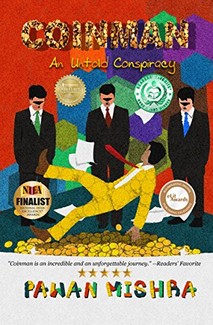


The narrative intermingles Coinman’s recollections of interaction with family, education, social settings, an arranged marriage, work and day to day living.
Writer Mishra has produced a provocative narrative told as a series of short stories. His skill as a storyteller is well honed.
An unusual, thought provoking paperback about coming of age, finding your identity and accepting who you are while trying to fit into the expected norm of the society in which you live Coinman an Untold Conspiracy is a tale written by an author with a fine command of language. Coinman, the main character in this work, is pretty socially obdurate, inept, awkward and to top it all has a thing for coins. The sound they create as he touches them or just walks around and the way the feel in his hands is very satisfying; even though the habit tends to drive those near him to distraction.
I received a paperback book for review, read whole review on AD mjhollingshead den page.
Enjoyed the read, happy to recommend.
m