Kindle Edition
Amazon
Category:
Spirituality
Publisher: Heart Breaking Open
ISBN-10: 0998093513
Type: Non-Fiction
Pages: 97
Copyright: Nov. 2, 2016
ISBN-13: 9780998093512
Price: $5.99 (eBook)
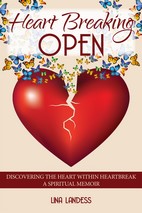
What would you do if you found out that your husband/partner was having an affair? Thanks to the power of prayer and the Buddhist practice of Metta (Lovingkindness), this easy to read, honest and heartfelt memoir begins and ends in ways that prove that what you think may be the worst moment of your life may just be one of your life's greatest gifts.
From the dark night of the soul to awakening into the truth that philosophers and seekers have pursued throughout time, Lina Landess' memoir proves that the greatest journey we might ever undertake is the inner one.
Faced with her husband's confession about his affair, Lina must choose love over fear. What happens next is truly a story worth telling. And sharing.
Excerpt
CHAPTER TWO
A WHOLE NEW WORLD
“All day I think about it, then at night I say it. Where did I come from, and what am I supposed to be doing? I have no idea. My soul is from elsewhere, I’m sure of that, and I intend to end up there.”
–Rumi
I didn’t understand why he wanted a divorce, and we never talked about it—just as we
never talked about anything important. His mind was made up and I simply, albeit tearfully, accepted it. As if I had any other option. I realized later, as happens with so many of the losses and challenges in our lives, that he had done me a favor. We weren’t really happy, and we certainly weren’t growing. At least not together. We were really just existing. Living a half-life.
I suppose this is what many people do. As Oscar Wilde noted long ago, we weren’t alone. “To live is the rarest thing in the world. Most people exist, that is all.”
If I’ve learned anything about life so far, these two things stand out: 1) things happen for a reason and 2) it is vital that we learn from our experiences. Borrowing from the wisdom of George Santayana, “If we don’t remember (our) past, we are doomed to repeat it.”
While I struggled to understand what I was meant to learn from our marriage, I recognized that it had gotten me to Northern California, where after my marriage ended, my new life would begin. Maybe that was its primary reason.
Finding a deeper meaning or purpose for that relationship has been challenging. Like so many young women of the time, my mind was filled with romantic notions about what marriage would be, yet totally unaware of the effort required to keep such a relationship fresh. From the vantage point of history, I see now that what gets lost within the fairy tale I and so many young girls grow up with is the value of friendship—of befriending your potential partner while not losing yourself, as women so often do. Being friends with another, especially one with whom there is such intimacy, requires becoming best friends with yourself first, then your partner, before you can truly commit to the highs and lows of such a relationship.
What does it mean to be a friend, a true friend to yourself? With the wisdom gained over 70+ years, I see the issue so much more clearly now. To love yourself means that you don’t compromise your values or your heart so that someone else will love you. To recognize that we don’t have to do anything or be anything other than who we are in order to be loved is a gift that arises out of selling ourselves short one too many times. Seeing that not being true to ourselves hasn’t gotten us what we thought we wanted, we might ask, “what is there to lose by being myself?”
Loving yourself means that you can trust yourself fully. Trust your inner knowing. In Western culture, trusting our intuition has been largely discouraged. It’s been put down and discredited. And yet, at the end of the day, if we learn from our so-called mistakes and missteps, we discover that there was a part of us that knew. We know, too, that if we had listened to that still, small voice that whispered so softly in our ear, we could have avoided some pain or hurt.
When we befriend ourselves we also offer ourselves the kind of love and compassion that we would naturally offer a friend. We love ourselves without judgment. That doesn’t mean that we have to be perfect, but that we are willing to accept our flaws. Just as we don’t need to hide who we really are with a true friend, we don’t deny our shortcomings to ourselves or anyone else. My first husband and I lacked the capacity to talk, to share, to be friends enough that we could tell each other the truth. I suppose that neither of us had ever really befriended ourselves.
That willingness to be that honest, to share our fears and talk about our concerns wasn’t even on our radar. Honest communication requires that we have enough trust in our lovers, our partners and our friends that we are willing to tell them our truth—and accept the outcome. Telling the truth requires us to be vulnerable.
Brene Brown, a researcher who has recently, and rightfully, come to the attention of Oprah and other media stars, wrote a wonderful book, Daring Greatly, about her findings regarding shame and vulnerability—and how our fear of being vulnerable so deeply limits our experience of life. Brown speaks of vulnerability this way: “I define vulnerability as uncertainty, risk and emotional exposure. With that definition in mind, let’s think about love. Waking up every day and loving someone who may or may not love us back, whose safety we can’t ensure, who may stay in our lives or may leave without a moment’s notice, who may be loyal to the day they die or betray us tomorrow—that’s vulnerability.”
That willingness to take the risk to love, without knowing the outcome, is something we do naturally as children. We do it readily—until we experience the inevitable hurt. When we think that our love has been rejected, be it intentionally or accidentally, we feel as if we have been rejected, betrayed or abandoned. The lack of honest communication in my first marriage was, I know now, borne of neither of us realizing the importance of telling the truth about what we needed, and our fear of feeling rejected or abandoned, as we no doubt experienced as children.
Whether expressed as a heartfelt prayer to an unseen force, or the simple, honest
sharing of our feelings with another, that willingness to be vulnerable, to lovingly and shamelessly tell the truth of our experience, is perhaps the greatest gift we can share—the
greatest offering of love and compassion we might ever experience.
|