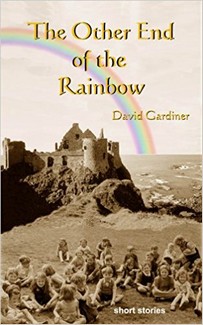
25 of my short stories, linked together by the utterances of the wandering Rainbow Man, talking to his voices and telling his stories.
The stories span a large range of subjects and styles, often with an Irish setting or connection. They range from outright comedy to the very dark. They have beginnings, middles and ends, like I believe stories should.
Professional Reviews
The Short Review
The Other End of the Rainbow
David Gardiner
" Spaces don’t look so big at night. The scale of the world becomes more comfortable.…"
Reviewed by Jason Makansi
The Rainbow Man, a mythical story-telling gadfly, at once the court jester, town drunk, and muttering old sage, introduces each story in this artful collection, where a sense of dignity seems to permeate the space around the words, and the circus of colorful characters that speak them. We're introduced to a psychological therapist who decides you, dear reader, are his next "chat up," a strange tenant who just seems to start talking to you about how "normal" he isn't, and a man who talks to you about his comatose wife. No, wait. He's talking to his comatose wife!
A multi-layered, sophisticated story, Sam, one of the longer ones of the collection, deals with recovery from a serious head injury, and the uncovering of two people from the same brain. Through this story, the reader embarks on a journey through the "firings of tiny brain cells and the pattern of their interconnection."
Gardiner uses the word parable to describe his stories. Indeed, Man the Pumps! which, lo and behold, even begins with "Once upon a time," is a thinly veiled send-up of wayward faith and terrorism perpetrated in the name of religion, mostly pointing at radical Islam. But it works. The Claddagh Brooch features a man regretting late in life not acting on a crush at work. The day he finally gets up the nerve to express his feelings is the day she leaves their place of work to get married. Moral of this parable: Time is short; don't waste it. Again, simple, almost child-like, but it works.
Even in a rather gruesome story, New Gloves, there's a dignity to the dialogue as one character terrorizes another with the threat of an infectious disease in retaliation for being accosted. You won't believe what the gloves cover up. At the other end of the spectrum is Cambridge, one of those stories where nothing really happens, but the situation keeps you reading along. In this case, a man and a woman, both in other relationships, meet each year at a music festival with the only rule that they must tell each other the truth. Their mutual understanding and care can't be compromised even by the fact that they tell each other about their other affairs and trysts, too. Again, there's a dignity to the story, the way it makes us yearn for mutual respect, though we know this ideal relationship doesn't come close to reflecting the messiness of real life, and rampant infidelity is the norm for this "couple." New Gloves and Cambridge certainly demonstrate Gardiner's range with his material.
My personal favorite, Light of the World, harkens back to Twain and the traveling hucksters making a buck off that "old time religion". Reverend Fishbone offers salvation and healing, for a price, but the reader gets an insidious message about the relativity of evil.
"'Folks either help themselves or nobody helps them. Everything just depends on what you've got going on in here.' He tapped his head. 'There ain't nothing out there. Just the dark.'"
The last line is biblical in modern day proportion: "Artificial light manufactured by mankind to hold the darkness of the world at bay." In the end, Rainbow Man delivers. Dignified, simply told tales, wise beyond their words.
Sue Guiney: Writing Life
The Other End of the Rainbow
I'd like to introduce you to David Gardiner and his wonderful new collection of short stories "The Other End of the Rainbow." David is an expat Irishman, a former teacher and "professional student" now living in London. He has previously published the sci fi novel, "Sirat", and his first short story collection, "The Rainbow Man", plus a number of stories in magazines and anthologies. He is Co-editor of Gold Dust magazine and volunteer editor for bluechrome and UKA Press. His interests range from science, philosophy, travel, wild life, communal living and alternative lifestyles, to contemporary folk music, photography, scuba diving, IT and cooking and many of these interests have found their way into his stories. David is the organiser of the annual UKAuthors.com holiday for writers and the last few UKAlive writers' events in London, and he is especially pleased to note that he has recently been presented with his very own London bus pass .
I loved reading David's new collection. They take you back and forth from a world of fairy tales to harsh, modern reality, yet he accomplishes this with a lightness of touch and a real musicality of language. Within his stories David inhabits the skins of dozens of characters, bringing their voices to life and their lives to voice. The first of these characters that you meet is the Rainbow Man himself, and that led me to my first question:
* I see that this is the second time you have used the conceit of The Rainbow Man. He is a fabulous character, but I was wondering if there is a technical reason why you've used his voice again as an entree into your stories.
The Rainbow Man is just a gimmick I invented to tie the first collection together, and since people seemed to like him I decided to keep him on for the second collection. I came up with him when I was on a one-week writers' retreat at a place called Anam Cara in Co. Cork, which I won as a prize in the Fish Short Story Competition. At that point I had a back catalogue of fifteen or twenty stories that I thought might be good enough for publication, but they were very diverse both in style and subject matter and I felt they were more of a heap than a collection. At Anam Cara we did a lot of talking about the craft of story-telling, and I remembered an old story-telling vagrant that I had known in Ireland when I was a boy. I had the idea of resurrecting him, embellishing him quite a lot, and allowing him to introduce each of my stories with some piece of apocryphal wisdom. It seemed to work. People liked him and the heap became a collection. The attraction for me is that he allows me to steer my readers surreptitiously in a particular direction and get them into what I consider the correct frame of mind for what's coming.
* Story-telling is an important cultural experience within in many cultures, but especially among the Irish. Do you think your Irishness has contributed to the particular form of story-telling that your narratives fall into?
I've noticed that although I've lived in England much longer than I've lived in Ireland, when I sit down to write it's more often than not my Irish background that comes to the fore and I find my stories taking place in Irish settings or spawning Irish main characters. The Irish influence seems to be very strong. I'm not aware of having been steeped in a story-telling tradition but I think it must have been there, as when Welsh people discover they can sing even though they have no conscious recollection of learning how to do it or growing up in a musical culture. Story-telling is something quite deep in the Irish psyche – it's the Irishman's natural mode of artistic expression. The country has produced writers in numbers and quality totally out of proportion to the size of its population.
*Before your story, “Light of the World,” the Rainbow Man says: “If ye were to wait to find out what story was true an’ what one wasn’t before ye believed it,sure ye wouldn’t have anything to believe at all, an’ then where would you be?” What a fabulous definition of fiction! But it makes me wonder about the role that “truth” has in your writing, and if you conceive of yourself as a writer of “magical realism”?
Truth in fiction is a difficult one. Obviously what we write isn't literally true or it wouldn't be fiction, but it has to contain truth of another kind if it's to be any good as fiction: it has to be 'true of', to contain insights into human nature and motivation. When the writer is doing his or her job properly you recognise the truth in the piece, it strikes a chord, you find yourself saying in effect: 'I always knew that but I wouldn't have been able to put it into words'. When I was a student I had an enormous regard for Solzhenitsyn and I particularly loved his Nobel Prize speech which was all about this aspect of literature. It was published under the title 'One Word of Truth'. I recommend everybody to read it. 'Magical Realism' strikes me as one of these terms invented to give critics something to argue about. It doesn't really matter if a particular story comes within that category or not; if it contains lots of realism and a little bit of magic that's more than enough for me.
*What comes first, the idea of the story or the idea of The Rainbow Man's question?
In every instance, the story comes first, but it's set up to look as though the story grows out of The Rainbow Man's reflections. Many of the stories in both collections were previously published elsewhere without The Rainbow Man's introduction, which rather gives the game away.
* “Intelligent Design” looks at the connection between myth and science. As I tried to explore in “Tangled Roots,” this is an idea that fascinates me. Do you see this as an important central focus of the collection?
I don't think the collection has a central focus, I wish that it had, but I've always been very drawn to scientific ideas and the philosophy of science and I suppose this shows through in places. My first (and only) novel was a science fiction story about artificial intelligence ('Sirat') and my early stories were practically all in that genre. I think there is a relationship between myth and science: human beings are story-telling animals, they need a story about everything, they can't leave holes in their understanding of the world and just say 'I don't know'. So every culture's understanding of the universe begins in myth, which, if they are lucky, is slowly replaced by science. I don't think the two are in any sense the same. The difference is that science is self-critical, always looking for counter-examples and better theories to replace ones found wanting. Myth on the other hand is fixed and immune to revision in the face of contrary evidence. That is exactly what is going on at the moment, particularly in the US bible belt, with respect to the conflict between evolutionary theory and 'intelligent design'. In this story I'm poking gentle fun at the whole thing, and also I hope getting people to think about something that may actually lie in the human future.
Well, I could go on forever discussing your work with you, David, but I should probably leave well enough alone now and just urge everyone to go out and buy it. Read it for yourselves and let David carry you into his world.
Part Three in the Mu Series - Sarah Thompson reluctantly abandons her desperate search for her soul mate on Maui and returns to her Montana hometown. Her brother has had a terrible accident...
May I offer you a Round the World Cruise of a lifetime for the price of a novel?
Not only do the seas roll on but two romances,a death at sea, uncovered past lives, history uncovered in Brazil, caves in Australia, poetry in Senegal, the Lux Mundi
London: Lashed, Lacerated, Lampooned and Lambasted satirizes 18 popular Jack London novellas with adult content and language and the work is author Jay Dubya's 37th published hardcover/paperback book.