
Kindle Edition
Download to your Nook (eBook)
Download from Apple iTunes (eBook)
Download from Smashwords (eBook)
Amazon
SMASHWORDS
Category:
Poetry
Publisher: Ikechukwu Joseph
ISBN-10: 1521783128
Type: Non-Fiction
Pages: 36
ISBN-13: 9781521783122
Price: $7.99 (eBook)
- It is the call for animals with horns that brought out the snail.
Meaning: there are pretenders or imitators among us.
- The chameleon said that the forest being on fire cannot make him forsake the walk style of his grandparents.
Meaning: Don’t allow your circumstances to control you, rather control your circumstances
Overview
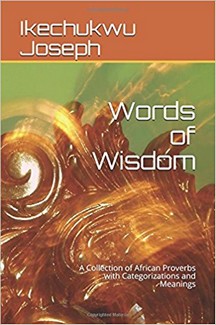
Words of Wisdom: A New Collection of African Proverbs by Ikechukwu Joseph
Words of Wisdom is a new collection of African proverbs - right from elder's mouth and wisdom.Many biblical proverbs have parallels in ancient Greece. “A soft answer turneth away wrath” was known to Aeschylus as well as to Solomon, and “Physician, heal thyself” (Luke 4:23) was also known to the Greeks.
“Proverbs are the palm oil with which words are eaten,” an Igbo proverb says. The art of conversation and argument depends, in fact, on their use. By them the speaker shows his learning.
Wisdom tips from Proverb 30:25-28 we can learn these wisdom tips.
- The Ants being slow teaches us the wisdom of early preparation
- The Conies being feeble teaches us the wisdom of protective positioning in the rock
- The Locust being strong in flight teaches us the wisdom of using our strength when we have it (strong propelling movement)
- The Spider rich in treads teaches us the wisdom of continuous productions (builds her web (home), defensive productions)
Proverb is defined as a one sentence utterance that holds the conventional wisdom of the ages. Imagery or images, symbolism or symbols, paintings or pictures, objects, words of wisdom, wise sayings, bible verses or knowledge of the grey hair and understanding of the elders spice up our lives with deep thoughts and powerful reasoning. They decorate our thoughts with glossy, golden foils and varieties
Excerpt
Table of Contents
Chapter One: Introduction
Chapter Two: African Proverbs Part 1 (People)
Chapter Three: African Proverbs Part 2 (Animals and Plants)
Chapter Four: African Proverbs Part 3 (Abstract)
Chapter Five: African Proverbs Part 4 (Nature)
Appreciation
Acknowledgment
Appendix A
Appendix B
About The Author
Author’s Contact
back to the top
*****
Chapter One
Introduction
- It is the call for animals with horns that brought out the snail.
Meaning: there are pretenders or imitators among us.
- The chameleon said that the forest being on fire cannot make him forsake the walk style of his grandparents.
Meaning: Don’t allow your circumstances to control you, rather control your circumstances
Many biblical proverbs have parallels in ancient Greece. “A soft answer turns away wrath” was known to Aeschylus as well as to Solomon, and “Physician, heal thyself” (Luke 4:23) was also known to the Greeks.
“Proverbs are the palm oil with which words are eaten,” an Igbo proverb says. The art of conversation and argument depends, in fact, on their use. By them the speaker shows his learning. Use of proverbs also enables the speaker to attack an opponent obliquely, without mentioning his name or the subject of the dispute. Proverbs express not only a people's inherited wisdom and code of behavior (“If a child washes his hands, he will eat with kings” [Igbo]) but also imagination and sense of humors (“If the earthworm does not dance in front of the cock, he will still be eaten, but at least the cock cannot say that he was provoked” [Yoruba]). The largest collection of African proverbs, made by a Swiss Lutheran missionary, J.G. Christaller, and published at Basel in 1879, contains 3,600 in the Twi language of Ghana. (Encyclopedia Britannica)
As also explained in Encyclopedia Britannica proverbs are part of every spoken language and are related to such other forms of folk literature as riddles and fables that have originated in oral tradition. Comparisons of proverbs universally show that the same grain of wisdom may be garnered under different cultural conditions and languages. The biblical proverb “An eye for an eye, a tooth for a tooth,” for example, has an equivalent among the Nandi of East Africa: “A goat's hide buys a goat's hide, and a gourd, a gourd.” Both form part of codes of behavior and exemplify the proverb's use for the transmission of tribal wisdom and rules of conduct. Though Jesus came and reversed an eye for an eye asking people to bless those that curse them. Often, the same proverb may be found in many variants. In Europe this may result from the international currency of Latin proverbs in the Middle Ages. The proverb known in English as “A bird in the hand is worth two in the bush” originated in Medieval Latin, and variants of it are found in Romanian, Italian, Portuguese, Spanish, German, and Icelandic.
Certain stylistic similarities have been found in proverbs from the same part of the world. Middle Eastern proverbs, for instance, make frequent use of exaggeration and colorful pictorial forms of expression. Typical is the proverbial Egyptian description of a lucky man: “Fling him in the Nile and he will come up with a fish in his mouth.” Classical Latin proverbs are typically concise and brief (e.g. Praemonitus, praemunitis; “forewarned is forearmed”). Many languages use rhyme, alliteration, and wordplay in their proverbs, as in the Scots “Many a mickle makes a muckle” (“Many small things make one big thing”). Folk proverbs are commonly illustrated with homely imagery—household objects, farm animals and pets, and daily occurrences.
Proverbs come from many sources, most of them anonymous and all of them difficult to trace. Their first appearance in literary form is often an adaptation of an oral saying. Abraham Lincoln is said to have invented the saying about not swapping horses in the middle of the river, but he may only have used a proverb already current. Popular usage sometimes creates new proverbs from old ones; e.g., the biblical proverb, “The love of money is the root of all evil” has erroneously become “Money is the root of all evil.” Many still-current proverbs refer to obsolete customs. The common “If the cap fits, wear it,” for instance, refers to the medieval fool's cap. Proverbs sometimes embody superstitions (“Marry in May, repent always”), weather lore (“Rain before seven, fine before eleven”), or medical advice (“Early to bed, early to rise, makes a man healthy, wealthy, and wise”).
Wisdom tips from Proverb 30:25-28 we can learn these wisdom tips.
- The Ants being slow teaches us the wisdom of early preparation
- The Conies being feeble teaches us the wisdom of protective positioning in the rock
- The Locust being strong in flight teaches us the wisdom of using our strength when we have it (strong propelling movement)
- The Spider rich in treads teaches us the wisdom of continuous productions (building her web, defensive productions)
Definitions:
Proverb is defined as a one sentence utterance that holds the conventional wisdom of the ages. Imagery or images, symbolism or symbols, paintings or pictures, objects, words of wisdom, wise sayings, bible verses or knowledge of the grey hair and understanding of the elders spice up our lives with deep thoughts and powerful reasoning. They decorate our thoughts with glossy, golden foils and varieties
African proverbs are rich in verbal symbols, glyphs, imageries that enrich discussions and settling disputes seen with wise minds. We use proverbs to explain proverbs. African rich culture! Illiterate but informally educated men full of wise sayings, hard sayings that solve problems, dissolve doubts and quench fires.
Proverbs usage could be multifarious depending on situations and the user. One proverb can apply to different meanings and situations. Here we tried to give the meaning of each proverb as closely accurate as we could. Actually translating or transcribing the symbolism of these native languages and wisdom of our elders of ages past into English makes it lose its potency or weight as we mislay and misplace out some word strength. It is better spoken and understood in the native. However we have to share this rich way of life to help you understand people, circumstances and the true world we live in. Enrich your vocabulary, conversations, speech pattern and interactions with others using proverbs. African Proverbs!
back to the top
*****
Chapter Two
African Proverbs Part 1 (People)
- When an elder coughs to clear his throat, it is either he’s passing a message or he is sick
Meaning: Learn to pay attention to hints or decrypt secret codes or conundrums
The sound of a town crier’s voice draws the attention of the ear
Meaning: always listen to warning cries or alarm
- If a child insists on knowing what killed his Father, what killed his Father will kill him.
Meaning: A nosy and noisy person always enter trouble
- The blind man’s walking stick is his eyes
Meaning: Instructions, experiences or our guardian or whatever helps us are our guide
http://amzn.to/2xt0hkA
|