Kindle Edition
Amazon
https://www.elsevier.com/books/dominance-and-aggression-in-humans.
Category:
Psychology
Publisher: Elsevier
ISBN-10: 0128053720
Type: Non-Fiction
Pages: 376
Copyright: Nov., 2016
ISBN-13: 9780128053720
Price: $31.00 (eBook)
A new, comprehensive look at human behavior and personalities, written from a biological view, comparing human behavior (the normal and the strange) to that of lower animals.It is good read for anyone interested in the complex nature of the human species.
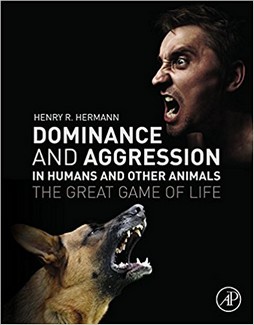
Dominance and Aggression in Humans and Other Animals was published by Academic Press (Elsevier) in 2016 and is available from them as well as Amazon.com.
Dominance and Aggression in Humans and Other Animals: The Great Game of Life examines human nature and the influence of evolution, genetics, chemistry, nurture, and the sociopolitical environment as a way of understanding how and why humans behave in aggressive and dominant ways. The book walks us through aggression in other social species, compares and contrasts human behavior to other animals, and then explores specific human behaviors like bullying, abuse, territoriality murder, and war. The book examines both individual and group aggression in different environments including work, school, and the home. It explores common stressors triggering aggressive behaviors, and how individual personalities can be vulnerable to, or resistant to, these stressors. The book closes with an exploration of the cumulative impact of human aggression and dominance on the natural world.
The Table of Contents is offered here to show the book's comprehensive nature.
Acknowledgments – 12
Preface – 16
Chapter 1 – Defining Dominance and
Aggression – 20
Dominance – 22
Dominance in Biology, Anthropology and Psychology – 23
Dominance and Sociality – 25
Social Dominance – 31
Dominance in Game Theory - 32
Dominance in Ecology – 32
Aggression – 41
Human Aggression – 44
Is Aggression Inherited or Learned? – 46
Origin of Aggression – 47
Dominance and Aggression – 50
Benefits and Detriments of Being Dominant – 52
Dominance in Humans – 53
Chapter 2 – Traits of Dominant Animals – 56
Gregariousness – 56
Issues Concerning Social Animals – 61
Burying Beetles - 61
Social Issues - 62
Dominance Struggles, Characteristic of All Social Animals – 62
The Nature of Social Species – 63
Relationship to Other Social Species – 65
Benefits and Detriments of Dominance and Subordinance – 67
Dominance in Polistes annularis Colonies – 67
Degrees of Dominance – 69
Importance of Dominance in Other Animals – 71
Other Social Traits – 76
Selfishness (Psychological Egoism) – 76
Deception – 77
Human Deception – 80
Cooperation and Agonistic Behavior – 81
Altruism – 82
Reciprocity – 83
Territoriality – 84
Morality – 84
Immorality and Amorality – 85
Religious Morals – 85
Divergence from Moral Behavior – 85
Morality and Non-Religious Beliefs – 86
Redefining Dominance – 87
Redefining Aggression – 89
Personality - 90
Chapter 3 – The Significance of Comparative Studies – 91
Attributes Shared with Other Organisms – 91
Investigations on Other Animals – 101
Chapter 4 – Social Non-Primate Animals – 103
Invertebrates – 104
Arachnids – Spiders and their Relatives – 104
The Rise of Sociality – 104
Termites – 104
Paper Wasps – 105
Bumble Bees – 105
Honey Bees – 107
Ants – 107
Mollusks – 108
Vertebrates – 109
Fishes – 110
Amphibians – 111
Reptiles – 112
Birds – 112
Mammals – 115
Chapter 5 – From Whence We Came – Primates – 120
The Rise of Primates and their Prosimian Beginnings – 120
Primate Rankings – 123
Prosimians – 124
Lorises – 125
Galogos – 125
Lemurs – 125
Indris and Sifacas – 126
Aye Ayes – 126
Tarsiers – 126
Simians – 126
New World Monkeys – 128
Old World Monkeys – 130
Apes – 133
Common Ancestor of Hominid Great Apes - 133
Gibbons (the lesser apes) – 135
Orangutans – 137
Gorillas – 137
Chimpanzees and Bonobos – 138
Concluding Statement about Prehuman Primates - 142
Humans – 142
Chapter 6 – The Human Animal – 144Where Did Contemporary Humans Come From? – 145
Humans and the Earth they Live Upon – 145
Development and Evolution of the Earth – 149
Its Anaerobic Beginning - 150
Life on Earth – 152
Mutations, Diversification and Natural Selection – 153
Rise and Fall of Dominant Forms - 155
Chapter 7 – Similarities between Humans and other Living Organisms – 158
Humans as Social Animals - 158
Fossils and Dating – 160
Comparing Homologous Structures and their Chemistry – 161
Biogeography – 161
Population Change - 161
Basic Biological Fundamentals and their Origins – 164
Significance of the Brain – 164
Development of the Human Brain – 167
The Animal Becomes Human – 168
Chapter 8 – Human Nature, Its Beginning and Philosophical Base – 170
Domain Eukarya – 171
The Rise of Advanced Hominines – 174
Mammalian Anatomical Features Found in Primates – 178
Behavioral Traits Shared with Other Animals – 179
Anatomical Traits Shared Between Humans and Other Primates – 180
Distinctly Human Anatomical Traits – 182
Behavioral Traits Shared between Humans and Other Primates – 182
Distinctly Human Behavioral Traits – 183
Emotions – 184
Personality – 185
The Betterment of Humankind – 194
Humans in a Complex World - 195
Evolution of Philosophical Thinking in Humans – 195
Nature and Nurture – 197
Human Behavioral Features – 197
Variation, the Hallmark of Human Culture – 198
Chapter 9 – Alternate Human Behavior – 199
Mental Illness - 206
Psychopathic Behavior – 208
Scale of Evil – 212
Love – 213
Respect – 214
Falling Out of Love – 216
Stalking – 216
Tolerance – 219
Adultry – 223
Hate and Hatred – 2223
Hatred and Hate Groups – 224
Who is Hated? - 227
Gangs – 228
Terrorists - 230
Chapter 10 – The Chemical, Physical and Genetic Nature of Dominance,
Aggression and Aberrant Behavior – 232
Relationship between Brain Structure and Function – 233
Anatomical Variations in the Brain – 234
Genetics and Aggression – 234
Mutations – 235
Monoamine Oxidase – 236
Nitric Oxide – 236
Stimulation of the Amygdala and Hippocampus – 237
Chemical Influence and Stress – 237
Behavioral Influence and Stress – 237
Chemistry and Aggression – 237
Inadequate and Improper Body Chemicals – 237
Elements and Simple Chemicals in Foods and their Influence on
Behavior - 238
Indirect Affects of Chemicals – 244
More Complex Chemicals in Foods and their Influence on
Behavior – 245
Brain Chemicals – 247
Physical and Congenital Anomalies – 252
Substance Abuse – 252
Substance Abuse and the Brain – 253
Substance Abuse and Child Development – 255
Environmental Factors and Drugs – 258
Neural Tissue Damage and Modification – 258
Hyperactive Amygdala – 259
Misinterpretation of Surroundings – 259
RADI and Impulsive Aggression – 259
Unchecked Aggressive Behavior – 259
Social Stressors and Relationships – 259
Media and Acquisition of Aggressive Tendencies – 259
Rejection in Children – 260
Behavioral Variability – 260
Chapter 11 – Dominance and Aggression in the Workplace – 262
Conflict in the Workplace – 262
The Serial Bully – 264
Toxic Leaders – 267
Chapter 12 – Dominance in Religion – 271
The Beginnings of Religion – 271
Initial Development of Religion – 273
Theistic System – 276
The Formative Stage of Religion – 276
Creation Stories – 277
The Basic Nature of Indigenous Religions – 277
Strange New Religions – 278
Hierarchical Nature of Religions – 282
Mesoamerican Religious Hierarchy – 283
The Value of Contemporary Religions – 283
Controversy between Religion and Science – 284
Summary of Concepts on Change – 288
Religions with the Term Science in their Name – 289
Dominance Conflicts between Religions with War-like
Tendencies – 292
Moral Codes, Intolerance and War – 294
Religious Harmony and Disharmony – 295
Relationship between Religions and Human Behavior – 297
Religious and Non-Religious Morals – 297
Religions and Crime – 298
Chapter 13 – Dominance in Politics – 299
The Power of Politics – 301
Toxic Leadership – 302
Chapter 14 – Human Aggression – Killing and Abuse – 308
Killing – 309
Origin of a Killing Trait – 310
Interspecific Killing – 311
Growing and Killing Domestic Animals – 312
Fishing – 314
Overfishing – 315
Hunting – 316
Reasons for Hunting – 318
Wildlife Exploitation – 322
The Pet Trade – 330
Chapter 15 – Killing Humans - 339
Abuse to Humans and Other Animals – 339
Pet Abuse by Notorious Killers – 339
Connecting Animal Cruelty and Family Violence – 340
Stopping the Cycle of Abuse – 341
Killing Individuals of One’s Own Species – 341
Infanticide – 341
Abortions – 343
Killing of Adults – 344
People Who Kill – 345
Family Violence and Abuse – 346
Lack of Respect for Other Humans – 347
Ethnic Cleansing – 348
Eugenics - 348
Murderers and Serial Killers – 349
Honor Killings – 350
Are We All Potential Killers? – 350
Attractive Nature of Violence – 352
Gangs and Hate Groups – 353
Warfare – 353
Territoriality – 353
Human Territories – 355
Comparing Humans with other Simians – 357
Human Warfare – 359
Aboriginal Humans as Warring Animals – 362
The Atrocities of War – 365
The People Who Fight in Wars – 368Origin of Aggressive Behavior in Humans – 370
Final Note – 371
Chapter 16 – Are We Our Own Worst Enemy? – 374
Changes in Humans and Their Environment – 374
Language – 376
Acquiring Innovative Skills – 376
Contemporary Humans – 377
Opening the Can of Worms 378
Dominant Life Forms on Earth through Geologic Time – 379
The Power of Petroleum – 381
Other Oil-Related Accidents – 387
The Industrial Revolution and Technological Expertise – 390
Establishing Marine Dead Zones – 399
Human and Other Body Wastes – 401
Other Animal-Related Problems – 406
Global Warming and Climate Change – 406
Anthropogenic Influences – 407
Carbon Dioxide (CO2) Emissions from Pastured Animals – 407
Nitrogen from Fertilizer and Food Production – 409
Methane (CH4) – 409
Nitrous Oxide (N2O) – 410
Conflict, Hunger and Disease – 410
Strategies and Next Steps – 411
Disposal of Human Wastes – 413
Sewage Sludge – 415
Human Health – 415
Industrial Wastes – 415
Increasing Population – 417
Population Growth and Environmental Carrying Capacity – 417
Genetically Modified Organisms and the World Population - 418
Reviewing Our Situation – 419
Earth’s Dwindling Resources – 422
Value of Trees – 422
Overuse of Resources – 423
Other Pollution – 424
Solid Wastes – 426
Recycling – 428
Our Dilemma – 429
Other Indications of Our Destructive Nature – 430
Forest Devastation – 435
Chapter 17 – Attempts to Save the Natural World – 438
Worldwide Intergovernmental Organizations – 439
Regional Organizations – 439
World-Wide Environmental Protection Groups – 43
United States Environmental Groups – 440
Florida’s Attempt to Restore its Natural Environment – 441
A Need for More Concern – 444
Love Canal Environmental Disaster – 445
The Baia Mare Cyanide and Heavy Metal Spill – 446
The Complex Human – 447
Chapter 18 – The Nature of Things – 448
A Transforming Earth - 452
What this Book Has Tried to Do – 463
Criticism of Science by Antiscience Personalities – 463
Our Ultimate Fate - 474
References – 478
Glossary – 568
Notes – 612
Index
Excerpt
Solomon Naumovich Rabinovich, Yiddish author and playwright (pseudonym Sholem Aleichem), once wrote that “Life is a dream for the wise, a game for the fool, a comedy for the rich [and] a tragedy for the poor” (Waife-Goldberg, 1968). Yet, when we analyze life at the various levels mentioned, we find that there are numerous games we and all other animals play on a daily basis (dominance and aggression games) at each of these levels, and the games generally influence and are influenced by the position we occupy in society throughout life. The differences between people in the world are largely based on where the games are played, the rules they play by, the conditions allotted to them at the games’ beginning, the intelligence they have at the onset of the games, the experience they acquire along the route to the games’ termination and how the games are played.
At times, the games are simple and pleasurable, and humans look forward to playing them. Others are more serious, affecting their health and longevity. Some games may happen within minutes, hours or days, while others take long periods of time to play out. In each, there most often is a winner and a loser. Each player may win at certain games, and others may win at different ones. Winning and losing, however, are often disproportionate because some players are more serious about or talented at playing the games and receiving the rewards they get by being a winner. Some win most of the time, while others lose most of the time. Bacause of this inequality, winners may dominate their competitors when the game averages are determined.
Sometimes, the rules to the games are fair, made by people who have other’s interests and harmony at heart, and sometimes, they are unfair, built on selfishness and greed. In some cases, the winners are ruthless in how they play; they are intolerant of the losers, and the losers suffer from their losses.
Sometimes, the rules are strongly enforced, and sometimes they are not enforced at all. In some areas of the world, the rules may be different, depending on who the rule-makers are, the number of people in the games and the conditions that exist at the time the games are executed.
Some people follow the rules to the letter, and still others refuse to follow them at all. Sometimes, the rules can be altered, depending on the degree of influence one player has over other players, and sometimes the rules change because of both intrinsic and extrinsic factors. Sometimes, the games can be won, and sometimes, there is no chance of winning. At times, players need help to understand the rules, and sometimes they require assistance in how they should make their moves.
Games of dominance and aggression are present in everything we do and face us every day of our lives, no matter what our position in life. They can be simple, non-threatening and life-enhancing or they can be life-threatening and difficult to cope with. The games commence at our birth and end at our death. As we enter the world, we, unlike most other animals, inherit a cognizant mind and behavioral propensities which influence our personalities, and the environment we grow up in influences the development of game enhancers or deminishers we may use and carry to the end. As we express our dominant nature during life’s excursion, we often display various forms of aggressive behavior toward one another, which ultimately determine where we will end up in a ranking system we refer to as a dominance hierarchy.
Some of us play the game with a highly competitive spirit, and others lack a competitive nature. Some of us cheat, and others feel cheating is undesirable or unethical. Thus, some of us play fairly, while others take advantage of the weaknesses of other players. Some of us enjoy a high position in the hierarchy and are miserable at the low levels. Others do not care what their position is in the hierarchy.
At times, there are many such hierarchies, and we play endlessly for a position in them in order to maintain our degree of dominance amongst others of our population. How we flaunt our position in each of the hierarchies is an expression of the personality we carry through life, and as we meet life’s challenges and age, we may forfeit our position in the dominance hierarchy to younger, more able and smarter competitors.
In the end, no one really wins, but we as humans can attempt to set up the playing field and improve the games that will be played by the next generation and hope that they will do the same or better at playing than we did. What may block the success of subsequent generations is the failure of the human population to abide by the rules and the conditions that arise because of this failure.
Throughout this book, an attempt is made to describe these games that humans and other animals play. In the process, we learn something about the players and how similar or different they are. Although humans consider themselves either as the elite of the animal kingdom and/or some form of living creature that occupies a position among living things somewhere between animal status and God, they nevertheless share biological features which link them to many other types of biota and express themselves in both animalistic and humanistic ways.
There are other implications for the powers of dominance. The level of dominance is not merely restricted to individuals who influence other members within their own society. Dominance becomes influencial on a much larger scale, determining how we act and work in social groups, families, coalitions, organizations, cities, nations, communities, ecosystems and as global inhabitants, how we utilize the resources we require for modern living and how we treat Mother Earth in getting the things we need.
Over long periods of time, humans have changed from an almost totally animalistic existence to one in which they have become more technologically advanced. As such, humans have exploited the Earth to obtain materials for which they can utilize their technological prowess. And with a population that is steadily increasing beyond its environmental carrying capacity, it has overexploited certain of the Earth’s resources and in the process, it has altered the motherboard, planet Earth, and its animal competitors.
On occasion, generally over long periods of time, the motherboard itself changes on its own, and the organisms which occupy it become stressed. This brings on new rules, extinction of old and the diversification of new players and major changes in the playing fields (ecosystems) to which they belong.
In many ways, the human population functions like a colossal superorganism, taking in materials which it must process in order to obtain energy, grow, fight infections, other delitarious circumstances and obstacles in order to survive and produce subsequent generations. Its body must recycle materials that are important to metabolic functions and dispose of others that must be eliminated as wastes. In carrying out these functions, it must strive to maintain homeostasis, in spite of abuse, and if homeostasis is unattainable, it will become sick and possibly die. In certain cases, Earth becomes antagonistic to the species which live upon her, and mass extinctions occur.
A look at the Table of Contents will show that the topics covered are quite diverse. Yet, they are all aimed at understanding the complexity of human nature, its origin and evolution, its animalistic and humanistic connections and how their combined effects have influenced the Earth upon which they have thrived for many thousands of years.
How human nature is expressed varies tremendously as a gradation from dark to light, mild-tempered to psychotic, complete subordinance to ultradominant (despotic), altruistic to selfish, cooperative to antagonistic, pleasant to disruptive, moral to immoral. While we tend to group individuals into well-defined categories, based on their behavioral expressions, the distinction between expressions is actually quite plastic, a gradation or cline from one extreme to another, based on both genetic propensities and learned behavior, and no two people are alike. Thus, the artificial categories we tend to put people in overlap tremendously, sometimes making it difficult to understand a particular behavior and how it is manifested.
Commencing with definitions of dominance and aggression, earlier concepts are presented and redefined, based on contemporary comparative research. When we embark on such an enterprise as attempting to understand human nature, we immediately become overwhelmed with the complexity of the animal, the vastness of pertinent literature and the number of researchers who work on different phases of the subject. While I will admit that a single volume of work like this one cannot possibly cover the subject of dominance and aggression in a totally comprehensive fashion, it is my hope that the present volume, for which I have spent years in its preparation and writing, will be covered adequately enough to at least stimulate the thoughts of others who feel they must also express themselves on the subject.
When we are born, we are fortunate to begin life on a planet that has supported life for about four billion years. Humans have experienced what Earth has to offer for only a fraction of this time. Life over time has not always been pleasant, and life for many humans and other animals continues to be unpleasant today. As organisms evolved on an ever-changing Earth, their populations and ecosystems underwent a variety of gargantuan modifications due to constantly-shifting environmental stresses over long periods of time. Many species became extinct in the process. Subsequently, the Earth rebounded and the games and players diversified.
Through natural selection, each species that remained extant developed assorted mechanisms to maximize its advantages for survival and reproduction. Humans, like other successful animals, have developed many of their own mechanisms for this purpose, but at the same time, they have inherited and continue to express numerous animalistic features from a wide assortment of predecessors. We are thus mutants with an amalgamation of animalistic and humanistic qualities.
The human story, including anatomical, physiological and behavioral aspects which associate and dissociate this animal from others, and a characterization of what this wondrous dominant animal is like in the early 21st century will unfold as we move from one chapter to another. The chapters incorporate such concepts as where they and their personalities arose, their similarities and differences when compared with other animals, their moral or immoral nature, how they express their dominant and aggressive nature and how they function amongst other environmental biota.
It elaborates on just how complex, intelligent and sometimes strange humans are and how they have affected world homeostasis and instability. We will find that the social nature of humans, along with human intelligence, dominance and aggressiveness, have been behind human success in becoming the most dominant animal on the planet. On the dark side, as the human population grows, its dominant and aggressive nature may negatively affect its longevity as a dominant species and its continuing existence on planet Earth.
|