According to one reviewer: "The first section of the book (Vignettes one through six) is quite magical. On the surface, this collection of vignettes appears to be loosely strung together – much as a set of heirloom pearls on a threadbare necklace – and written in authentic twentieth century descriptive literary style. The effect of these rather peculiar vignettes is somewhat reminiscent of Ravel’s glittering yet playful "Valses nobles et sentimentales", as each vignette is in essence a pond reflection of the previous one(s) – thus giving an impressionistic feel to the dance through this odd construction of tales. However, these vignettes are also written in a style that recalls the masterful storytelling of Voltaire : Candide-esque and a bit “naughty” in that they are written both with the purpose of amusing and challenging the insider group of former Victorians, as well as serving as a playful betrayal of “secrets” to the uninitiated. Moreover, the overall work lends itself to the philosophy of the author in regards to Poïetics – with its much ado about nothing other than the embellishment of the boring ... and giving equal weight to both fact and fiction." Adam Donaldson Powell
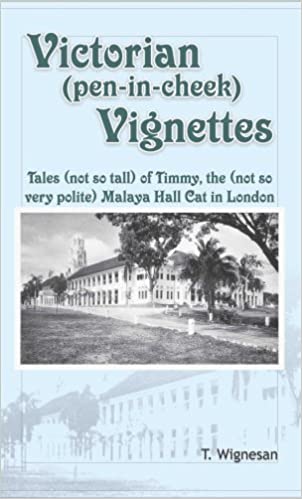
Victorian (pen-in-cheek) Vignettes & Tales (not so tall) of Timmy, the (not so very polite) Malaya Hall Cat in London by T. Wignesan
The Victoria Institution, a secondary school founded in Kuala Lumpur in 1893 by the British administration in close collaboration with the leaders of the three major communities: Malay, Chinese, and Indian in the capital, comes closest to upholding the British public school tradition in the region. Widely recognised as the "premier school" of the country, its established traditions and ties have stood, it might be said, the test of times. The overwhelming role of former alumni in public life attests even today - though the school has lost its former pre-Independence reputation - to time-honoured British educational policies. This collection of eleven vignettes by a former pupil of the school who rebelled against this "strict inflexible tradition" as interpreted and transmitted by the local staff, who had not themselves wholly and intrinsically imbibed the spirit of the colonial tradition, borders on satire, expressed in a rebellious debunking attitude towards his fellow alumni who mistakenly or otherwise assumed the importance of their nurture in an older, well-grounded heritage, both in Malaysia and in England where many or some among them went to qualify later on. To this end, Wignesan has even, sometimes, recourse to ribald language and humour, but always with tongue in cheek. The vignettes also sketch a veridical toile of times gone-by when other socio-political standards held sway in a land still in the making, so to speak. His insights into his fellow-school mates and the long-arm reach of a government over its young in a foreign territory all speak of a Kafkayesque microcosm and makes one wonder if inculcated intrinsic cultural values may triumph over a closed-circuit world of political shenanigans. An air of earnest light-heartedness pervades this collection of vignettes, especially the "not so tall tales" related by Timmy, the Malaya Hall cat in London; perhaps this approach might make what is most unpalatable to the indigene who were/are somehow deprived of an intellectual life and make them now more willing to accept criticism or adopt the chastening habit of being auto-critical.
(c) T. Wignesan - Paris 2000-2001
Excerpt Victorian (pen-in-cheek) Vignettes & Tales (not so tall) of Timmy, the (not so very polite) Malaya Hall Cat in London by T. Wignesan
In August 1998, I began a new career: the career of a retired Civil Servant. Curious, I didn t ask to be made a civil servant. French laws governing the statutory body in which I was a Research Fellow for a quarter of a century offered all foreigners with the rank of researchers (chercheurs au Centre National de la Recherche Scientifique) the possibility of opting for the status of a functionary in the French State. I did nothing, and one fine morning I think at the beginning of January 1984 - an official letter arrived announcing that I was nominated a Civil Servant which meant that I could not easily be sacked unless, say, I dangled myself by my chignon from the Eiffel Tower and sang the Terang Bulan naked! The curious thing is that I was a Stateless Person when I arrived in France in 1972 and still am. Soon after being retrograded into active retirement, a relentless hunter after Victoriana surfaced out of the Internet to rope me into raking my memory of old school days. Nothing was farther away from my thoughts than the solitary turban-turning memories I entertained of the old school. In less than a year-and-a-half, we Chung Chee Min (a former school laureate, later a teacher, and now one of the school webmasters) and I had chalked up over 1500 small-print pages in correspondence over old school mates, teachers, and other Tom Brown school-type reminiscences. Our correspondence focussed on the numerous official careers of the old boys and girls from the Victoria Institution, the vaunted premier school of the country. They all smacked of the odour of success in public life: straight, square, solid, with squire-like stolid citizen success stories. There s nothing wrong with that, of course, but I was put off by the odour of goodness and sweetness that pervaded all their fragrant memories. "Look, what a pretty boy I am, Mummy Victoria! Obedient! Clean! I have done all my homework for the week, and ..." that sort of achievement.
(c) T. Wignesan - Paris 2000-2001
Professional Reviews
5.0 out of 5 stars Literary criticism (2009) by Adam Donaldson Powell 5.0 out of 5 stars Literary criticism (2009) by Adam Donaldson Powell
Reviewed in the United States on November 15, 2015
Literary criticism (2009) by Adam Donaldson Powell – based upon “Victorian (pen-in-cheek) Vignettes”, published by Cyberwit.net, India, 2008, respectively : ISBN 978-81-8253-107-9, 207 pages, paperback, US$20.
“Victorian (pen-in-cheek) Vignettes” is based upon the Victoria Institution and its alumni, and the Malaya Hall community in London. The Victoria Institution being a secondary school in Kuala Lumpur, Malaysia which upholds the British public school tradition for Malays, Chinese and Indians in the capital. The classical literary flow of the first half of the book is abruptly broken in the second half (starting with vignette no. 7), as that portion takes on a style and character more likened to a gossipy and trivial (albeit saucy and humorous) quasi-historical account from the author’s perspective (more specifically that of a cat named Timmy). I personally found the first half of the book to be of greater interest to myself as a reader who lacks even the most rudimentary historical, political and social knowledge of Malaysia or first hand experience of the Victorian Institution and Malay Hall. However, the storytelling by Timmy the cat is nonetheless entertaining even though not all world readers will have the necessary background to glean the most out of this writing.
The first section of the book (Vignettes one through six) is quite magical. On the surface, this collection of vignettes appears to be loosely strung together – much as a set of heirloom pearls on a threadbare necklace – and written in authentic twentieth century descriptive literary style. The effect of these rather peculiar vignettes is somewhat reminiscent of Ravel’s glittering yet playful "Valses nobles et sentimentales", as each vignette is in essence a pond reflection of the previous one(s) – thus giving an impressionistic feel to the dance through this odd construction of tales. However, these vignettes are also written in a style that recalls the masterful storytelling of Voltaire : Candide-esque and a bit “naughty” in that they are written both with the purpose of amusing and challenging the insider group of former Victorians, as well as serving as a playful betrayal of “secrets” to the uninitiated. Moreover, the overall work lends itself to the philosophy of the author in regards to Poïetics – with its much ado about nothing other than the embellishment of the boring ... and giving equal weight to both fact and fiction.
The author’s incorrigibility – falling short of the outright impudence of an “enfant terrible” -- and his inherent understanding of Asian and French sarcastic wit and humor lend to these vignettes a delicious edge whereby the inclination is to laugh ... but in a guarded fashion. This because inside ourselves we readers know that each expression of the adventurous and unwitting Fool must also be accompanied by a good measure of apprehension, for no one is to be trusted absolutely – not the police, not our colleagues, not doctors or lawyers or bureaucratic systems ... and perhaps not even ourselves.
On a slightly less positive note, I would comment that T. Wignesan occasionally breaks the magic he creates by failing to adjust the content length, endings and transitions in some passages – thus running the risk of both overcrowding with too much information and abandoning an otherwise sparkling quality with overhurried endings (eg. Vignette no. 6). This is a challenge for all writers but is of particular importance when working with collections of short works which should both function as separate, individual pieces and interlocking parts of a larger jigsaw puzzle. The solutions available are many but the decision making process is often rather difficult – especially when the author is struggling to simplify information along with complicated techniques, style and language.
That being said, the “Victorian Vignettes” are an interesting and entertaining read.
By Adam Donaldson Powell, 2009.
Want to review or comment on this book?
Need a FREE Reader Membership?
Reviews for "Victorian (pen-in-cheek) Vignettes&Tales(not so tall)of Timmy, the(not so v"
It appears that you may have posted this book before. And as near as I could gather, the vignettes are not about Victorian literature, but about classmates in Victoria Hall back in Kuala Lumpur. It also appears that Adam Donelson Powell was the only one to give the book a clearly thorough and definitive review.
I like the idea of the tales being humorous and "magic," but unless I have some reading time freed up I will not be able to get to reading them.
Join me as we travel together on the road called "Aging." I will be sharing my personal experiences with you and offer ideas on how we can better navigate the complex byways of our older years. Grief, healing, generations, ancestors, and more.
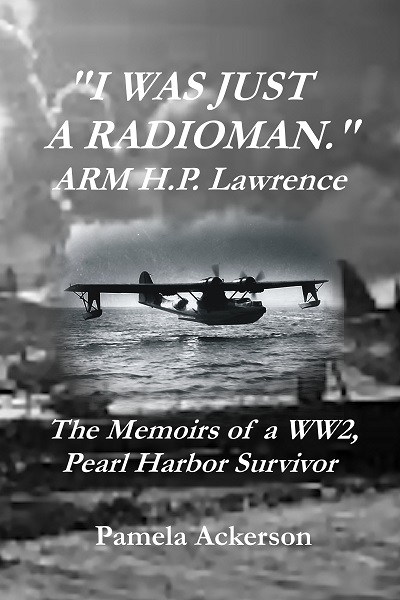
This is not a drill. The attack on Pearl. They were the ghost planes of the night, deadly, illusive, sharp-clawed Black Cats. The Memoirs of ARM H.P. Lawrence, a Pearl Harbor survivor, Black Cat, and decorated war veteran.