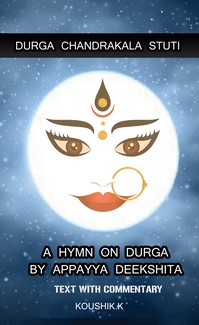
In this hymn various glories of the mother goddess durgā from Vedas and various puranas are summarized. The hymn comprises of eighteen shloka,
Durga chandrakala stuti is a hymn composed by Appayya deekshita the great shaiva and scholar of Vedas Puranas and mantra shastras who lived in Tamil nadu in the fifteenth century (1520–1593 CE)
In this hymn various glories of the mother goddess durgā from Vedas and various puranas are summarized. The hymn comprises of eighteen shloka, the first shloka being the mangalacharana (invocation of the goddess) and the last shloka the phala shruti (description of benefits which are attained by the recitation of this hymn.)
So the main hymn is of sixteen shlokas and hence the name durgā chandrakalā stuti (hymn to durga like the sixteen states of moon) is given to it by the composer.
This hymn is considered very powerful by the practitioners of Shakta and Shaiva tradition – the worship of the mother goddess (the embodiment of all power) because this hymn is the summary of the great and powerful text Devi māhāthmyam of Mārkandeya purāna which is of 700 shlokas and hence also known as durgā saptashatī (seven hundred verses praising durgā)
In addition to that Appayya Deekshita also summarizes various glorious incidents about goddess durgā and her manifold forms from various purānas. Hence reciting this hymn daily is equal to remembering all the important glorious deeds of the goddess mentioned in the puranas. The Devi mahatmya and the other anecdotes about the devi given in Varahapurana, Harivamsa, Bhagavata etc., are given in condensed form in this work to be precise.
Reciting this hymn with devotion bestows the devotee with protection, wealth, wisdom, courage good fortune and liberation.
Excerpt
The famous encounter with Shumbha and Nishumbha has been discussed in the third shloka of this hymn quoting the uttama charitra of devī māhātmyam. The one quoted here is a different encounter which is described by the mother goddess herself in chapter eleven of devī māhātmyam after the devas praised her with nārāyanī stuti.
Mother goddess manifested as Raktadantikā to destroy vaipracittas, and took the form of vindhyavāsini to destroy the reborn Shumbha and Nishumbha, the mother incarnated as Shatākshi – the mother with hundred eyes in the times of a great long drought and blessed the humans and sages with food grains. She filled the land with food grains and plants and hence she is known as Shākambharī (she who fills with food crops) then she killed the demon Durgama who troubled all the worlds by taking away their wisdom with his evil magical powers and thus the goddess is praised by the name durgā. May the goddess save me, protect me with all the above mentioned forms and all the other forms which are taken by her during the times of most difficult troubles of the worlds.
Professional Reviews
Highly recommended
Namaskarams,
I had been looking for an apt translation of Durga Chandrakala Stuti by Srimad Appayya Deekshitar in Tamil or English.
I had read a few translations available on the internet, but nothing made justice to the work, I felt.
I also had the sva-vykhyana by Srimad Appayya Desskshitar himself in Sanskrit.
But my sanskrit knowledge isn't all the great, so this sanskrit vyakhyana was like - there is a saying in tamil 'naai petra thengampazham' - Full unbroken coconut with a dog, it cannot do anything with it.
Koushik sir's translation seems to be based on the sva-vyakhyanam of Srimad Appaya Deekshitar.
This was goddess sent and many thanks to the author for the translation.
May Jagadamba bless him with her infinite grace.
Finally! Understand and learn from the New Testament Book of Acts.
Try James first for free
Now there is a Bible translation that is easy to read, understand, and study.
This translation is unique in that it is arranged in
Finally! Understand and learn from the New Testament Books of Matthew, Mark,Luke, and John.
Try James first for free
Now there is a Bible translation that is easy to read, understand, and study.
This translation is uniqu