Category: Young Adult/Teen Publisher: Open Books Press
ISBN-10: 1941799388
Type: Fiction
Pages: 220
Copyright: Oct 6, 2016
ISBN-13: 9781941799383
Price: $3.99 (eBook)
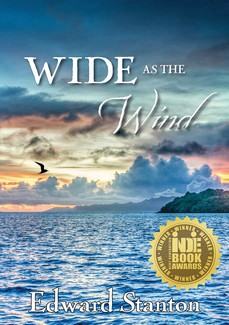
When Vaitéa is ravaged by war, hunger and destruction, it falls upon Miru, the fifteen-year-old son of a tribal warrior, to sail to a distant island to find the seeds and shoots of trees that could reforest their homeland. Wide as the Wind is both a stirring novel of adventure and a prophetic tale for our times.
The lyrical tale of a boy, a girl, their island, and how they saved it.
Wide as the Wind is the first novel to deal with the stunning, tragic history of Easter Island (Vaitéa). It could be described as quest fiction for all ages in the line of Tolkien’s The Hobbit, but it is set in the real world, not Middle-earth. Wide as the Wind portrays Polynesian voyages across the Pacific Ocean in canoes with no metal parts or instruments: the greatest adventure in human prehistory, as bold as modern space voyages (National Geographic).
When Vaitéa is ravaged by war, hunger and destruction, it falls upon Miru, the fifteen-year-old son of a tribal warrior, to sail to a distant island to find the seeds and shoots of trees that could reforest their homeland. If he decides to undertake the voyage, he must leave behind Kenetéa, a young woman from an enemy tribe with whom he has fallen deeply in love. And if Miru and his crew survive the storms, sharks and marauding ships that await them on a journey over uncharted ocean, an even greater mission would lie ahead. They must show their people that devotion to the earth and sea can be as strong as war and hatred. Wide as the Wind is both a stirring novel of adventure and a prophetic tale for our times.
Excerpt
Chapter 1
Call
Dawn spread white wings across the sky. Miru awoke, aware that it was the day when he must travel to the forbidden grove. Outside a rooster crowed. As he imagined the priestess in her dank cave, the boy shivered. He strapped a knife of obsidian to one arm.
He walked on bare feet over the earthen floor. Miru saw his mother by the hearth, where last night’s embers glowed. He ran to her. Smiling, Ia pressed her nose against her son’s. With the long fingers of one hand she grazed the freckles on his cheeks.
“Good morning,” she said with her voice like water. Miru’s features had come from her: he had his mother’s brown skin, her dark hair and green eyes the color of the sea.
From the fire Ia pulled a yam. She set it on a wooden plate to cool. With sleepy eyes Miru stared at it, feeling a pang of hunger. He knew that she had roasted the yam for his father. As soon as his mother turned away, Miru snatched it and scurried out the door.
He squatted on the ground by the family’s well. Using his knife, he cut through the warm yam’s skin as he had seen fishermen slit a mackerel’s belly. Steam rose from the yellow pulp and filled the child’s nostrils.
As Miru ate with his fingers, he watched the life that stirred around him in the square: dogs rousing from sleep, pigs rooting in the dust, birds hopping, roosters, hens and their chicks pecking the dirt. Curls of smoke seeped through the thatch walls of houses. When a fly landed on Miru’s foot, he kicked. It flew away. As he always did when he was happy, he wiggled his toes, smiling.
He yearned to be with his mother at the hearth again. But he knew she would scold him for eating his father’s food. Miru also remembered that he must journey to the seer’s grotto today. Why would the old sorceress want me to go there, he wondered.
The boy could not resist peeking through the door. He spotted his mother by the hearth. Without looking at her son, she asked, “Why did you steal your father’s food?” Even when she tried to be stern, Ia’s voice sounded like coursing water.
“I was so hungry, Mother.” The child entered.
“I cooked taro for you.”
“I’m tired of taro,” he said, drawing closer. “We all used to eat yams—why can’t I eat them now?”
Ia placed her thin hands on Miru’s shoulders. Already the boy knew she would not scold him. “The enemy has burned many of our fields. The harvest of yams is reserved for soldiers who need strength to fight, like your father.”
“I need strength too—I’m going to make a long trip today.”
She pulled the boy to her side. Miru buried his face in his mother’s belt of tapa cloth. “You’ve already eaten the yam, right?”
“Yes.”
“Then go before your father wakes. Be careful, my son.” She rubbed the braids of his dark-brown hair. Passing one hand over his brow, she gave Miru her blessing.
He spun and rushed over the threshold. In the square he scattered the chickens, birds, pigs and dogs. Miru ran through sparse woods to the coast. With his braids swinging behind him, he dashed along the beach, splashing in small waves. He felt a light and foamy ease until the witch’s cave returned to his mind.
Miru stopped at the cove where he and Kenetéa often met in secret. On the sand he recognized her shapely footprints. How he would have liked to wait for her there instead of going to the cavern! How he would have wanted to show her his tattoos, the new markings on his face, chest and shoulders! But Miru continued on his way, staying clear of fields where armies were already skirmishing in the early light. He could hear the cries of soldiers and the clashing of weapons.
Day moved across the world. Before noon he had entered the secluded grove, the thickest forest on Vaitéa. Miru shuddered as he tiptoed through the shady woods. When he approached the cave, a guard challenged him, raising his lance.
“The priestess called me here,” Miru said. “I’m Koro’s son.” Hearing that warrior’s name, the man bowed his head, lowered his spear and led the visitor to the cavern’s mouth.
Miru crawled into the blackness. When he stood up, he bumped his head on the stony ceiling. Slowly his eyes grew accustomed to the dark. Keeping low, he moved forward, groping with both hands along moist walls. Miru came to a large chamber where he could stand without stooping. He smelled a musty odor, old as the world. Waves crashed on the rocks below.
“Welcome to my sanctuary, Miru!” a voice boomed from the grotto’s depths. The boy looked around him: he could see nobody.
“I’m here!” the voice called, behind him now, laughing, echoing against the walls. He whirled. He still could not see the sorceress.
A torch flared ahead of him, and a woman appeared in a circle of light. Swaying from side to side, her body covered in a cape of bark-cloth, her head topped by a tall cone of feathers, Marama moved toward him. As she walked, Miru heard the rustling of her garment and the creaking of her bones.
She extinguished the torch and dropped it on the cave floor. Marama rubbed the boy’s chest where it was tattooed with a pair of leaping dolphins. “The artist captured your spirit-animals well,” she told him. He did not understand how the woman could see in the darkness. But after all, he thought, Marama had been named for the moon.
With her hand she brushed his shoulders and their images of breaking waves. Finally Marama skimmed the lines that the tattooer had etched on Miru’s face with birdbone needles. “You are beginning to resemble a man,” she said.
Without warning the seer grasped his arm with one hand. Her sharp fingernails, curved like a bird’s talons, broke Miru’s skin. For the first time in his young life he felt fear in his chest.
“Look at this eye,” Marama told him, pointing to her good one, the left, with her free hand. Miru was becoming used to the dark, but he could scarcely discern that eye. “It sees the world,” she said. Marama touched her other eye, the right, blank as the moon. “See this one? It’s blind yet it perceives more and greater things—those that are invisible to you and others.” Water dripped from the cavern walls. “So listen to what will change your life forever, Miru.”
The witch paused to draw a breath. “Our people think we suffer because the tribes are at war, because we’re ruled by men with bloody hands. They’re wrong. It’s something larger than all of us.”
“What?” Miru’s voice echoed in the chamber.
“Our land and our seas are dying,” Marama intoned. “We’ve razed our forests and poisoned our shores so that our nesting birds, our fish and shellfish have dwindled or disappeared. Fighting has despoiled our land. Many people are hungry. Your own mother cooks less food for your family.”
“How did you know?”
“I know many things, sometimes before they happen.” Marama tightened her grip on the boy’s left arm. “You must sail to an island far away, Miru, to bring back the seeds and shoots of new trees, to restore our woods and rescue Vaitéa.”
“What!” His eyes looked big as oysters. “We live at the end of the world! Nobody has ever reached another island—how could I?” Miru remembered Kenetéa.
“You must forget her.”
He failed to comprehend how the priestess could steal his thoughts. Recalling the girl’s skin, smooth as mother-of-pearl, he said, “I cannot forget.”
“Her tribe is locked in war with ours.” Marama allowed her utterance to sink into Miru’s mind. “Anyway you’ll never love her or any other woman until you pass the rite and leave this cave as a man.”
Those words ran through him like a spear. Trying to hold back the tears welling in his eyes, he drooped his head. “Marama,” he said, “my father has trained me to be a soldier so I can defend our family and our tribe.” Without thinking, Miru clasped the hilt of his dagger with his right hand.
“Your father’s a great soldier but your mission is more crucial than war. You’re the last boy who’s been schooled as a sailor, right?”
“Yes.”
“Your family owns the best longboat on Vaitéa, true?”
Miru nodded. “But it takes a crew of three to sail it,” he said. “All our men are at war or have died in battle.”
“You’ll have to find a crew.”
He did not reply. It was useless to argue with Marama, who had an answer for everything. A roller smashed on the shore with a sound like a huge tree cracking. He thought of bright-eyed Kenetéa.
The priestess loosened her hold on Miru’s arm. “Listen to me,” she said softly, leaning forward. He could smell her odor of smoke and ashes. “The time has come, Miru. You must sacrifice your love for Kenetéa in order to save our island home.” She pressed the boy’s arm with both hands.
He was trapped in the grotto, sickened by Marama’s clammy touch, her nails and the stench of her body. He no longer felt afraid. Miru pushed the seer’s hands away.
Marama knew the sadness of an old woman whose body revolts a young man. Yet she drew nearer, so close that he could feel her breath on his face now, smell it. She stroked Miru’s chest. Marama raised both arms beneath her cape, swelling in the dark like a bird with wide wings.
“Son of Koro,” she said in her sonorous voice, “at your birth-feast I predicted you would be headstrong—”
“Like you, Marama?”
The witch smiled. “Yes. And in you I’ve almost met my match.” She paused. “Few sons are as good as their fathers—in fact most are worse. I thought you might be different. But you’re a slave of your own heart.”
“No son or father could make that voyage.”
“Aayy!” Marama cried in a wail so piercing, so painful that it seemed to shake the roots of the earth. Aiming a crooked finger at the boy’s face, she said,
“I’ve never banished anyone from this cave. You’re the first, Miru. Go! Don’t return until you’re brave enough to hear my call.”
His face burned with shame. The sorceress, who could see so clearly in the dark, watched Miru’s cheeks flush. With both hands he covered his face. Then he stood straight and bumped his head on the ceiling again. As he slunk from the cavern, Marama smiled with cunning.
Professional Reviews
School Library Journal
"Protagonist Miru is a valiant hero, sailing into the sunset and bringing back trees and plants that are essential to the viability of his close-knit community. Miru is well-developed, and he’s featured in an engaging subplot of a chaste romance, sustained even through a long separation during his seafaring years. Miru’s extended family is large, and many additional interactions between him and members of the community showcase his coming-of-age. For readers who appreciate intricately detailed storytelling, the payoff is a strong sense of Polynesian culture in a novel whose style is reminiscent of James Michener’s. Stanton spent many years as an English literature professor, and his craftsmanship reflects this background. VERDICT: Recommended for ambitious middle and high school readers who appreciate a depiction of a little-discussed but significant historical period and culture; for large historical fiction collections." —Amy Thurow, School Library Journal, November 2016
Leatha Kendrick
"Wide as the Wind transports us to an island world both outside time and urgently relevant to us in the 21st century. At the center of the story stands fifteen-year-old Miru, an extraordinary young man who is called upon to forsake passion, family, and security in a quest to restore his island so it might sustain his people again. This novel reminds us of what is important and what we might be called upon to set aside in order to make a world where we and our descendants can live and thrive."
—Leatha Kendrick, author, Almanac of the Invisible
Midwest Book Review
"Years of tribal wars between the Tuus and the Raas have savaged the tiny Polynesian island of Vaitea. Those tribespeople who survive the massacres are slowly starving to death. The high priestess Marama believes 15-year old Miru is the chosen one and tasks him with saving the island and its people from total destruction. . . . During their long treacherous journey, Miru finds within himself not only strength and determination but the true answer to saving Vaitea—peace. Miru understands that in order to save the environment he must first save his people from themselves. . . . Stanton paints the ravages of Vaitea's war and the splendor of Ragi's paradise in vivid detail and poetic prose. Stanton has sculpted a modern parable that shows how mankind's hatred and violence sow the seeds of environmental devastation. . . . Wide as the Wind is an inspiring adventure about the bravery and courage of three young earth warriors who save the future."
—Peggy Tibbetts, Reviewer, Midwest Book Review, December 2016
I am fond of historic fiction and especially those of prehistory where there really is no historical writing, but only archaeological and anthropological evidence down through the ages. Like my take on the Iceman of the Alps in my first novel. So your book was intriguing. I once failed to go on a tour that included Easter Island back about 1979. I can't recall what happened and why I didn't go on the trip. I had the time and the price was right.
Anyway, I've been following what happened at Easter Island and was not surprised to find out that the people there had prospered by using the giant palm trees there for many uses, including shipbuilding and transporting the giant monoliths remaining in silent reverence for what happened after all of the trees were gone. A lesson that has occurred many times in many places, like in Scotland, once covered with forests, mostly grass and heather.
I see you have fine reviews. I am too busy writing and other activities to read many books, but if I do I will certainly write a review for you.
The second book in the Megan Martin series takes Megan, her best friend May, and now the nosy neighbor girl, Brianna, on adventures through a haunted house.