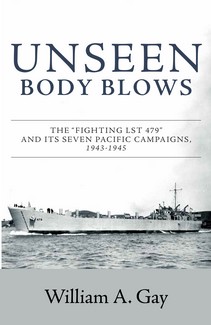
2020 Military Writers Society of America Silver Medal award. Book is about life aboard a World War Two amphibious ship that was involved in seven Pacific campaigns: Kiska, Gilbert’s, Marshalls, Hollandia, Guam, Philippines and Okinawa.
Between 1942 and 1945, 1,051 amphibious tank-landing ships were rapidly produced.
These were anonymous vessels, slow and unwieldy, and in the words of one crew member, they looked like bathtubs. At first, LSTs had a reputation of being expendable and of relatively low value, and so were bestowed another, less noble, nickname; “Large Slow Targets.”
Put into service to get troops and equipment ashore, the story of LST 479 is in some respects the story of all of these ships. Typical of all early LSTs, its crew on commissioning day, April 19, 1943, consisted of raw amateurs.
But over the next 1,046 days, through collisions, accidental groundings, navigational errors, and lots of mechanical breakdowns, the 479 crew became sailors.
Displaying heroism and ingenuity, they rescued the crew of a crippled landing craft during an Alaskan storm, battled fires aboard a burning LST hit by kamikazes, and fought off air attacks on the way to Makin and Guam, at Saipan, in the Philippines and around Okinawa.
This LST crew became the embodiment of the Navy’s 2018 recruiting slogan: “Forged by the Sea.”
In gripping, meticulously researched, “you are there” fashion, author William A. Gay, recounts the fascinating history of the 479’s seven Pacific campaigns; from the day-to-day life of the men aboard her, to their terrifying encounters in battle as they delivered “unseen body blows” to the enemy that helped win the war in the Pacific.
https://youtu.be/Qrn7RZmmiBs
Excerpt
Near the conclusion of World War II, the crew of LST 479 adopted a nickname and a logo. The logo shows a battered and frowning bulldog surrounded by images of six islands with palm trees and a seventh with an ice-capped mountain. At the bottom are seven stars. The stars depict LST 479’s seven campaigns and the islands and atolls where they occurred.
The ice-capped island is Kiska in the Aleutians of Alaska. The others represent the Gilberts (Makin and Tarawa), the Marshalls (Kwajalein), New Guinea (Hollandia), the Marianas (Guam), the Philippines (Leyte), and Okinawa (Kerama Retto and Ie Shima). Arching over the bulldog and the islands is the nickname the crew gave their ship: “The Old Sea Dog.”
While the Navy awarded the 479 only five battle stars, crew members were convinced they had earned the seven depicted on their ship’s logo. However, wartime rules eliminated Kiska and the Philippines from the ship’s campaign record. The Japanese had escaped from Kiska and the landing there was uncontested despite violent Alaskan storms and many friendly-fire casualties. As for the Philippines, the LST was not there during the appropriate Leyte-campaign dates. That was despite the fact the Japanese had continued their air assaults on the U.S. fleet there, perfecting kamikaze attacks that would dominate the upcoming Okinawa campaign.
The story of LST 479 is, in some respects, the story of all 1,051 tank landing ships that were rapidly produced between 1942 and 1945. They were also called landing ship, tank. These were anonymous ships, slow and unwieldy, and in the words of one crewmember, they looked like bathtubs. LSTs had a reputation at first of being expendable and of relatively low value, and as such were bestowed another less noble nickname: “Large Slow Targets.”
You are doing a great service by completing your father's story/legacy and that of LST 479. You are right that people do not think of tank carrying landing craft as warships, but based on your brief description, it is obvious that they served well during battle as any other Navy craft.
On this 75th anniversary of D-Day, I'm sure that LSTs played a pivotal role on that great landing that saved Europe from tyranny.
An illustrated developmental history of the American military chemical and biological protective respirator for use against war agents, this work provides photographs of actual respirator specimens and several useful appendices, in addition to its en
Mushroom Cloud, a fact-based historical novel, is the first book of The First Strike Trilogy: USA and the Soviet Union are building nuclear arms for a face off in a potential nuclear war in the late 1950's and early 1960's.
Mushroom Cloud, a fact-based historical novel, is the first book of The First Strike Trilogy: USA and the Soviet Union are building nuclear arms for a face off in a potential nuclear war in the late 1950's and early 1960's.