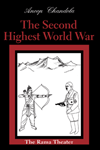
An untold dramatic backside story of World War II from a remote Himalayan region of India that changed the course of history.
Why is it that the face of World War II has appeared in print or film so often, but very seldom the back, the larger part? Could Hitler's rise and fall be seen in India? The reader will find controversial answers in this backside story of WWII from a remote, spectacular Himalayan region. Chander, a U.S.-educated journalist, writes his memoirs at the request of his American wife, Kristi. The memoirs, which remained unpublished for decades due to the young couple's accidental death, reval that Chander as young boy lived with his mother, while his father was fighting in WWII. Chander recounts his dramatic experiences of local WWII soldiers and civilians from 1941 to 1948. The experiences are juxtaposed with his hometown's Rama Lila, a famous folk play of the Ramayana epic, where Prince Rama fights the terrorist-chief Ravana. Jagriti, a girl in Chander's village, introduces and, though forbidden, enacts parts of the play with him. Inspired by her, he watches the ten-night Rama Lila every year, while experiencing war's reactions and other emotionally charged actions, from humorous to terroristic, in his Hindu village, Christian school, and Hindu-Christian-Muslim town.
Excerpt
"How did we accept this four-division system?"
"That's an ancient system. But it has become the reason for the war we fought in Europe."
"You mean Hitler?"
"Yes, Hitler. He knew that Aryans were white people. In India, they discriminated against black people, the Shudras. The whites became the priests, warriors, and merchants. Shudras deserved to remain servants. Hitler had the same agenda. All others should serve the whites or be eliminated. So Jews and Gypsies became his victims." Uncle sighed.
"Uncle, do you believe in the caste system?"
"We have to break it if we don't want a further breakup of India, son!"
He went beyond my question as he added,
"Religions are like mosquitoes that sing sweetly and suck out humanity or inject mass fatal hate."
* * *
In a scene Rama questioned Sita's character because she lived in Ravana's Lanka for so many years. I refused to act as Rama. "Why?" Jagriti asked. "You are so beautiful," I said. "I can't allow you to burn. No, no!" Jagriti insisted that I say Rama's lines, "Chander! they have been burning women in this country for ages. Men here have kept several women at once. Some called those women wives. Those men should have been questioned. Instead, many were honored as holy men."
Professional Reviews
Praise of
"Professor Anoop Chandola's 'The Second Highest World War' is a fine work of fiction about one of India's least well-known regions, the author's 'native' Garhwal Himalaya region of the remote Northern Indian mountains. Anoop is a brilliant writer and understands India as few others do. His compelling work is at once deeply true yet wonderfully imaginative raising his story to the highest level of fictive art."
--Dr. Stanley Wolpert, Professor of History at the University of California, Los Angeles, and author of the Hollywood movie novel "Nine Hours to Rama."
Praise of
"The long fiery action of WWII, which propted my own career, engulfed countries as distant as India. Could the Allies have won WWII without India? The mind-blowing story of this novel clears up a lot of smoke to reveal how the heroism of unheralded soldiers from a Himalayan region turned the war around in favor of the Allies. Professor Chandola removes the curtain to expose the reader to a long hidden view of the role played by India as told through the dramatic memoirs of the young son of a WWII front-line officer from the Indian Himalayas."
--(Ret.) Lt. General K.S. Garewal, PVSM (India).
Want to review or comment on this book?
Need a FREE Reader Membership?
Reviews for "The Second Highest World War: The Rama Theater"
Reviewed by dinesh dhyani
12/11/2002
The Second Highest World War is the very intresting book written by Prof. Chandola ji. We are proud of him and really the people of Garhwal Hiamalya seems proud of him. All the best and good wishes with Prof. Chondal ji.
thanks
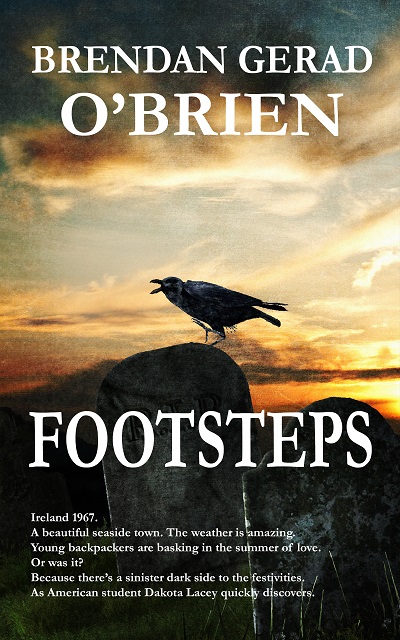
Ireland 1967. The Summer of love. Or was it?
A holiday weekend. Amazing weather. American student Dakota Lacey is hiking around Kerry.
But there’s a sinister, dark side to the atmosphere. Lone female hikers are being brutally attacked.